A sculpture looks intentional when it has three things: breathing room, a base at the right height, and light that shows its shape. Get those right and even a modest piece reads as a focal point. Skip them and the same piece looks like clutter. This guide walks you through each decision, from choosing the spot to aiming the light, and shows how a curated collection of sculptures and statues can be paired with lamps and fixtures so the whole room works together.
TL;DR
- Give each sculpture its own zone with clear space around it, so you can see it from more than one angle.
- Match the base to the piece: a pedestal for presence, a console or shelf for a quieter look, the floor for large, bold forms.
- Mix heights and scale in a grouping, and keep the grouping to an odd number of objects when you want it to feel relaxed.
- Light the piece from above and slightly in front, at roughly a 30-degree angle, with a warm, dimmable source.
- Put pieces where they will not be bumped, and use stable bases in busy rooms.
Table of Contents
- Start With the Spot, Not the Sculpture
- Pedestal, Shelf, Mantel or Floor: Choosing the Base
- Scale, Height and Grouping
- Lighting Sculptures So They Look Three-Dimensional
- Room-by-Room Sculpture Display Ideas
- Displaying Sculptures Safely
- Common Mistakes That Make a Display Look Cluttered
- Where to Find the Pieces and Fixtures
- Our Perspective
- FAQ
- Sources
Start With the Spot, Not the Sculpture
Most display mistakes happen because the piece is chosen first and the location second. Reverse that. Walk through your room and notice where your eye already lands: the end of a hallway, the wall opposite the entrance, the corner beside a sofa, the empty stretch of a console. These are natural focal points, and a sculpture there does the work of anchoring the room.
Designers often point out that three-dimensional objects behave differently from wall art. London-based designer Hubert Zandberg told Livingetc that “sculpture has more presence than paintings or photography” because you physically move around it. That is useful to know when you plan. A sculpture needs a path around it, or at least a clear view from the direction people will approach.
A quick test before you commit: stand where you would normally sit or enter, and look at the spot. If a door swing, a cord, or a tall plant interrupts the sightline, move the piece or the clutter.
Decide What the Piece Is Doing
Before you place anything, decide its role.
- Statement: one large form that sets the tone for the room. It needs the most space and the strongest light.
- Accent: a smaller figure or abstract shape that adds a note of interest to a shelf, side table or mantel.
- Part of a layered vignette: a sculpture combined with books, a lamp and a vase, where the sculpture is one voice among several.
Knowing the role keeps you from asking a small accent to carry a whole wall, or from crowding a statement piece with competing objects.
Pedestal, Shelf, Mantel or Floor: Choosing the Base
The base changes how a sculpture is read. The same bronze figure feels formal on a plinth, casual on a bookshelf, and dramatic on the floor beside a sofa.
Pedestals and Plinths
A pedestal gives a piece status. Tom Cox, co-founder of Hám Interiors, told Homes and Gardens that putting sculpture on a pedestal has the immediate impact of elevated status, echoing how galleries show work. Zandberg suggests a classical, symmetrical placement to tone a bold piece down, or an edgier plinth to turn it up, and he likes plinths in marble, parchment and gypsum plaster, according to Livingetc’s interview.
A practical rule: the top of the sculpture should land somewhere between chest and eye level for a standing viewer. A figure that sits too low gets overlooked, and one that sits too high feels like it is looming.
Shelves, Consoles and Mantels
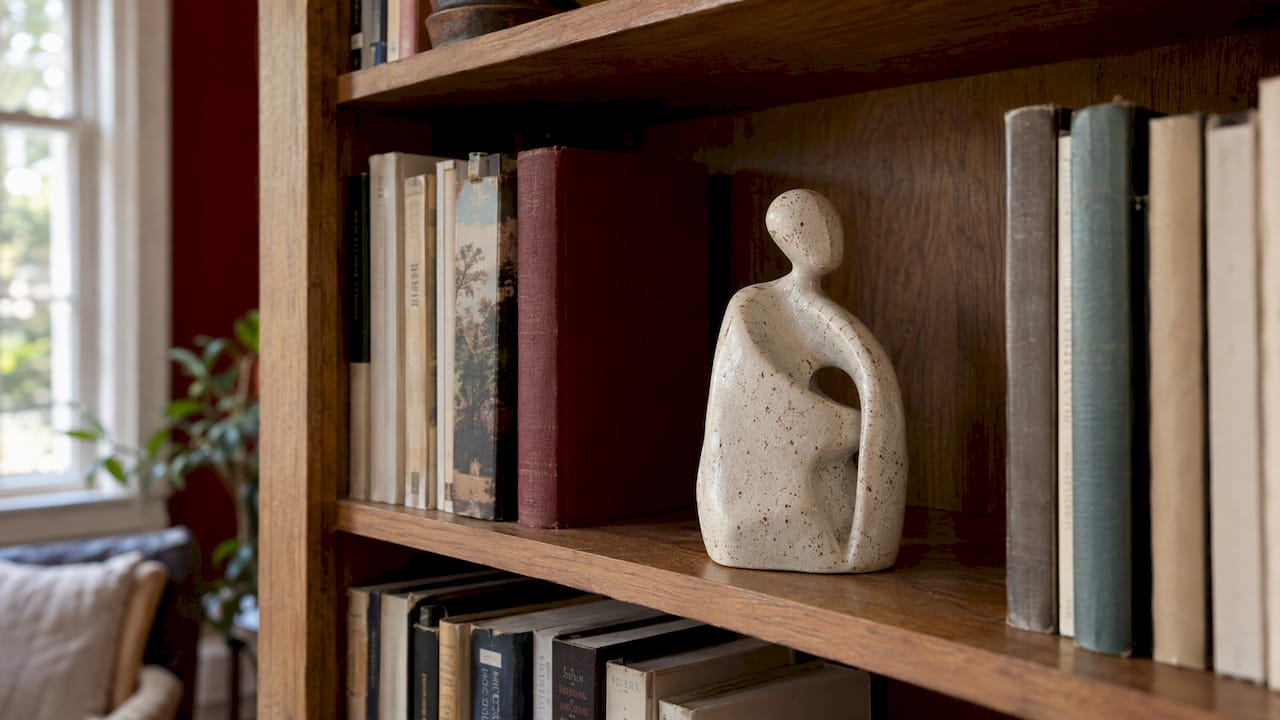
These are the easiest places to start. A console table or mantel gives you a ready-made stage with a wall behind it, which helps a sculpture’s silhouette stand out. Leave a gap between the sculpture and its neighbors, roughly the width of the piece itself if space allows. On open bookshelves, pull the sculpture slightly forward of the books and let it sit against empty space, not a wall of spines.
The Floor
Large sculptures, especially tall or heavy forms, often work best on the floor in a corner, beside a window, or next to a sofa. Floor placement feels relaxed and architectural. Put a rug edge or a pair of plants nearby to ground it, but keep the area around it open enough that no one has to squeeze past.
The Wall
Wall-mounted sculpture frees up surface space in small rooms. Zandberg recommends attaching sculptures to walls with brackets, which keeps them secure and makes them part of the architecture. Use hardware rated for the piece’s weight, and anchor into studs or use proper wall anchors for heavier work.
Scale, Height and Grouping
Proportion is where a display goes from fine to polished. A sculpture that is too small for its surface gets lost, and one that is too large crowds everything around it. As a starting point, a single sculpture on a console should take up about a third to half of the console’s visible length. In a group, vary the sizes.
Artist Margit Wittig described a table arrangement to Homes and Gardens in which two clay portraits face each other on wooden bases with a lamp between them. Her takeaway: “the key to making a successful arrangement is to mix height and scale.”
Here is a simple formula you can adapt:
- Pick a tallest piece to set the high point, such as a table lamp or a standing figure.
- Add a mid-height object, such as a sculpture on a small riser or a stack of books.
- Add a low piece, such as a bowl, a small statue or a tray, to finish the triangle.
- Repeat a material or color across at least two objects, for example black ceramic and matte black metal, so the group feels related.
- Edit. Remove one item. Most arrangements improve when you do.
If you like dark finishes, our guide to black sculpture decor covers how to style and care for them.
Pairing Sculptures With Lamps
Lamps are the natural partner for sculpture because they provide height and light in one object. A table lamp beside a figure gives you the middle of a three-part grouping, and a sculptural lamp can be the art itself. If you are coordinating pieces across a room, how to coordinate lamps with furniture is a good companion read, and why sculptural lamps command attention explains how a lamp can do double duty.
Lighting Sculptures So They Look Three-Dimensional
Light is what turns a nice object into a display. Sculpture depends on shadow and highlight to show its form, so the angle matters more than the brightness.
The 30-Degree Rule
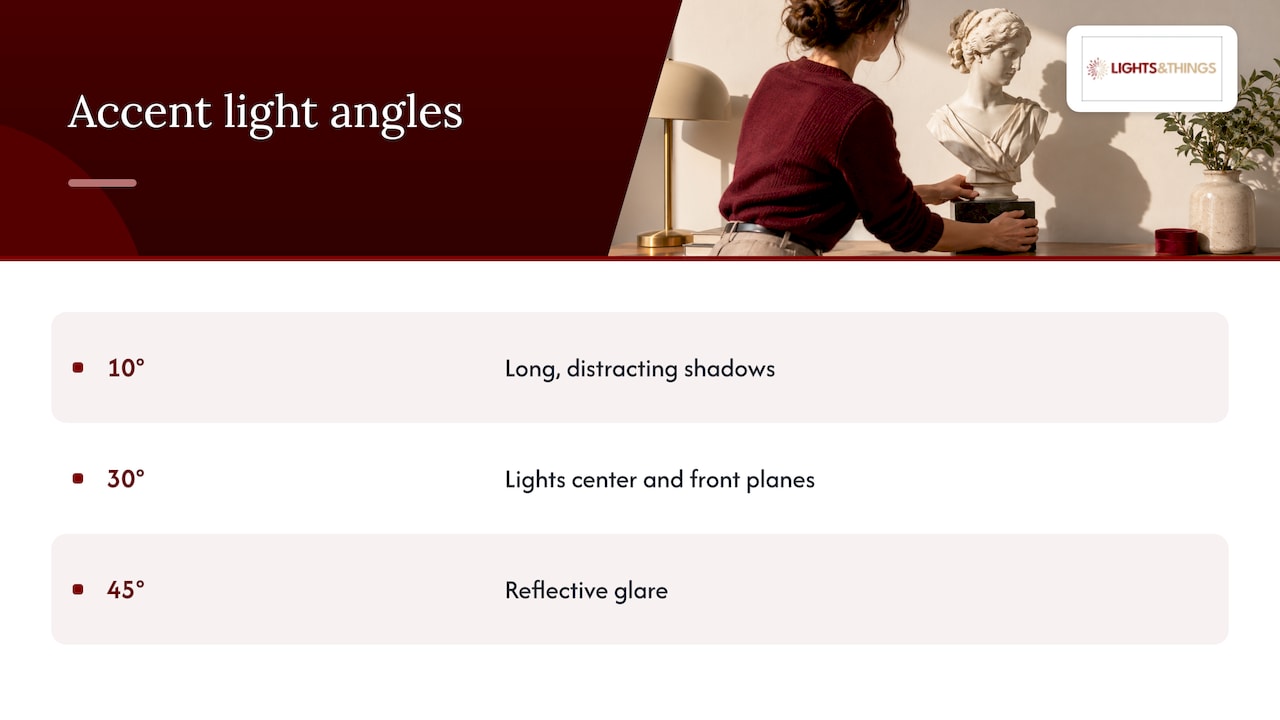
Lighting experts quoted by Architectural Digest advise that a ceiling-mounted accent light should hit the center of an artwork at about 30 degrees. Around 10 degrees casts long, distracting shadows, and 45 degrees can cause reflective glare. For a sculpture, think of it as lighting from above and slightly in front, so the face and front planes are lit while the shadows below add depth.
The same article notes that LED bulbs emit no UV light and little heat, while halogen bulbs can gradually damage art materials. For anything delicate, such as painted finishes or resin, LEDs are the safer choice.
Warm, Dimmable and Layered
For a home, warmth usually looks better than a clinical white. Choose a bulb in the 2700K range for a soft, inviting glow, and pair it with a dimmer so you can move from daytime to evening without rethinking the setup. Layering is the principle here: combine ambient light from a ceiling fixture, a table or floor lamp near the piece, and, where you have it, a small accent light aimed at the sculpture.
A table lamp with a built-in dimmer, such as this weathered brass accent lamp with dimmer, is an easy way to add a controlled pool of light beside a sculpture on a console or side table. For a taller piece in a corner, a traditional brass floor lamp with a rattan shade casts a soft glow that grazes the surface and lets texture show.
Do Not Forget Natural Light
Zandberg says he prefers living with sculpture in changing natural light, from morning to evening, and notes that artificial light can sometimes cast a strange shadow, as he told Livingetc. A piece near a window will look different at every hour, which is part of the pleasure. Keep delicate finishes out of long, direct afternoon sun, and combine daylight with a lamp for evenings.
For more angles, layers and lamp choices, see our full guide to sculpture lighting ideas for your home.
Room-by-Room Sculpture Display Ideas
Potter Jonathan Adler describes placing sculptures “high, low, on a pedestal, on the floor” in rooms as varied as bathrooms, bedrooms and reception rooms. His point is that sculpture is no longer reserved for one formal room. Here is how that plays out in practice.
Living Room
The living room can handle the biggest statement. Try a tall figure beside the sofa or fireplace, or a pair of matching statues flanking a mantel for a symmetrical, classical look. A low coffee table can hold one bold bowl-like or abstract sculpture, kept clear of drinks and trays. For ideas on scale and style, our guide on choosing sculptures for living room decor goes deeper.
Entryway
An entry console with a sculpture and a lamp sets the tone the moment someone walks in. Keep it simple: one sculpture, one lamp, one small tray for keys. Visitors see it head-on, so choose a piece with a strong front silhouette.
Bedroom
Bedrooms suit quieter forms. A smaller sculpture on a nightstand or dresser, lit by a dimmable lamp, adds personality without feeling busy. Pick soft, rounded shapes and calm finishes.
Dining Room
A sideboard is the stage here. Pair a sculpture with a vase or candlesticks at different heights, and keep it off the table itself, where it competes with place settings. A sculptural ceiling fixture overhead can echo the shape of the piece below; examples of sculptural ceiling fixtures shows how.
Home Office
A small figure on a bookshelf or desk gives you something to rest your eyes on between tasks. Keep it at the edge of your workspace so it does not crowd your screen.
Garden and Patio
Outdoor sculpture benefits from a natural backdrop. If you are planning a garden setting, this look at decorative stone garden design ideas shows how gravel, boulders and planting can frame a focal piece. Choose finishes made for outdoor use, and set the base on level, firm ground.
For more room-specific inspiration, browse our sculptural decor accent examples for every room and the guide to why decor statues elevate rooms.
Displaying Sculptures Safely
A good display is also a stable one. The Bower Center for the Arts advises in its home gallery guide that sculptures sit on sturdy tables, ideally in room corners or in cabinets against the wall, so they are less likely to be knocked over. It also suggests downward-facing spotlights to highlight them.
A few habits that protect both the piece and the room:
- Use a stable base. The surface should be level and wider than the sculpture’s footprint, with no wobble.
- Keep pieces away from traffic. Avoid narrow hallways, doorways and the edge of a table where children or pets pass.
- Secure tall or top-heavy forms. Use brackets for wall mounting, and a weighted or wide base for floor pieces.
- Use felt pads under ceramics and metal to protect wood and stone surfaces.
- Mind cords. Route lamp cords away from walking paths, and do not run them across the base of a sculpture.
If you have young children or live in an area with frequent earthquakes, take extra care with heavy or fragile pieces and consider wall-secured or low, wide-based options.
Common Mistakes That Make a Display Look Cluttered
- Too many small pieces. Many small objects scattered across a surface read as clutter. Group them or replace them with one larger piece.
- Hugging the wall. Pulling a sculpture slightly away from the wall adds depth, and light can then create a soft shadow behind it.
- One light source. A single overhead bulb flattens form. Add a lamp for layered light.
- Matching everything. A bit of contrast in height, finish and shape keeps a display lively.
- Ignoring the background. A busy pattern behind a sculpture competes with it. A plain wall, a shelf back, or a bank of soft drapery makes the silhouette clearer.
Where to Find the Pieces and Fixtures
If you are building a display from scratch, you need two things that work together: the sculpture and the light. At Lights & Things, you can shop decorative lighting and home decor in one place, from ceiling lighting, floor and table lamps and home decor to a dedicated range of sculptures and statues. Shopping both together makes it easier to match finishes, heights and proportions. We also offer free shipping thresholds, easy returns, secure checkout, price matching and financing, which can make a larger purchase, such as a statement piece, easier to plan.

If you are starting with the lighting, our floor and table lamp collection is a good place to begin, and the 12 examples of sculptural floor lamps shows how a lamp can be a sculpture itself.
Our Perspective
We think of a sculpture and its light as a single decision. The piece gives a room character, and the lamp or fixture decides how that character is seen at seven in the evening, not just at noon.
That is why we pair decorative lighting with decor accents in one catalog. A statue on a console wants a lamp at the right height beside it. A sculptural floor lamp wants a quiet figure nearby so neither fights for attention. When you can see both together, proportion becomes much easier to judge.
Our advice is to start with one piece you love and build outward. Choose the spot, set the base, add a dimmable light, and live with it for a week. Move it a few inches. Rooms that feel curated are rarely finished in a day, and they are almost never the result of buying the most expensive thing. They come from placing a good piece well.
Norm Blain
FAQ
How do you display a sculpture on a shelf?
Pull the sculpture slightly forward and leave empty space around it, so its outline is visible. Pair it with one or two objects at different heights, such as a small stack of books or a vase, instead of filling the shelf. Add a nearby lamp or accent light to bring out the shape.
What height should a sculpture be displayed at?
For a standing viewer, aim to place the main part of the piece between chest and eye level. Pedestals are useful for this, because they raise smaller pieces to a comfortable viewing height. Large floor sculptures can stand lower, since their size makes them visible from across the room.
What kind of lighting is best for sculptures?
Light the piece from above and slightly in front, at about 30 degrees, using a warm, dimmable LED source. Architectural Digest’s lighting experts note that this angle avoids long shadows and glare. Combine it with a lamp beside the sculpture for softer, layered light in the evening.
Can you display sculptures in a small room?
Yes. Choose one or two pieces scaled to the surface, such as a compact figure on a nightstand or a wall-mounted piece that saves surface space. Keep the area around them clear, and use a lamp to give the piece its own glow.
How do you keep a sculpture from being knocked over?
Set it on a sturdy, level surface in a corner or against a wall, away from busy walkways. Use brackets for wall-mounted pieces and a wide or weighted base for tall ones. Felt pads add grip and protect the surface beneath.
Sources
- Decorating With Sculpture: Tips From the Experts, Livingetc
- 15 rules artists and designers say you must follow when displaying artwork, Homes and Gardens
- 8 Tips for Lighting Art, Architectural Digest
- How to Design the Best Gallery at Home, Bower Center for the Arts