Branch and organic forms work best over dining tables and in foyers; geometric rings suit modern living rooms and open-plan kitchens; clustered bubble pendants shine in vaulted or double-height spaces; linear and oval chandeliers belong over long dining tables and kitchen islands; and floral or petal silhouettes bring intimacy to smaller dining rooms and bedrooms.
Here’s a quick visual scan of the silhouettes worth knowing:
- Branch/organic: Cascading arms or botanical forms, often in metal or porcelain, that read like a frozen moment in nature. Scale covers a range of sizes suited to various table lengths.
- Geometric ring: Clean circular or rectangular line-art frames in iron or brass. Strong architectural presence without visual weight.
- Clustered bubbles: Groups of glass spheres or blown pendants suspended at varying heights. Ideal for double-height ceilings where a single fixture would look lost.
- Linear/oval: Horizontal bar or elongated oval forms. The go-to silhouette for dining tables 5–10 feet long and kitchen islands.
- Floral/petal: Layered petals or leaf forms in porcelain, resin, or fabric. Softer and more intimate than branch styles.
- Staircase/entry statements: Vertically oriented sculptures, stacked elements, or long pendant chains designed to read beautifully from multiple floor levels.
TL;DR: Match silhouette scale to ceiling height first. Rooms under 9.8 feet need compact or flush-mounted sculptural forms; anything grander belongs in spaces with 9.8 feet of clearance or more.
Pro Tip: Before you fall in love with a silhouette online, measure your ceiling height and your table or island length. Those two numbers will eliminate at least half the options and save you a return.
Table of Contents
- What makes a ceiling fixture sculptural? A gallery of styles to know
- How to choose the right sculptural ceiling fixture for your room
- Sizing, placement, and installation: the rules that actually matter
- Materials, finishes, and maintenance for sculptural ceiling fixtures
- What’s trending in sculptural ceiling lighting right now
- Where to buy or commission sculptural ceiling fixtures in the U.S.
- Key Takeaways
- Why a sculptural ceiling fixture is worth the commitment
- Find your next sculptural ceiling fixture at LightsThings
- Useful sources and further reading
What makes a ceiling fixture sculptural? A gallery of styles to know
A fixture earns the label “sculptural” when its form is the point. The silhouette, the negative space between elements, and the three-dimensional profile all matter as much as the light output. You’re looking at something that functions as overhead lighting and as a piece of art you happen to be able to turn on.
Branch and organic forms
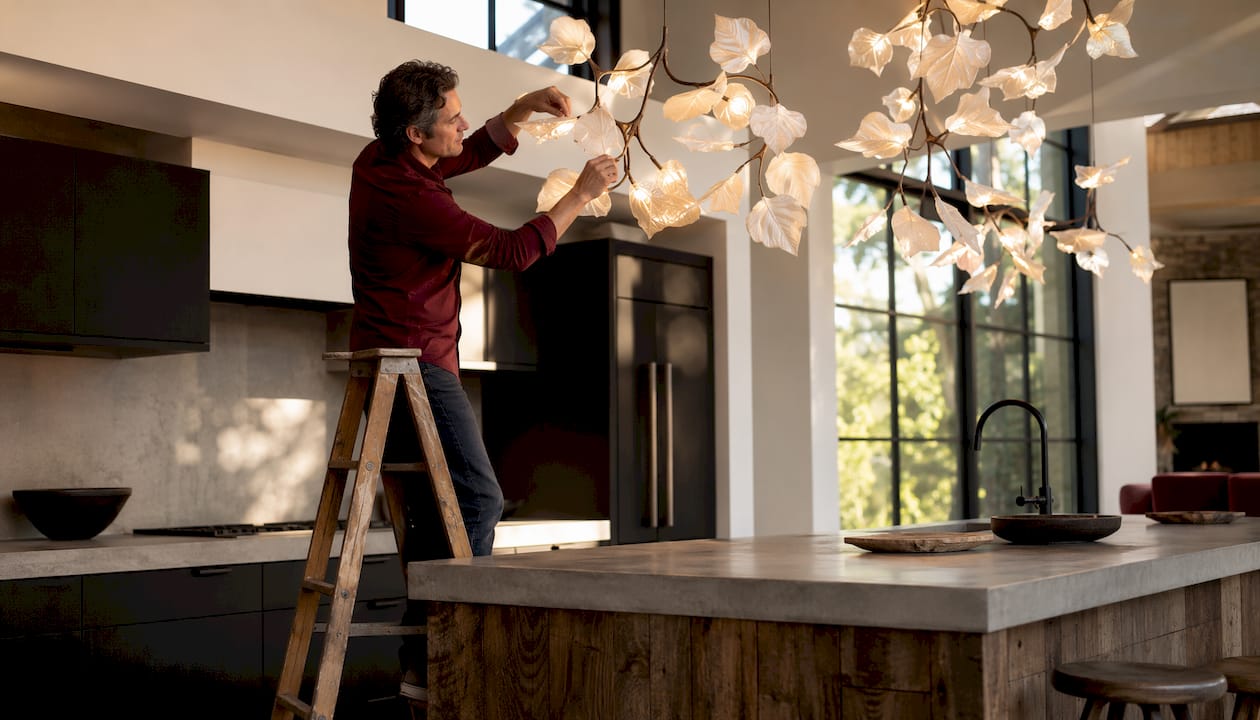
Think of bare winter branches cast in antique brass, or dense clusters of hand-cast porcelain leaves arranged along a horizontal spine. The Gingko Folia is a strong example: hand-cast white porcelain ginkgo leaves cluster along brass branches in a floating horizontal profile available in multiple sizes spanning a range of lengths. That range lets you scale the same silhouette from an intimate dining room up to a grand double-height foyer. Branch forms work especially well in transitional and organic-modern interiors where you want warmth without ornamentation that reads as traditional.
Geometric ring and line-art forms
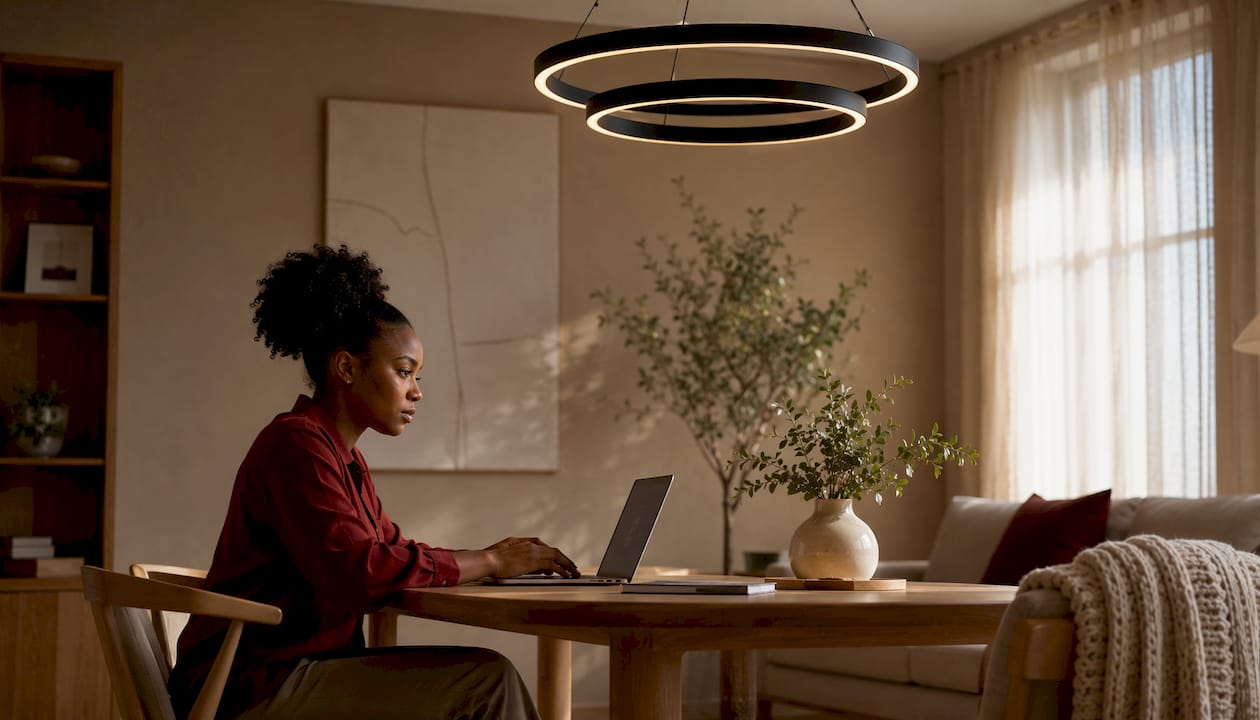
Precision-formed iron frames, intersecting rectangular planes, and open geometric compositions define this category. The ARC chandelier is a clear example: an electroplated gold iron framework of intersecting lines that commands attention without imposing visual weight, available in several sizes suitable for different spaces. Geometric ring and line-art fixtures pair naturally with contemporary or minimalist interiors, and their open silhouettes keep sightlines clean even at large scales.
Clustered bubble and multi-pendant forms
Multiple glass or blown-glass pendants suspended from a shared canopy at varying heights create a sense of movement and depth. Bocci’s multi-pendant designs feature several glass pendants suspended from a canopy, arranged artistically at varying heights and positions. These fixtures are particularly effective in double-height foyers and vaulted living rooms where a single pendant would feel undersized.
Floral and petal forms
Layered petals, overlapping leaves, or radiating organic shapes in porcelain, plaster, or resin. The Alexander Lamont Folly Gesso Ceiling Light is a refined example: teak leaves overlapping in plaster, suspended by three square-form chains in gilded brass, black bronze patina, or polished brass. Softer and more intimate than branch styles, floral forms suit dining rooms with lower ceilings and bedrooms where you want sculptural presence without architectural drama.
Radial and shadow-play forms
Some of the most compelling sculptural ceiling fixtures work primarily through the shadows they cast. The Penumbra Ceiling Light Sculpture by OMET uses slender brass sheets arranged radially to filter light, casting intricate patterns across surrounding surfaces. The fixture itself is relatively compact; the room becomes the canvas. This category suits spaces where you want the lighting to animate walls and ceilings as much as it illuminates the floor plane.
Staircase and entry statement forms
For double-height foyers and open staircases, designers typically specify fixtures that read as vertical sculptures rather than wide horizontal profiles. Long pendant chains, stacked elements, or cascading forms keep sightlines clean when viewed from multiple levels. See entryway chandelier ideas for a practical look at how scale and vertical proportion work in foyer applications.
Minimal sculptural forms
Not every sculptural fixture is dramatic. Some achieve their effect through precise material choices and restrained geometry: a single asymmetric ring in matte black, a shallow dome in hand-blown opal glass, or a disc of perforated brass. Foscarini’s Le Soleil suspension lamp sits in this territory: six rings of various diameters and shapes with an oblique cut in matte polycarbonate, creating a diffuser that shifts appearance depending on your vantage point. Minimal sculptural forms work in rooms where the architecture or furniture is already strong and you want the fixture to add presence without competing.
Pro Tip: When your room has strong architectural lines, such as exposed beams or a coffered ceiling, choose a silhouette that contrasts rather than echoes the geometry. A soft organic branch form reads more clearly against a grid of beams than a second geometric shape would.
How to choose the right sculptural ceiling fixture for your room
Getting the silhouette right is only part of the decision. Before you commit, work through these questions:
- What is your ceiling height? Fixtures in rooms with lower ceiling clearance need compact or flush-adjacent forms. Large sculptural chandeliers are better suited to rooms with higher ceilings, typically around or above standard height clearances.
- What are your table or island dimensions? For dining tables, fixture diameter or total linear length should be roughly 1/2 to 2/3 of table length for balanced proportion.
- Is your existing wiring on a dimmer circuit? Many sculptural fixtures with integrated LED arrays require specific dimmer compatibility. Check before you order.
- How much light output do you actually need? Sculptural fixtures are often mood-first and task-second. If the room needs strong ambient light, plan for supplemental sources.
- What is your style compatibility? A porcelain branch chandelier reads differently in a farmhouse kitchen than in a minimalist loft. Consider the finish, material, and silhouette against your existing palette.
- What is your budget, and does it include installation? Factor in electrician costs for heavy or complex fixtures, not just the purchase price.
Budget brackets
- Under $500: Entry-level sculptural pendants, simple geometric rings, and single-pendant statement forms. Materials are typically powder-coated steel or basic glass. Customization is limited.
- $500–$1,500: Mid-range sculptural chandeliers with better material quality, more finish options, and larger size ranges. This is where most well-designed ready-to-buy options live.
- $1,500–$5,000+: Premium and semi-custom fixtures with hand-cast elements, mixed materials, and designer pedigree. Lead times may extend to several weeks.
- Custom fabrication: Pricing varies widely based on scale, materials, and engineering requirements. Expect significantly higher costs and longer lead times than ready-made options.
Red flags to watch for
- A fixture weight that exceeds what a standard ceiling box can support (most standard boxes are rated for 35–50 lbs; heavy sculptural pieces often exceed this).
- Integrated LED drivers with no documented dimmer compatibility list.
- Unshielded bare bulbs in a fixture with a low hang height, which creates glare at eye level.
- No UL listing or equivalent safety certification for the U.S. market.
Sizing, placement, and installation: the rules that actually matter
Getting the scale right is the single biggest factor separating a fixture that looks intentional from one that looks like an afterthought. Here are the heuristics designers use most consistently.
Sizing chart: ceiling height, fixture diameter, and hang height
| Ceiling Height | Recommended Fixture Diameter | Hang Height (bottom of fixture to floor) |
|---|---|---|
| — | compact sculptural only | — |
| 9–10 ft | 24 in | — |
| 10–12 ft | 36 in | 7–— |
| 12–16 ft (double height) | 47.2 in | 9–10 ft |
| Over 16 ft | vertical statement form | 10 ft+ |
For dining tables specifically, the bottom of the fixture should hang roughly 30–36 inches above the tabletop. Linear fixtures work best over dining tables 5–10 feet long, and the ARC chandelier’s smallest size at 47.2 inches suits tables seating four to six in rooms up to roughly 25 square meters. It’s advisable to avoid large sculptural fixtures in rooms with low ceilings, where they may crowd the space and reduce clearance.
For double-height foyers and staircases, vertical sculptures and long pendant chains read better than wide horizontal profiles. The goal is a form that looks intentional from both the ground floor and the upper landing.
Installation notes
Large sculptural fixtures frequently exceed the load rating of a standard ceiling box. Before installation, verify that your junction box is rated for the fixture’s weight, or have an electrician install a fan-rated or dedicated structural box. Manufacturers and studios consistently recommend installation by a licensed electrician for high-ceiling applications and any fixture with a complex suspension system. For guidance on lighting in high-ceiling rooms, the mounting approach matters as much as the fixture choice.
Integrated LED fixtures also require planning for driver ventilation and future replacement access. Document the driver specs at installation so you can match a compatible dimmer if you ever need to replace it.
Pro Tip: Before your electrician arrives, photograph the ceiling from directly below and from the main sightline into the room. Those two angles will confirm whether your planned hang height looks right before any holes are made.
Materials, finishes, and maintenance for sculptural ceiling fixtures
The material a fixture is made from shapes everything: how heavy it is, how it ages, how it interacts with light, and how much upkeep it needs.
Common materials and their trade-offs
- Metal frames (iron, steel, brass): The structural backbone of most sculptural fixtures. Brass develops a warm patina over time; powder-coated steel is more stable but less characterful. Both are durable and relatively low-maintenance.
- Hand-blown glass: Creates soft, diffuse light and organic variation in form. Fragile during shipping and installation; clean with a soft, dry cloth to avoid micro-scratches.
- Hand-cast porcelain: Used in branch and floral forms for its ability to hold fine detail. Heavier than it looks; verify ceiling box ratings carefully. Wipe with a barely damp cloth; avoid abrasive cleaners.
- Resin: Lightweight and moldable into complex organic shapes. Less durable than metal or porcelain over time; can yellow with prolonged UV exposure in bright rooms.
- Fabric shades: Warm and diffuse, but they collect dust and require periodic vacuuming with a brush attachment. Not suitable for damp locations.
- Mixed media (glass + metal + porcelain): Increasingly common in premium fixtures. Maintenance combines the requirements of each material.
Finish effects on perceived scale and warmth
Polished brass amplifies light and reads as warm and slightly formal. Aged or antique bronze recedes visually and suits organic, earthy palettes. Matte black creates strong graphic contrast and reads as contemporary. Painted porcelain in white or off-white keeps the fixture feeling light even at large scales.
Energy efficiency and bulb types
Many sculptural fixtures now ship with integrated LED arrays. These offer longer driver life and more diffuse light distribution, but they limit future bulb replacement options. If you prefer replaceable bulbs, look for fixtures specifying E12 or G9 sockets, which give you flexibility to swap color temperature or wattage over time. For color temperature, designers are increasingly favoring warm-diffuse outputs around 2700K to preserve texture and shadow rather than flattening a room with cool overhead light.
Safety certifications
For the U.S. market, look for UL listing on any fixture you purchase. Bocci’s 74.7, for example, carries UL, cUL, CB, CE, UKCA, and RCM certifications. If the fixture will be installed near a bathroom or kitchen moisture zone, verify the IP rating: IP30 is suitable for dry locations only. Wet or damp locations require a higher IP rating, and not all sculptural fixtures qualify.
What’s trending in sculptural ceiling lighting right now
The direction in 2026 is toward fixtures that feel considered rather than conspicuous. A few clear threads:
- Organic asymmetry: Irregular, nature-derived forms in brass, porcelain, and resin are replacing the perfectly symmetrical chandelier as the default statement piece. Works especially well in living rooms and dining spaces with natural material palettes.
- Mixed materials: Glass combined with metal and porcelain in a single fixture creates visual layering that reads differently from every angle. The Gingko Folia’s combination of hand-cast porcelain leaves and brass branches is a good example of this direction.
- Warm-diffuse LEDs: The shift away from cool, flat overhead lighting is well underway. Fixtures designed to diffuse light softly at 2700K preserve the shadow and texture that make a room feel three-dimensional.
- Integrated smart lighting: Dimmer compatibility and smart-switch integration are increasingly standard in mid-to-premium sculptural fixtures. Worth confirming before purchase.
- Scaled-down luxury: Not every room needs an 80-inch statement piece. Compact sculptural forms in premium materials, priced in the $800–$1,500 range, are gaining ground as an alternative to large-scale chandeliers in rooms with standard ceiling heights.
For longevity, the safest bet is a fixture whose appeal comes from material quality and silhouette clarity rather than a specific surface trend. A well-proportioned brass branch chandelier or a clean geometric ring in matte black will still read as considered in five years; a fixture that relies on a single trendy finish or novelty shape may not.
Where to buy or commission sculptural ceiling fixtures in the U.S.
Your sourcing route depends on how specific your requirements are and how much lead time you can absorb.
Buying routes and what each offers
- Curated online retailers: The most accessible route for ready-to-buy sculptural fixtures. You get a broad range of styles, clear pricing, and relatively fast shipping. LightsThings carries decorative ceiling lighting across a range of price points, from accessible statement pieces to premium fixtures above $1,000, with free shipping thresholds, easy returns, and price matching. For distinctive sculptural pieces with a retail-sourced feel, specialty home furnishing retailers like Cozyhome also carry distinctive lighting with strong design credentials.
- Specialty lighting showrooms: Useful when you want to see scale and finish in person before committing. Showrooms often carry designer lines not available online and can advise on dimmer compatibility and installation requirements.
- Custom fabrication studios: The right route when your ceiling volume is unusual, your silhouette requirements are specific, or you need engineering support for a very large installation. Studios like LightArt can fabricate from small pendants to 16-foot diameter rings, but expect higher costs and longer lead times than ready-made options.
- Design marketplaces and auction platforms: Good for one-of-a-kind vintage or artist-made pieces. Provenance and condition vary; always ask for UL listing documentation before purchasing for a U.S. installation.
Typical cost ranges and lead times
Ready-made sculptural fixtures from established retailers generally ship within one to three weeks. Custom fabrication lead times vary widely, from six weeks for simpler pieces to several months for large-scale installations with engineering requirements. Custom work also increases price substantially, reflecting material costs, fabrication time, and project-specific structural planning.
Questions to ask before ordering
- Is all mounting hardware included, or do I need to source a structural junction box separately?
- Does the fixture carry a UL listing for the U.S. market?
- What is the lead time, and does it include shipping time to my location?
- What is the warranty on the fixture and the LED driver?
- How is the fixture packaged for shipping, and what is the return policy if an element arrives damaged?
Pro Tip: For fragile mixed-media fixtures, ask the vendor specifically about their shipping insurance and damage claim process before you order. A porcelain branch chandelier that arrives with broken leaves is a real scenario, and knowing the resolution path in advance saves significant frustration.
Key Takeaways
The most effective sculptural ceiling fixtures match silhouette scale to ceiling height first, then to table or room dimensions, with material and finish chosen to complement the room’s existing palette.
| Point | Details |
|---|---|
| Match silhouette to room type | Branch/organic for dining and foyers; geometric rings for modern living rooms; clustered bubbles for vaulted spaces; linear/oval for long tables. |
| Respect ceiling height minimums | Avoid large sculptural fixtures in ceilings under 9.8 ft; double-height spaces (12–16 ft) can carry fixtures 48–80 inches in diameter. |
| Size over dining tables carefully | Fixture diameter or linear length should be roughly 1/2 to 2/3 of table length; hang the bottom 30–36 inches above the tabletop. |
| Verify weight and UL listing | Standard ceiling boxes typically support 35–50 lbs; heavy sculptural pieces often exceed this and require a reinforced junction box and licensed electrician. |
| LightsThings for curated options | LightsThings carries sculptural ceiling fixtures from accessible price points to premium pieces above $1,000, with price matching, free shipping thresholds, and easy returns. |
Why a sculptural ceiling fixture is worth the commitment
There’s a tendency to treat the ceiling fixture as the last decision in a room, something you choose after the sofa, the rug, and the paint color are settled. That order is backwards. A sculptural ceiling fixture is the one element in a room that occupies three-dimensional space above eye level, which means it shapes the room’s visual hierarchy in a way nothing else can. It’s the difference between a room that feels furnished and one that feels designed.
That said, sculptural lighting is not always the right move. In rooms where the architecture is already complex, such as a heavily coffered ceiling or a room with strong exposed structural elements, a bold sculptural fixture competes rather than complements. The better choice in those spaces is often a minimal sculptural form or a well-proportioned pendant that adds presence without adding noise.
The other thing worth saying plainly: sculptural fixtures are mood-first, task-second. If you need strong, even ambient light for a workspace or a kitchen where you’re doing detailed prep, a sculptural chandelier alone won’t deliver it. Layer it with well-placed task and accent lighting so the sculptural piece can do what it does best, which is create a focal point and set the room’s tone, without being asked to do everything. Separating sculptural fixtures from precision artwork lighting, as lighting designers consistently recommend, yields the best results in homes with art collections or strong architectural features.
Find your next sculptural ceiling fixture at LightsThings

LightsThings curates decorative ceiling lighting for homeowners who want both visual impact and purchase confidence. The collection spans statement chandeliers, geometric pendants, and organic sculptural forms across a range of price points, including a premium collection at $550 and up for those ready to invest in a true centerpiece. Not sure where to start? The staff picks collection is a fast way to see what’s resonating with other design-focused buyers right now. Every order comes with free shipping above the threshold, easy returns, a price-match guarantee, and financing options, so you can buy with confidence. Browse the full collection at LightsThings and find the silhouette that fits your room.
Useful sources and further reading
A short list of authoritative references for readers who want to go deeper on specifications, custom fabrication, or design context:
- Gingko Folia Porcelain Branch Chandelier (Zenduce): Detailed product specs for a hand-cast porcelain branch chandelier, including sizing guidelines matched to table lengths from 39 to 79 inches. Useful for understanding how branch-form fixtures are scaled.
- ARC Geometric Line Art LED Chandelier (Zenduce): Specifications, mounting options, and room-size guidance for a geometric line-art chandelier. Good reference for installation requirements and dimmer compatibility.
- Bocci 74.7 Sculptural Cable: Technical specs and certification details (UL, cUL, CB, CE) for a multi-pendant sculptural installation. Useful for understanding safety certification standards in the U.S. market.
- LightArt Custom Fabrication: Overview of custom sculptural lighting fabrication capabilities, from small pendants to large-scale installations. Relevant for readers considering bespoke ceiling sculptures.
- Ceiling Lights for Artwork (Bannolighting): Explains the distinction between decorative sculptural fixtures and precision artwork lighting, with guidance on layering both in the same space.
- R. Jamin Declares War on the Big Light (Elephant): Design perspective on the shift toward warm-diffuse sculptural lighting at lower color temperatures, and why designers are moving away from cool overhead fixtures.