Lamps do not have to match, and forcing identical pairs everywhere usually flattens a room. The rule worth following is coordinated, not identical: repeat one or two details, like finish or shade color, and let the rest vary. The main exception is a spot that needs symmetry, like flanking a bed or framing a sideboard. From there, your call comes down to function, scale, and color.
TL;DR:
- Coordinated lamps that share one attribute, like finish or shade color, create visual unity without requiring full matchy-matchy pairs.
- Mismatched lamps add personality and movement to a room, especially when layered in height, material, or style within a curated or eclectic design.
- Matching is most effective near focal points or in formal settings, while mismatching suits layered, relaxed, or contemporary interiors better.
- When selecting lamps, consider their intended role—task, ambient, or accent—to determine how strict their matching should be.
- Use room-specific scale and proportion rules, such as fitting lampshades at eye level from seated positions, to ensure lamps complement rather than clash with furniture.
Table of Contents
- When Should Lamps Match? Symmetry and Focal Points
- When Lamps Shouldn’t Match: Building in Personality
- The Coordinated-Not-Identical Method, Step by Step
- Match Lamps by Job, Not Just by Looks
- Scale, Height, and Lampshade Rules That Actually Work
- Tying Mismatched Lamps to Your Room’s Palette
- Your 7-Question Lamp Decision Checklist
- Lights & Things: Expert Styling Notes From Norm Blain
- Balancing the Rules With What You Actually Love
- Shop Coordinated Lamp Collections at LightsThings
- Sources
- FAQ
When Should Lamps Match? Symmetry and Focal Points
Matching earns its place when a pair sits on either side of something you want the eye to land on. Think nightstands flanking a headboard, a console centered under a mirror, or a fireplace mantel with a lamp on each end. In these spots, identical bases and shades reinforce the architecture instead of competing with it, which is why symmetry has been a go-to move in traditional and formal interiors for generations.
Matching also does real work in rooms that already have a lot of visual movement, like a busy gallery wall or patterned upholstery. A matched pair gives the eye a stable resting point.
- Identical bases and identical shades work best when the lamps flank a single focal feature.
- Near-matching (same shade, slightly different base finish) reads as intentional if the room is otherwise calm.
- Formal or symmetrical layouts, like a traditional living room with a centered sofa, benefit most from true pairs.
If you’re shopping for a bedroom set, our guide on picking a table lamp for your bedroom walks through sizing pairs for nightstands specifically.
When Lamps Shouldn’t Match: Building in Personality
Mismatched lamps are what make a room feel collected instead of showroom-staged. Designers routinely mix pieces on purpose, because mismatching draws the eye through the room rather than letting it stop at one symmetrical grouping. That movement is part of what makes eclectic and contemporary spaces feel lived-in rather than assembled from a catalog.
Mismatch also supports layered lighting, since a room rarely needs the same kind of light in every corner. Varying heights and materials between a reading lamp and an accent lamp adds depth you won’t get from a matched set.
- Keep one linking element (finish, shade color, or scale) so the mix reads as curated, not accidental.
- Limit yourself to two or three lamp styles per room; more than that starts to feel cluttered.
- Save the boldest mismatch for smaller, secondary pieces rather than your largest fixtures.
The Coordinated-Not-Identical Method, Step by Step
This is the practical middle ground: repeat one or two attributes across your lamps, and let everything else differ. Shade color, finish, material, silhouette, and visual weight are the five attributes designers lean on most, and you only need to lock in one or two of them to hold a room together.
- Match the shade, vary the base. Two lamps with identical white linen shades can sit on entirely different bases, brass on one side, ceramic on the other, without the mismatch feeling random.
- Match the finish, vary the scale. A tall floor lamp and a smaller table lamp in the same brushed brass finish look related even though their proportions differ.
- Match the shade shape, vary the silhouette. Two drum shades of the same size can top very different lamp bodies and still feel like a set.
Pro Tip: Change one variable at a time. If a pairing feels off, swap the shade or the finish first before replacing the whole lamp. It’s a cheaper way to test the fix.
For more on tying lamps to the furniture around them, see how to coordinate lamps with furniture.
Match Lamps by Job, Not Just by Looks
Before worrying about whether two lamps look alike, ask what each one is supposed to do. Lighting designers generally sort fixtures into three roles, and the IES recommended practice for residential lighting treats these categories as the starting point for any room plan.
- Task lighting, like a reading lamp beside a chair, needs enough output to work by, matching or not.
- Ambient lighting fills the room with general glow and tends to come from floor lamps placed for even coverage.
- Accent lighting highlights a shelf, artwork, or corner, and is where mismatched, personality-driven lamps do the most good.
Matching genuinely matters when two lamps share a job, like paired reading lights on either side of a sofa. Nobody wants one side dimmer than the other. Layer your fixtures at different heights and outputs so the room has depth instead of one flat wash of light, and lean on warm-white bulbs across all of them for a consistent, cozy feel even when the fixtures themselves differ. Our living room lighting guide covers layering room by room.
Scale, Height, and Lampshade Rules That Actually Work
Get the proportions wrong and no amount of color coordination will save the pairing. A common styling benchmark places the lampshade at roughly eye level for someone seated, which is where the often-cited 5’7" guideline comes from: it’s a rough stand-in for average seated eye height, not a rigid measurement you need a tape measure to hit.
- On end tables next to seating, aim for the shade’s bottom to land close to eye level when you’re sitting down.
- Console and buffet lamps can run taller, since no one is sitting directly beside them.
- Match shade shapes (drum, empire, bell) more often than you match bases; a shared silhouette does more visual work than a shared finish.
- Scale affects perceived matching too. A short, wide lamp and a tall, narrow one in the same finish can still look mismatched simply because of visual weight.
Technical grounding on illuminance and placement comes from the same IES guidance referenced above, which covers quantity of light alongside layout.
Tying Mismatched Lamps to Your Room’s Palette
Color and finish are the fastest way to make lamps that don’t match still feel related. Repeating an accent color, a metal finish, or a texture across otherwise different lamps ties them to the room rather than to each other, which is a subtler trick than matching the lamps directly.
- Pick one accent color from your room’s palette and echo it in at least one lampshade lining or base detail.
- A restrained pop of color inside a shade adds warmth without overwhelming a neutral space.
- Mix materials on purpose: a metal lamp, a ceramic lamp, and a woven-base lamp can share a room if their finishes sit in the same warm or cool family.
- If your trim, doors, or hardware lean toward a specific finish, echoing it in at least one lamp keeps the room from feeling disjointed; current interior finish trends are a useful reference point if you’re planning a broader refresh.
Your 7-Question Lamp Decision Checklist
Run through these before you buy, especially if you’re shopping online and can’t set the lamps side by side in the store.
- Is there a focal point to frame? If yes, lean toward a matched pair.
- What job does each lamp need to do? Task, ambient, or accent changes how strict the matching needs to be.
- What’s the surface and scale? A tiny nightstand can’t carry the same lamp as a wide console.
- Is there a shared color or finish link? Pick one now, before you shop, so you’re not guessing later.
- How many lamps are actually in this room? More than three styles usually reads as clutter, not curation.
- What’s the budget split? A statement piece can anchor the room while simpler lamps fill secondary spots.
- Does the room lean formal or relaxed? Formal spaces tolerate less mismatch; relaxed, eclectic rooms invite more.
Red flags to fix fast: shades that clash in shape, more than two competing metal finishes, or one lamp noticeably dimmer than its neighbor. Test candidates with warm-white bulbs and compare shades in the actual room before committing.
Lights & Things: Expert Styling Notes From Norm Blain
Norm Blain, writing for LightsThings, recommends selective matching over all-or-nothing rules: match the pair that anchors your room’s main sightline, and let secondary lamps carry your personal style. That’s easier when you’re shopping from a curated assortment where shades and finishes are already designed to coordinate across different bases, rather than hunting for one-off matches across unrelated brands.
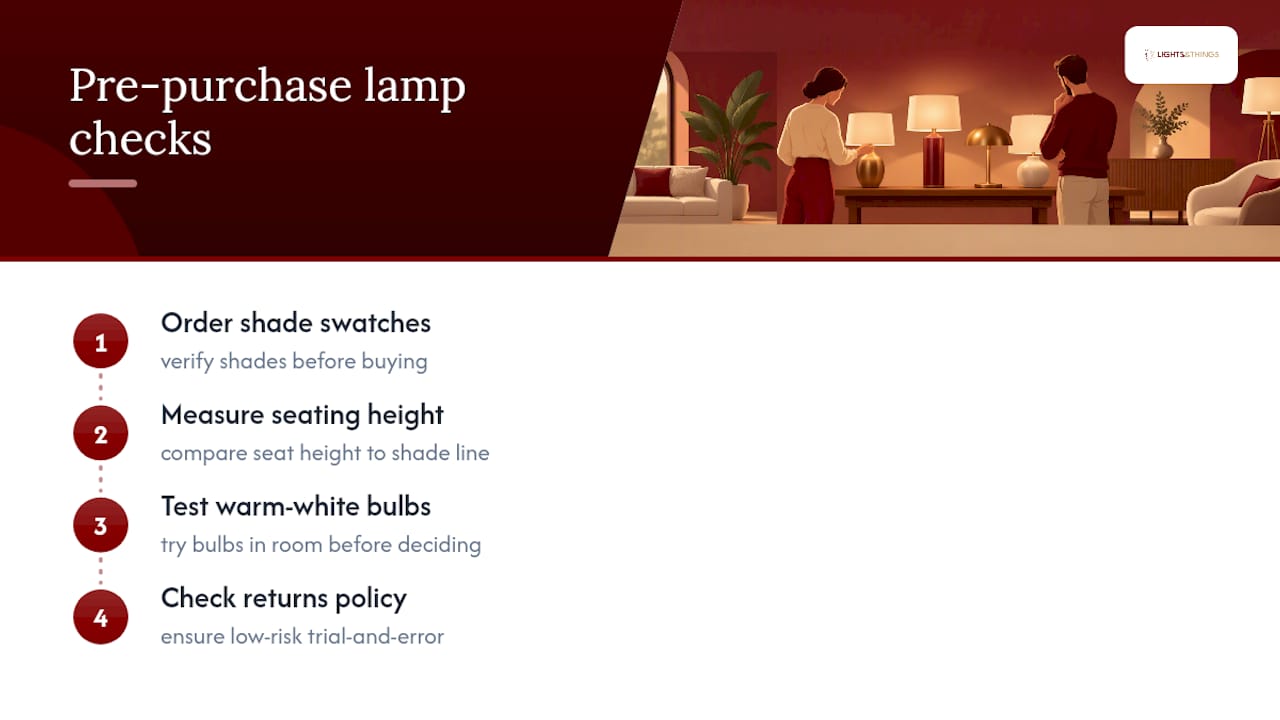
Before you buy, order shade swatches if they’re offered, measure your seating height against the shade line, and test bulbs at warm white before deciding a lamp is wrong for the room. A clear returns policy makes this kind of trial-and-error low-risk, which matters most when you’re pairing lamps across two different purchases.
Balancing the Rules With What You Actually Love
Rules are a starting point, not a ceiling. A sentimental lamp that breaks every guideline still belongs in your room if it makes the space feel like yours, and a deliberately out-of-place lamp can be the detail that keeps a room from feeling staged. Try low-risk swaps first, a different shade, a temporary placement, before committing to anything permanent. Lighting has to serve your mood as much as your decor.
— Norm Blain
Shop Coordinated Lamp Collections at LightsThings
LightsThings gives you a shortcut past the trial-and-error most homeowners go through when mixing lamps: our floor and table lamp collections are curated so shades, finishes, and silhouettes already coordinate across different bases, which means you can build a coordinated-not-identical look without hunting across a dozen unrelated brands.
Some retailers offer benefits like free shipping thresholds, easy returns, and financing options, which can make testing a taller floor lamp against your existing table lamp a lower-risk experiment. If you’re starting with a statement piece, the Traditional Brass 65" Floor Lamp with Rattan Shade pairs well with smaller brass accent lamps for exactly the kind of shared-finish coordination this guide recommends. Browse the full lighting and decor catalog to start building your room’s palette today.
Sources
- How to Pick Lamps for the Living Room | The Spruce
- Dear Danica, Should All The Lamps In The Same Room Match? | Nadine Stay
FAQ
Is It Okay to Have Mismatched Lamps?
Yes. Mismatched lamps are common in eclectic and contemporary rooms and often add more personality than a matched pair. The key is keeping one linking element, like a shared finish or shade color, so the mix still feels intentional.
What Is the 5’7" Lighting Rule?
It’s a rough styling benchmark suggesting a lampshade’s bottom edge should sit near a seated adult’s eye level, commonly referenced around 5 feet 7 inches. It’s a guideline for comfortable sightlines, not a strict measurement.
What Is the Lampshade Rule?
The general rule is to match shade shape or size more consistently than base style, since a shared silhouette does more to unify lamps visually than a shared base finish. Bases can vary in material and height as long as the shades relate.
Can You Have Two Different Lamps in a Living Room?
Yes, and it’s often the better choice unless the lamps flank a specific focal point like a sofa or console that calls for symmetry. Two different lamps work well when they share at least one attribute, such as finish or shade color, and serve different lighting jobs in the room. LightsThings’ floor and table lamp collections are built with this kind of mixing in mind.