For most laundry rooms, an LED flush-mount or low-profile flat panel is the right call. It sits close to the ceiling, casts even light across the entire floor plan, and leaves no awkward shadows over your washer or folding counter. If you want a single fixture that handles the full room without a second thought, start there. For a curated selection that covers every budget and style, browse the ceiling fixture collection at LightsThings.
Quick spec checklist before you buy:
- Color temperature: 4000K–5000K (neutral to daylight white)
- Brightness: 20–30 lumens per square foot for a typical small laundry room (e.g., 2,000–3,000 lumens for rooms around 8×10 ft)
- CRI: 80 minimum; 90+ when color accuracy matters
- Safety rating: Damp-rated or IP44 for steam and splash protection
- Listing: UL or ETL listed
- Dimmable: Yes, with a compatible dimmer switch
Table of Contents
- Which ceiling fixture types work best in laundry rooms?
- How do you size fixtures and calculate lumens for your laundry room?
- What color temperature and CRI should you use in a laundry room?
- Are your fixtures safe? Damp ratings, UL/ETL listings, and installation basics
- Integrated LED vs. replaceable-bulb fixtures: which should you choose?
- How do you layer lighting in a laundry room for the best results?
- Which finishes and styles work best in a laundry room?
- What should you budget for laundry room ceiling fixtures?
- How do you keep laundry room fixtures clean and performing well?
- Curated LightsThings fixtures that work well in laundry rooms
- Your quick buying checklist before you purchase
- Key Takeaways
- Why the right laundry-room fixture matters more than most people realize
- Ready to light your laundry room the right way?
- Useful sources and further reading
Which ceiling fixture types work best in laundry rooms?
Flush-mount fixtures are the most practical choice for low-ceiling laundry rooms because they deliver even light without eating into headroom. But the right fixture family depends on your ceiling height, room shape, and how much style you want the space to carry.
| Fixture Type | Best Room Scenario | Key Advantage |
|---|---|---|
| Flush-mount / flat panel | Low ceilings, compact rooms | Maximum headroom, even distribution |
| Semi-flush mount | Moderately low ceilings, mid-size rooms | Slight drop for visual interest, still practical |
| Recessed can lights | Larger rooms, full-coverage needs | Clean look, flexible placement |
| Wraparound / linear utility | Long, narrow rooms | Uniform light along the full length |
| Pendant | High ceilings, island folding stations | Directional task light, decorative impact |
Flush-mount and flat panels work in almost any laundry room. They mount directly to the ceiling box, require minimal clearance, and integrated LED panels replace older fluorescent tubes with far better color rendering and efficiency.
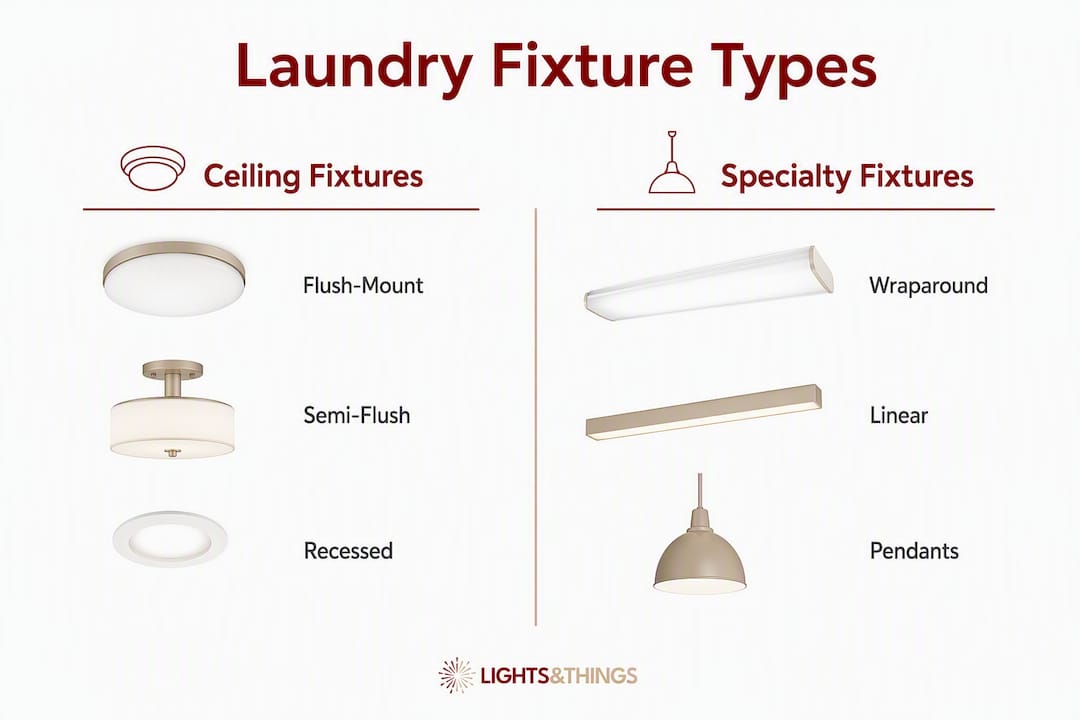
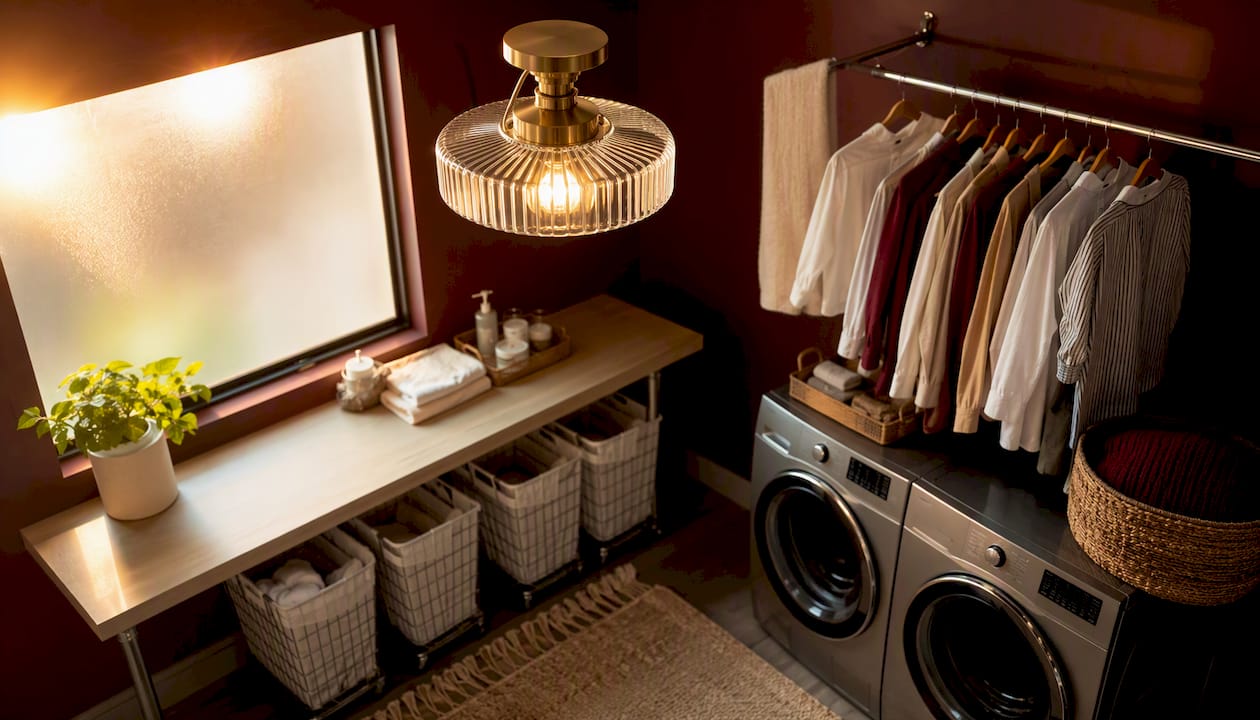
Semi-flush mounts drop 6–12 inches from the ceiling, which adds a decorative element without the commitment of a full pendant. They suit rooms with 8-foot or taller ceilings and work well when you want the laundry room to feel finished rather than purely utilitarian.
Recessed lighting gives you the cleanest ceiling profile and the most flexibility for directing light exactly where you need it. The trade-off is installation complexity: you need adequate ceiling depth and, in most cases, a licensed electrician for new-construction cuts.
Wraparound and linear fixtures are the underrated workhorse for narrow, galley-style laundry rooms. A single 4-foot wraparound running the length of the room covers more area than a round flush-mount of equivalent wattage, and it does so with fewer hot spots.
Pendants belong in laundry rooms with 9-foot or higher ceilings, particularly over a dedicated folding island. For guidance on choosing fixtures for taller spaces, the ceiling height matters as much as the fixture’s style.
How do you size fixtures and calculate lumens for your laundry room?
The math is straightforward. Multiply your room’s square footage by 20–30 lumens to get your target brightness range. A task-oriented laundry room sits at the higher end of that range because you’re doing detail work: reading care labels, spotting stains, sorting darks from navy.
Common room sizes and lumen targets:
| Room Size | Square Footage | Lumen Target (at 25 lumens/ft²) | Practical Fixture Setup |
|---|---|---|---|
| 6 × 8 ft | 50 ft² | 1,000 lumens | Single flush-mount or flat panel |
| 8 × 10 ft | 80 ft² | ~2,000 lumens | One large flat panel or two recessed fixtures |
| 10 × 12 ft | 120 ft² | ~3,000 lumens | Two panels or 4–6 recessed cans |
| 12 × 12 ft | 150 ft² | 3,750 lumens | Multiple fixtures or linear + task lighting |
For fixture diameter, a general rule is 1 inch of fixture diameter per foot of ceiling height. An 8-foot ceiling suits a fixture 8–12 inches in diameter for a compact room, or a 24-inch flat panel for broader coverage. Spacing recessed cans? Place them roughly 4 feet apart and 2 feet from walls to avoid dark edges.
One clarification worth making: buy by lumens, not watts. A 15-watt LED panel can produce lumens comparable to an old 60-watt incandescent. Wattage tells you energy draw, not brightness. Always check the lumen spec on the product page.
Pro Tip: Map your washer, dryer, and folding counter positions before choosing fixture placement. Center the main fixture over the primary task zone, then identify where shadows fall during a trial run with a portable lamp. That tells you exactly where task lights need to go.
What color temperature and CRI should you use in a laundry room?
Laundry rooms perform best with color temperatures between 4000K and 5000K for accurate stain detection and color sorting. At 4000K, the light reads as neutral white, close to natural daylight on a slightly overcast day. At 5000K, it shifts toward true daylight, which gives the highest contrast for spotting a mustard stain on a white shirt.
Warm white bulbs in the 2700K–3000K range are a common mistake in laundry rooms. That amber cast makes whites look cream-colored and hides yellowish stains entirely. Save warm white for bedrooms and living rooms.
CRI (Color Rendering Index) measures how accurately a light source shows colors compared to natural sunlight, on a scale of 0–100. A CRI of 80 is the minimum for a laundry room; at that level, you can distinguish most colors reliably. CRI 90+ is worth the small price premium if you regularly sort delicate fabrics or match colors for clothing care.
Quick reference:
- 4000K: Neutral white, good for general laundry tasks
- 5000K: Daylight white, best for stain detection and color sorting
- CRI 80: Minimum acceptable for laundry rooms
- CRI 90+: Recommended when color accuracy is a priority
- 2700K–3000K: Avoid in laundry rooms; hides stains and distorts whites
Fixtures with selectable CCT (color-correlated temperature) let you toggle between 3000K, 4000K, and 5000K with a switch or remote. If your laundry room doubles as a craft space or home office nook, that flexibility is genuinely useful rather than a gimmick.
Are your fixtures safe? Damp ratings, UL/ETL listings, and installation basics
Laundry rooms generate steam. Every time you open a hot dryer or run the washer through a spin cycle, moisture enters the air. That’s why fixture safety ratings matter more here than in a dry bedroom or hallway.
Damp vs. wet location ratings
| Rating | What It Covers | Laundry Room Use |
|---|---|---|
| Dry location | No moisture exposure | Not suitable for laundry rooms |
| Damp location | Indirect moisture, humidity, steam | Suitable for most laundry rooms |
| Wet location | Direct water contact, outdoor exposure | Required only near utility sinks with direct splash |
Choose damp-rated fixtures, or those with an IP44 rating, for any laundry room that experiences steam or occasional splashes. IP44 means the fixture is protected against solid particles larger than 1mm and water splashing from any direction. Most residential laundry rooms need damp-rated, not wet-rated, fixtures unless a utility sink sits directly beneath the light.
Installation checklist:
- Confirm your existing junction box supports the fixture’s weight (most residential boxes handle up to 35 lbs)
- Check ceiling type: drywall, plaster, and drop ceilings each require different mounting hardware
- Verify pendant clearance: allow at least 7 feet from floor to bottom of fixture in any walking path
- Hardwired fixtures require shutting off the circuit breaker; plug-in fixtures are DIY-friendly but limit placement
- Call a licensed electrician for new circuit runs, recessed can cuts, or any work involving the panel
UL and ETL listings confirm that an independent testing lab has verified the fixture meets U.S. safety standards. Always check for one of those marks before purchasing. Local electrical codes vary by jurisdiction, so confirm requirements with your municipality or a licensed electrician before installation.
Integrated LED vs. replaceable-bulb fixtures: which should you choose?
The choice comes down to longevity versus flexibility. Integrated LED fixtures wire the light source directly into the housing, which means no bulb to replace for 25,000–50,000 hours of use. Replaceable-bulb fixtures accept standard E26 or GU10 bases, giving you the freedom to swap bulbs as technology improves or as your style preferences change.
Integrated LED advantages:
- Even, shadow-free light distribution across the full panel
- No bulb replacement for the fixture’s lifespan
- Often thinner profile, ideal for low ceilings
- Selectable CCT options available on many models
Replaceable-bulb advantages:
- Swap bulbs without replacing the entire fixture
- Wider style variety in the fixture housing
- Easier to upgrade to higher-CRI or different-Kelvin bulbs later
For laundry rooms specifically, integrated LED panels win on practicality. The even distribution suits task work, and youre not climbing a step stool every few years to swap bulbs. For LED compatibility details and dimmer pairing, the fixture’s spec sheet is your first stop.
Dimming adds real value in a laundry room. A dimmer lets you lower the light for a quick load transfer at night and raise it to full brightness for stain inspection. Look for fixtures labeled TRIAC-compatible or ELV-compatible, and match them with a dimmer from the same manufacturer’s recommended list. Mismatched dimmers cause flickering, buzzing, and shortened LED lifespan.
Pro Tip: Before purchasing, search the fixture model number plus “compatible dimmers” on the manufacturer’s site. Most reputable brands publish a tested dimmer list. Using a dimmer from that list is the single easiest way to avoid flickering and buzzing after installation.
Smart controls at the switch level (a smart dimmer or occupancy sensor) work with most hardwired fixtures without requiring a smart fixture itself. That’s a lower-cost path to motion-activated convenience than buying a fixture with built-in sensors.
How do you layer lighting in a laundry room for the best results?
A single overhead bulb is one of the most common laundry-room mistakes lighting professionals flag. It creates shadows directly behind you as you lean over the machine, and it leaves folding counters and utility sinks in partial darkness. A layered approach, combining a primary ceiling fixture with localized task lighting, significantly reduces shadows and improves workflow.
The layered-lighting principle has three tiers: primary (general ambient), task (targeted at work surfaces), and accent (decorative or mood). In a laundry room, you’ll use the first two heavily and the third sparingly.
For a practical layered lighting checklist that applies across rooms, the same principles translate directly to utility spaces.
Three example configurations:
-
Small closet or stacked laundry (under 50 ft²): One flush-mount LED panel centered on the ceiling, providing ample lumens. Add an LED strip light under any shelf above the machines for direct task light on controls and door handles.
-
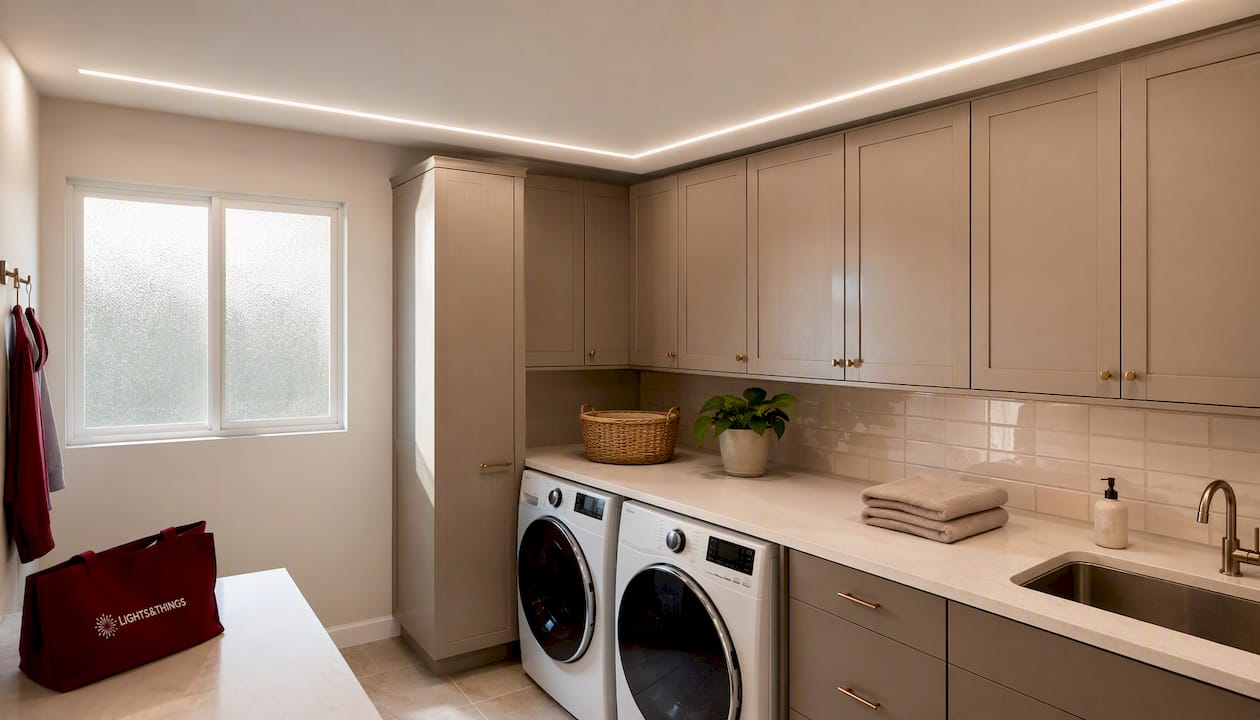
Typical laundry room with folding counter (60–100 ft²): One large flat panel or two recessed cans for general light. Under-cabinet LED strips along the full length of the folding counter. A gooseneck or wall-mounted fixture over the utility sink if one is present.
-
Large utility room with multiple zones (100+ ft²): A linear wraparound fixture running the room’s length for even baseline coverage. Recessed cans or a secondary flush-mount over the washer/dryer zone. Under-cabinet strips at the folding station, and a dedicated wall sconce or adjustable arm light near the utility sink.
For long, narrow laundry rooms, a wraparound or linear fixture paired with task lights over counters provides the most even coverage. That combination eliminates the dark-end problem that a single centered fixture always creates in a galley layout.
Which finishes and styles work best in a laundry room?
The laundry room doesn’t have to look like a utility closet. The right fixture finish ties the space into your home’s broader design language while standing up to humidity and the occasional wipe-down.
Finishes that hold up well:
- Satin nickel: Resists fingerprints, cleans easily, works with modern and transitional decor
- Matte black: Bold contrast, hides water spots better than polished finishes, suits industrial and farmhouse styles
- White: Blends with white ceilings for a clean, minimal look; pairs naturally with flat panels
- Brushed brass: Warm without being yellow, suits transitional and contemporary farmhouse spaces
Style pairings:
- Modern minimal: White or satin nickel flat panel, clean lines, no visible hardware
- Farmhouse: Matte black semi-flush with a frosted glass shade, or an exposed-bulb cage fixture on a high ceiling
- Industrial: Matte black wraparound or wire-cage pendant, metal diffuser
For a deeper look at how finishes translate across styles, the transitional lighting style guide at LightsThings covers finish pairings that work across multiple design directions.
Pro Tip: Avoid polished chrome and high-gloss white in steam-heavy laundry rooms. Water spots show immediately on polished surfaces, and high-gloss paint on fixture housings can yellow over time near heat sources. Matte and satin finishes are far more forgiving.
What should you budget for laundry room ceiling fixtures?
Price in this category breaks into three clear bands, and the differences are real rather than cosmetic.
Budget ($20–$80): Basic flush-mount LED panels and utility wraparounds. You get functional brightness and a UL listing, but limited finish options and no selectable CCT. Integrated LED lifespan is often rated lower, and dimming compatibility may be restricted.
Midrange ($80–$250): This is where most homeowners land. Fixtures in this range offer CRI 90+, selectable color temperature, dimmable drivers, and a wider finish selection. Build quality is noticeably better, and warranty coverage typically extends to 3–5 years.
Premium ($250 and up): Decorative semi-flush mounts, designer pendants, and statement flat panels with architectural profiles. LightsThings carries fixtures in this range that meet laundry-room functional specs while adding genuine visual impact. For statement pieces, the exclusive collection includes options that work in high-ceiling utility spaces.
On energy: an LED flat panel drawing 20–30 watts replaces a 4-tube fluorescent fixture drawing 120+ watts. Over a year of daily use, that difference adds up to meaningful savings on your electricity bill, and the LED requires no tube replacements.
Warranty and returns checklist:
- Confirm warranty length (look for 3 years minimum on integrated LED fixtures)
- Check whether the warranty covers the driver separately from the housing
- Verify the retailer’s return window before purchase (LightsThings offers easy returns)
- Note free shipping thresholds to avoid unexpected shipping costs on larger fixtures
How do you keep laundry room fixtures clean and performing well?
Maintenance is minimal with the right approach. Dust and lint accumulate faster in laundry rooms than in most other spaces, so a quick wipe-down every 4–6 weeks keeps diffusers clear and light output consistent.
Cleaning steps:
- Turn off the circuit breaker before touching any fixture
- For glass or acrylic diffusers, use a soft cloth dampened with mild soap and water; avoid abrasive pads
- For metal housings, a dry microfiber cloth removes dust without scratching satin or matte finishes
- Never spray cleaner directly onto a fixture; apply it to the cloth first
For replaceable-bulb fixtures, standard E26 LED bulbs rated at 4000K–5000K are widely available and inexpensive. Integrated LED fixtures don’t need bulb replacement, but if the driver fails after the warranty period, the entire fixture typically needs replacing. That’s a reason to buy from a brand with a solid warranty and a clear replacement policy.
A note on noise: Some integrated LED fixtures produce a faint hum from the driver, and combination ceiling fan/light fixtures add motor noise. In a laundry room adjacent to a bedroom or living area, that matters. Look for fixtures that specify a “quiet driver” or check recent reviews specifically for noise mentions before purchasing. Noise from LED drivers can be mistaken for appliance noise, which makes it harder to diagnose the actual source.
Curated LightsThings fixtures that work well in laundry rooms
LightsThings carries ceiling fixtures across the full price spectrum, and several options in the collection check every box on the laundry-room spec list: damp-rated or IP44, 4000K–5000K, CRI 80+, dimmable, and UL or ETL listed. Below are three representative picks by budget tier.
Budget pick: LED flush-mount flat panel
- Lumens: 2,000–3,000 | CCT: 4000K fixed | CRI: 80+ | Damp-rated: Yes | Dimmable: Yes
- Why it works: Sits flush to an 8-foot ceiling, covers a 6×8 to 8×10 room without additional fixtures, and installs in under 30 minutes on an existing junction box.
Midrange pick: Selectable-CCT semi-flush mount
- Lumens: 2,000–3,000 | CCT: 3000K/4000K/5000K selectable | CRI: 90+ | Damp-rated: Yes | Dimmable: Yes
- Why it works: The selectable color temperature handles both task-focused laundry sessions and softer ambient light when the room doubles as a utility or craft space.
Premium pick: Decorative semi-flush or statement panel
- Lumens: 3,000–5,000 | CCT: Tunable white | CRI: 90+ | Damp-rated: Yes | Dimmable: Yes
- Why it works: Designed to look intentional rather than functional, this tier suits laundry rooms that open to a mudroom or hallway where the fixture is visible from a main living area.
All three tiers are available in the LightsThings decorative lighting collection. Free shipping applies above the threshold, returns are straightforward, and the collection is curated for residential spaces rather than commercial utility.
Your quick buying checklist before you purchase
Use this before you finalize any fixture:
- Measure the room: Length × width gives square footage; multiply by 20–30 for a lumen target
- Check ceiling height: Under 8 ft, choose flush-mount; 8–9 ft, semi-flush is fine; 9+ ft, pendants or semi-flush with longer drop
- Confirm Kelvin: 4000K–5000K for task accuracy; avoid anything below 3500K
- Verify CRI: 80 minimum; 90+ preferred
- Check damp rating: Damp-rated or IP44 for any laundry room with a washer or dryer
- Test dimmer compatibility: Cross-reference the fixture’s compatible dimmer list before buying a new switch
- Review return policy and warranty: Minimum 3-year warranty on integrated LED; confirm the return window
- Choose a finish that cleans easily: Matte and satin finishes over polished or high-gloss
Before checking product dimensions online, measure your ceiling height and note the positions of your machines and folding counter. A fixture that looks right in a photo can be the wrong size or wrong shape for your actual layout.
Key Takeaways
The best laundry room ceiling fixture combines 4000K–5000K color temperature, 2,000–3,000 lumens for a typical small room, a damp-location rating, and dimmable output to handle both task work and quick walk-throughs.
| Point | Details |
|---|---|
| Fixture type by ceiling height | Flush-mount for ceilings under 8 ft; semi-flush for 8–9 ft; pendants for 9+ ft spaces |
| Brightness target | Aim for 20–30 lumens per square foot; most small laundry rooms need 2,000–3,000 lumens total |
| Color temperature and CRI | Use 4000K–5000K for stain detection; choose CRI 90+ when color sorting accuracy matters |
| Safety and ratings | Select damp-rated or IP44 fixtures; confirm UL or ETL listing before purchasing |
| LightsThings collection | LightsThings offers budget, midrange, and premium damp-rated fixtures with free shipping and easy returns |
Why the right laundry-room fixture matters more than most people realize
Most homeowners treat the laundry room as an afterthought when it comes to lighting. A single builder-grade bulb goes in, and it stays there for a decade. The conventional wisdom is that the laundry room is purely functional, so any light will do.
That thinking gets it backwards. The laundry room is one of the highest-stakes spaces for light quality in the entire home. You’re making color judgments, reading care labels in small print, and spotting stains that need pre-treatment before they set permanently. Poor light means missed stains, ruined garments, and wasted time re-washing items that looked clean under a warm, low-CRI bulb.
The other thing people underestimate is how much a well-chosen fixture changes the feel of the space. A laundry room that’s bright, clean, and visually coherent is a room you don’t dread walking into. That’s not a luxury consideration. It’s a practical one, because you’re in that room multiple times a week.
The spec checklist matters: 4000K–5000K, CRI 90+, damp-rated, dimmable. But the fixture also needs to fit the room’s proportions and match the finishes you’ve chosen elsewhere. Getting both right is exactly what LightsThings is set up to help you do, with a curated selection that doesn’t force you to choose between performance and style.
Ready to light your laundry room the right way?
LightsThings offers a curated selection of ceiling fixtures that meet the full laundry-room spec: damp-rated, 4000K–5000K, CRI 80+, dimmable, and UL or ETL listed, across budget, midrange, and premium price points. You get the task performance the space needs and the aesthetic quality the rest of your home deserves.

Why shop LightsThings for your laundry room:
- Free shipping above the threshold, so large fixtures arrive without surprise costs
- Easy returns if the fixture doesn’t fit your space or style
- Fixtures curated for residential spaces, not commercial utility
- Price matching and financing available for premium selections
- Every pick vetted for damp-location safety and residential installation
Browse the full ceiling fixture collection and filter by finish, style, and price to find the right fit for your room. Measure your space first, then use the spec checklist above to narrow your options before you buy.
Useful sources and further reading
- Illuminating Engineering Society (IES) — authoritative standards for residential lighting levels and fixture placement
- ENERGY STAR Certified Light Fixtures — verified energy-efficient fixtures meeting EPA performance standards
- UL Product iQ — search tool for verifying UL safety listings on specific fixture models
- Intertek ETL Listed Directory — ETL listing verification for fixtures and electrical products
- How to Choose the Best Laundry Room Lights — fixture type guidance and layered lighting recommendations
- Laundry Room Lighting Ideas — fixture styles, layered setups, and room-size examples