A well-lit living room doesn’t happen by accident. It’s the result of deliberate layering, the right fixtures in the right places, and bulbs that actually flatter the space. Here’s your living room lighting checklist at a glance before we go deeper into each element.
Your core checklist:
- Three minimum layers: ambient (overhead, dimmable), task (floor or table lamps beside seating), and accent (art, shelves, architectural features)
- Four to twelve light sources for a professionally finished look; five or more for a fuller, more dimensional effect
- Fixture mix: ceiling fixture or chandelier, floor lamps, table lamps, wall sconces, and at least one accent source
- Bulb color temperature: 2700K–3000K warm white throughout every layer
- Dimmers on all ambient fixtures to shift from functional daytime brightness to a relaxed evening glow
- Multiple heights: sources at floor, table, and ceiling level to eliminate flat, one-dimensional light
- Smart or plug-in options for renters or anyone avoiding rewiring
Pro Tip: Install a dimmer on your ceiling fixture before buying a single new lamp. Dimming the overhead moderately while floor and table lamps are running is the fastest way to make a living room feel warm and considered rather than clinical.
Table of Contents
- What are the three essential layers every living room needs?
- How do you choose and position fixtures for your living room?
- Which bulbs and controls make the biggest difference?
- Expert layering tips from the LightsThings team
- How does natural light affect your living room lighting plan?
- Are LED bulbs worth it for energy efficiency and sustainability?
- How do you keep living room lighting fixtures in good shape?
- LightsThings has the fixtures to bring your lighting plan to life
- Key Takeaways
What are the three essential layers every living room needs?
Relying on a single overhead light creates flat, clinical lighting that drains warmth from even a beautifully furnished room. Layering solves this by building contrast between bright and shadowed areas, which is exactly what gives a room depth and makes it feel lived-in.
Ambient lighting: the foundation
Ambient light is the room’s base layer; for ideas on selecting stylish options that fit any budget, see modern kitchen cabinet ideas for every budget. It fills the space with general illumination and typically comes from a ceiling fixture, chandelier, flush mount, or a grid of recessed downlights. The key rule: it should be dimmable. At full brightness with nothing else on, ambient light alone flattens the room. Think of it as the background, not the feature.
Task lighting: functional and personal
Task lighting serves specific activities — reading, conversation, working from the sofa. In a living room, this means floor lamps or table lamps positioned beside or slightly behind seating. Each primary seat where someone regularly sits benefits from its own dedicated source. A floor lamp at the end of a sofa, or a table lamp on a side table beside an armchair, places light exactly where it’s needed without throwing harsh shadows across faces.

Accent lighting: depth and visual interest
Accent light draws the eye to something worth looking at. A picture light above a painting, a small LED spot aimed at a bookshelf, an uplighter behind a large plant — these sources create bright points against a darker background, adding the kind of visual depth that multiple sources at different heights naturally produce. Without at least one accent source, even a well-furnished room can feel unfinished after dark.
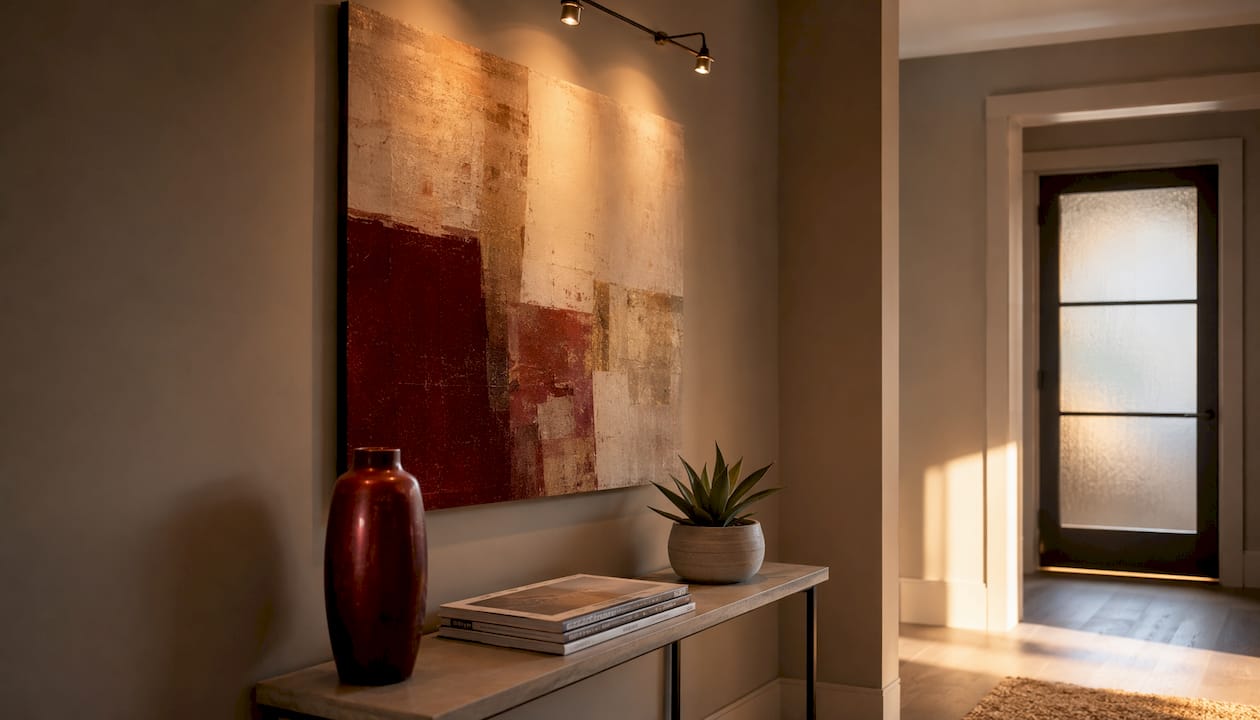
Pro Tip: Aim for multiple light sources total — including ceiling fixtures, task lamps at seating positions, and accent sources — for a living room that feels genuinely layered rather than just adequately lit.
How do you choose and position fixtures for your living room?
Fixture selection shapes both the function and the personality of your lighting scheme. The goal is variety: different fixture types at different heights, covering the room’s perimeter rather than concentrating light at the center.
Fixture types and what each one does
- Floor lamps (torchière/uplighter): Bounce light off the ceiling for soft, diffused ambient fill. Ideal for dark corners and rooms with low ceilings.
- Floor lamps (arc or standard): Provide directed task light over a sofa or reading chair without requiring a side table.
- Table lamps: Create intimate pools of warm light at seated eye level. The most personal source in the room, and the easiest to coordinate with your decor.
- Wall sconces: Frame a fireplace, mirror, or artwork; mount them roughly 60–66 inches from the floor for the most natural effect. Plug-in sconces with a cord cover are a practical option for renters.
- Recessed downlights: Work best when positioned toward the room’s perimeter rather than clustered at the center, and always on a dimmer with 2700K bulbs.
- Track lighting: Particularly useful in open-plan spaces or rooms with high ceilings where a pendant won’t sit right. Adjustable heads let you redirect light as furniture arrangements change.
- Pendant lights: A statement piece that doubles as ambient or task light. Hang the bottom edge about 7 feet from the floor in an open living area.
Placement principles that actually matter
Position sources around the room’s perimeter rather than its center. Perimeter placement illuminates vertical surfaces and walls, which creates the sense of spatial depth that makes a room feel generous. A single uplighter or indirect source positioned behind the sofa, directed at the wall, immediately changes the spatial quality of the seating zone.
For task lamps, position the shade’s bottom edge near seated head height to avoid glare into seated eyes. For reading specifically, the source should come from beside or slightly behind the reader, never from directly in front.
Pro Tip: If you’re planning a full lighting scheme and want grouped lamp control, ask your electrician about a dedicated 5-amp circuit. It lets you switch all your floor and table lamps simultaneously from one wall switch, which makes layering effortless in practice.
Which bulbs and controls make the biggest difference?
Fixture placement matters, but bulb choice and dimming controls are what determine whether your living room actually feels warm. Get these two elements wrong and even a beautifully arranged scheme will fall flat.
Color temperature: the number most people skip
Bulb color temperature is measured in Kelvin (K), and the range you choose shapes the entire character of the room. Warm white bulbs in the 2700K–3000K range are the right choice for living rooms. They’re close to incandescent light, they flatter skin tones, and they make natural materials like wood and linen look their best. Bulbs at 4000K or above read as cool and clinical in the evening, regardless of how good your fixtures are.
| Color Temperature | Character | Living Room Verdict |
|---|---|---|
| 2700K | Very warm, close to incandescent | Best choice for most living rooms |
| 3000K | Soft warm white | Acceptable; slightly more neutral |
| 2700K–3000K | Warm white | Flattering for living rooms |
| 4000K+ | Cool white to daylight | Avoid in living rooms |
If your room feels harsh or cold after dark, swap the bulbs before buying anything new. Replacing 4000K bulbs with 2700K across all existing fixtures costs very little and produces an immediate, noticeable shift.
Dimmers: the single most effective upgrade
A dimmer switch on the ceiling fixture changes how the entire room functions across the day. In the evening, when floor and table lamps are on, dimming the overhead while lamps are running creates the contrast between a lit seating zone and a softer room periphery that makes living rooms feel comfortable rather than institutional. When watching a screen, dim further to 20–30% and let the lamps carry the room.
LED dimmers vary in quality. Investing in a higher-quality dimmer eliminates the flicker and hum that cheaper models can produce with LED bulbs. Always confirm your bulbs are labeled dimmable before installing a dimmer switch.
Smart lighting: flexible control without rewiring
Smart bulbs and smart plugs let you set scenes — dim and warm for movie night, brighter and more neutral for hosting — without walking around flipping individual switches. They’re particularly useful in living rooms where you want layered control but can’t rewire. Start with the lamps in your main seating area rather than replacing every bulb at once. That’s a cheaper way to test whether scene-based control actually fits how you use the room.
Pro Tip: Stick to one consistent color temperature range, 2700K to 3000K, across every bulb in the room, including smart bulbs. Mismatched temperatures between fixtures create a disjointed look that no amount of dimming will fix.
Expert layering tips from the LightsThings team
Getting the layers right is one thing. Getting them to work together elegantly is where the details matter.
Here’s what makes the difference between a scheme that looks assembled and one that looks considered:
- Accent lighting needs a clear hierarchy. One well-placed bright accent source creates more visual impact than three dim ones competing for attention. Aim for an accent source roughly three times brighter than your ambient level, directed at a single focal point.
- Mix lampshade materials deliberately. Linen and cotton shades diffuse light softly and cast a warm glow upward. Opaque or very dark shades pool light downward and contribute little to the room’s overall warmth. Open-top shades spread light in both directions and tend to feel more generous.
- Renters have more options than they think. Plug-in pendants, plug-in sconces, and smart bulbs paired with dimming controls create a fully layered scheme without any rewiring. Visible cords can be routed discreetly along baseboards or behind furniture. Battery-operated picture lights are widely available and require nothing beyond a couple of small screws.
- Group your lamps for ease. Whether through a 5-amp circuit or a set of smart plugs, being able to turn all your floor and table lamps on simultaneously from one point makes layering something you’ll actually use every evening rather than a scheme you abandon because it’s inconvenient.
- Don’t leave corners dark. Unlit corners make rooms feel smaller and less finished. A floor uplighter, a small table lamp, or even a cluster of LED candles in a corner fills the room visually and adds the perimeter brightness that makes the space feel complete.
For a deeper look at how accent sources work within a full residential scheme, the accent lighting guide for homeowners covers fixture selection and placement in detail.
How does natural light affect your living room lighting plan?
Natural light is the starting point for any living room illumination guide, not an afterthought. The direction your windows face and how much daylight the room receives directly shapes which artificial sources you need and when you need them.
A north-facing living room receives cool, indirect light throughout the day. In these spaces, warm artificial sources matter more, not less, because the room never gets the golden quality that south or west-facing rooms enjoy in the afternoon. Leaning toward 2700K bulbs and adding more lamps than you think you need compensates for the absence of warm natural light.
Window treatments play a dual role. Sheer curtains or light-filtering shades diffuse harsh direct sunlight without blocking it entirely, which softens the contrast between bright windows and darker room interiors during the day. In the evening, heavier drapes or blackout liners prevent windows from becoming dark voids that make the room feel smaller. Covering windows after dark also improves the effectiveness of your artificial lighting by removing the visual competition of a black reflective surface.
If your room has significant natural light during the day, your lighting scheme needs to work in two modes: a daytime setting where artificial sources supplement rather than compete with daylight, and an evening setting where layered artificial light carries the room entirely. Dimmers make this transition seamless. Pairing your home’s interior lighting plan with thoughtful window treatment choices gives you control over both modes.
Are LED bulbs worth it for energy efficiency and sustainability?
LED bulbs use significantly less energy than incandescent bulbs and last far longer, making them the practical default for every layer of a living room lighting scheme. The efficiency advantage is meaningful in a room like the living room, where multiple sources run for several hours each evening.
A few practical points worth knowing:
- Choose ENERGY STAR-certified LEDs for verified efficiency and light quality. Certified bulbs meet standards for color consistency, lumen output, and longevity.
- Match lumens to the layer. Ambient sources typically need 800–1,600 lumens depending on room size. Task lamps for reading work well at 800–1,100 lumens. Accent sources are intentionally lower, often 200–400 lumens, to create contrast rather than fill.
- Dimmable LEDs are not universal. Always check that the bulb is labeled dimmable before pairing it with a dimmer switch. Non-dimmable LEDs will flicker or buzz when used with a dimmer, which defeats the purpose entirely.
- Dispose of old bulbs responsibly. Many hardware stores and municipal recycling programs accept CFL and LED bulbs. Check your local program before tossing them in general waste.
The upfront cost of quality LEDs is higher than incandescent alternatives, but the combination of lower energy draw and longer lifespan makes them less expensive over time. For a living room with five or more sources running nightly, the difference adds up.
How do you keep living room lighting fixtures in good shape?
Fixtures that are well-maintained perform better and last longer. The maintenance routine for living room lighting is straightforward, but it’s easy to overlook until something stops working.
Bulb replacement: Replace bulbs before they fail completely when possible. A bulb that’s flickering or noticeably dimmer than it used to be is drawing more energy and producing less light. In a layered scheme, one underperforming bulb disrupts the balance of the whole room.
Shade and fixture cleaning: Dust accumulates on lampshades and inside fixture housings, reducing light output over time. Wipe fabric shades gently with a lint roller or a dry microfiber cloth. Glass and metal fixtures can be cleaned with a slightly damp cloth. Always turn fixtures off and allow them to cool before cleaning.
Check connections periodically. For plug-in lamps, inspect cords for fraying or damage, particularly near the plug and at the base of the lamp. For hardwired fixtures, if you notice flickering that isn’t related to a dimmer or bulb issue, have an electrician check the connection at the junction box.
Dimmer switches: Quality dimmers are designed to last, but if yours develops a hum or produces inconsistent results after a bulb change, the dimmer and bulb may be incompatible. Switching to a dimmer rated specifically for LED loads resolves most of these issues.
For matching floor and table lamps that coordinate well and hold up over time, material quality at purchase makes maintenance easier down the line.
LightsThings has the fixtures to bring your lighting plan to life
Planning your lighting layers is the intellectual work. Finding fixtures that are actually worth living with every day is where LightsThings comes in.

LightsThings carries a curated catalog of decorative lighting built for residential spaces — ceiling fixtures, floor lamps, table lamps, chandeliers, and wall sconces that balance visual impact with genuine function. Whether you’re anchoring a seating area with a statement chandelier or filling a dark corner with a well-proportioned floor lamp, the range covers every layer of the scheme described in this guide. Free shipping thresholds, easy returns, price matching, and financing options mean you can build your lighting plan at a pace that works for your budget. Browse the full ceiling lighting collection to find the ambient anchor your living room needs, or explore the broader catalog to coordinate fixtures across all three layers. Your next step is simple: start with the layer that’s missing most from your current room and build from there.
Key Takeaways
Effective living room lighting requires at least three distinct layers, warm 2700K–3000K bulbs throughout, and a dimmer on every ambient fixture to shift the room’s mood from functional to atmospheric.
| Point | Details |
|---|---|
| Three layers are the minimum | Ambient, task, and accent lighting each serve a distinct purpose; removing any one flattens the room. |
| Aim for four to twelve sources | Most well-designed living rooms use five or more sources at varied heights for genuine depth and warmth. |
| 2700K–3000K bulbs throughout | Warm white bulbs in this range flatter skin tones and natural materials; anything cooler reads clinical at night. |
| Dimmers change everything | Dimming the ceiling fixture moderately while lamps are on creates the contrast that makes a room feel warm and considered. |
| LightsThings for every layer | LightsThings offers decorative ceiling fixtures, floor lamps, table lamps, and sconces to complete any layered living room scheme. |