An interior design lighting plan is a scaled technical layout that maps every fixture’s exact location, type, and control method across your floor plan. Professionals call it a lighting design or lighting scheme, and the two terms are interchangeable in residential work. A well-built plan organizes your home’s illumination into three industry-standard layers: ambient, task, and accent. Each layer serves a distinct purpose, and together they determine whether a room feels flat and lifeless or warm, functional, and visually curated. If you’ve ever walked into a space that just felt right without knowing why, a thoughtful lighting plan was almost certainly behind it.
What is an interior design lighting plan made of?
A lighting plan is more than a list of fixtures. It is a technical document that specifies fixture locations, types, switch positions, dimmer controls, and lighting zones for every room in the home. That level of detail matters because light placement determines where shadows fall, which surfaces get highlighted, and how usable a space feels at different times of day.
The plan’s three core layers are ambient, task, and accent lighting. Ambient lighting provides general illumination, typically through ceiling fixtures, chandeliers, or recessed downlights. Task lighting targets specific functions like reading, cooking, or applying makeup, and it lives in places like under-cabinet strips, desk lamps, and vanity fixtures. Accent lighting adds depth and visual interest by drawing attention to architectural features, artwork, or decorative objects.
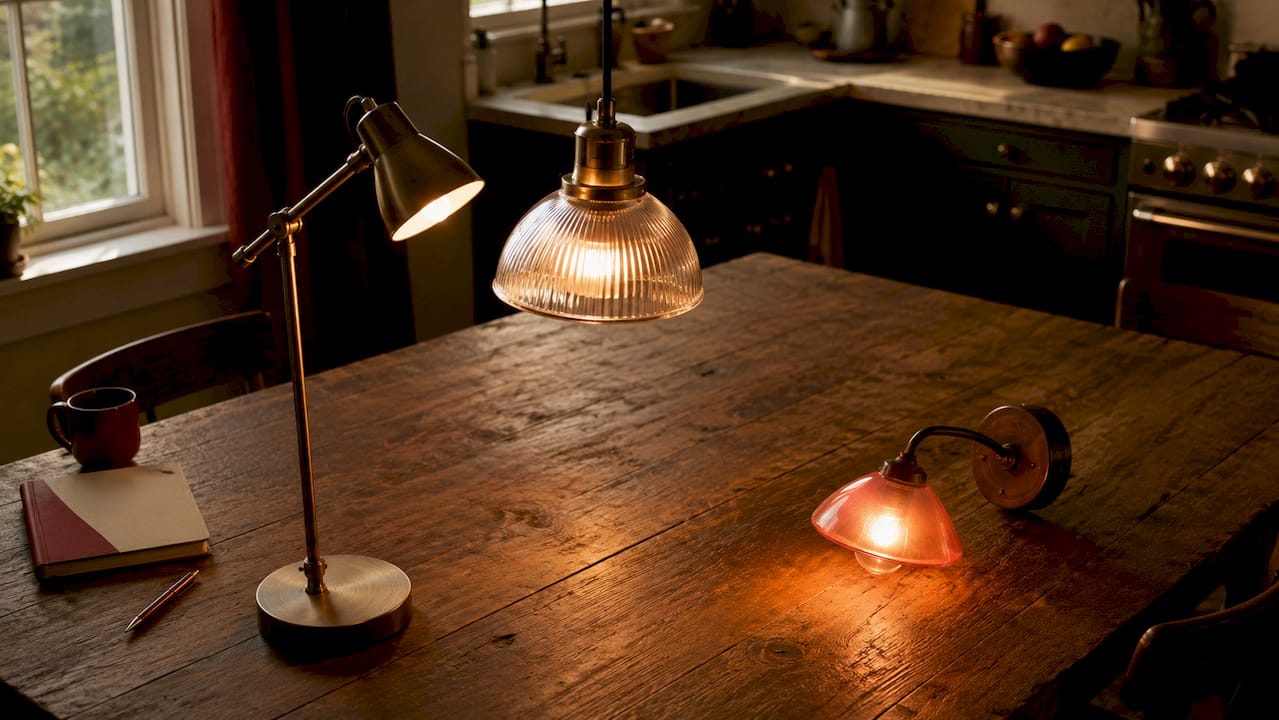
Effective rooms use 2–3 lighting layers for flexibility and mood control. That combination gives you the ability to shift a room from bright and functional to relaxed and atmospheric without changing a single fixture. Large living spaces may call for 10 or more light sources to cover different scenarios like entertaining, watching TV, or reading quietly.
Why do the three types of interior lighting matter?
Each lighting type solves a different problem, and skipping one creates a gap you’ll notice every day.
Ambient lighting is your foundation. Without it, a room feels dark and unwelcoming regardless of how many accent pieces you add. A chandelier or a flush-mount ceiling fixture typically handles this layer in living rooms and bedrooms.
Task lighting protects your eyes and improves accuracy. Reading in dim ambient light strains your vision over time. A dedicated floor lamp positioned over a reading chair, or under-cabinet lighting in a kitchen, solves this directly. Proper fixture placement matters as much as fixture choice. Under-cabinet lights mounted near the front edge cast light onto the work surface rather than the wall behind it.
Accent lighting is where personality enters the room. It highlights a painting, a textured wall, or a sculptural object. Accent fixtures should be noticeably brighter than the ambient layer to create contrast and draw the eye. Without that contrast, the accent effect disappears entirely.
- Ambient layer: ceiling fixtures, chandeliers, recessed lights
- Task layer: floor lamps, desk lamps, under-cabinet strips, vanity lights
- Accent layer: picture lights, directional spotlights, wall sconces, LED strip lights
Pro Tip: If you can only add one layer to a room you already have, make it task lighting. It delivers the most immediate improvement to daily comfort and function.
How do you plan fixture placement and lighting controls?
Placement and controls are where most homeowners make costly mistakes. Pre-construction planning is the most cost-effective way to avoid rewiring later. Finalizing your lighting map before installation saves both money and frustration.
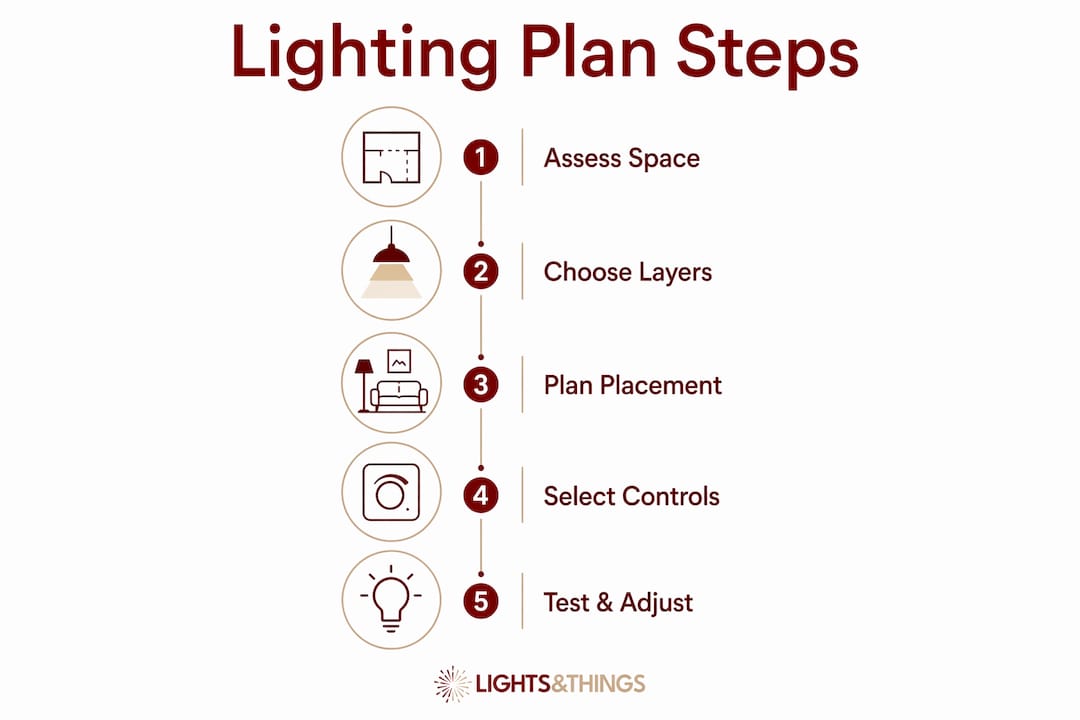
Follow these steps to plan your fixture placement and controls:
- Draw your floor plan to scale. Mark every door, window, and major furniture piece. This shows you where natural light enters and where shadows will form at night.
- Identify activity zones. A living room has a conversation area, a TV zone, and possibly a reading corner. Each zone needs its own lighting consideration.
- Mark fixture locations. Place ambient fixtures to cover the full floor area without dark corners. Position task fixtures directly above or beside the activity they serve.
- Assign separate circuits. Use separate circuits and dimmers for each lighting layer. This lets you dim the ambient light while keeping task lighting bright, or turn off accent lights without affecting the rest of the room.
- Plan switch and dimmer locations. Every dimmer should be reachable from the room’s main entry point. Three-way switches work well in rooms with multiple entry points, like open-plan kitchens and living areas.
- Review for dark spots. Walk through your plan mentally at night. Check corners, hallways, and under-stair areas. These spots are easy to overlook and frustrating to fix after installation.
The single most common and regrettable lighting mistake is relying on one overhead light per room. A single ceiling fixture casts flat, unflattering light and creates shadows in every corner. Multiple circuits with independent dimmers prevent this entirely.
Pro Tip: Install dimmers on every circuit from the start. Retrofitting them later costs more and often requires an electrician.
How does color temperature affect your lighting plan?
Color temperature is measured in Kelvin (K) and it changes how a room feels more than almost any other variable. Warm light around 2700K suits living rooms and bedrooms because it promotes relaxation and mimics the glow of incandescent bulbs. Cooler light in the 3500K–4000K range suits kitchens, home offices, and bathrooms because it sharpens focus and makes tasks easier to perform accurately.
| Room | Recommended color temperature | Primary purpose |
|---|---|---|
| Bedroom | ~2700K | Relaxation, sleep support |
| Living room | 2700K–3000K | Comfort, socializing |
| Kitchen | 3500K–4000K | Food prep, task clarity |
| Home office | 3500K–4000K | Focus, reduced eye strain |
| Bathroom | 3000K–3500K | Grooming, balanced visibility |
Dimmers add another layer of control on top of color temperature. A 2700K bulb at full brightness feels very different from the same bulb dimmed to 30%. That flexibility lets one fixture serve multiple moods across the day. Layered, dimmable lighting is the hallmark of professional residential design and the key to spaces that feel genuinely adaptable.
Pro Tip: Stick to one color temperature per room. Mixing warm and cool bulbs in the same space creates a visual inconsistency that makes the room feel unfinished.
Practical tips for building your home lighting plan
A lighting plan for home use does not require an architect or a large budget. It requires thoughtful decisions made in the right order.
- Choose LED fixtures throughout. LEDs are the industry standard in modern lighting plans because they are energy-efficient, long-lasting, and compatible with dimmers and smart controls. They also come in every color temperature, giving you full flexibility.
- Add smart controls where it makes sense. Dimmers, timers, and motion sensors give you hands-free control and reduce energy use. Smart bulbs let you adjust color temperature and brightness from your phone, which is especially useful in multifunctional rooms.
- Create lighting zones in open-plan spaces. A combined kitchen and living area needs at least two independent lighting zones. Bright task lighting over the kitchen island should not force the living area into the same brightness level.
- Work with rental constraints. Renters cannot rewire, but they can swap out bulbs, add plug-in floor lamps, and use battery-powered accent lights. A dimmable floor lamp placed in a dark corner transforms a rental living room without touching the wiring.
- Plan for maintenance. Group fixtures that use the same bulb type so replacements are simple. Fixtures mounted very high or in awkward positions become a maintenance burden over time.
- Use accent lighting to anchor focal points. A well-placed picture light or directional spot draws the eye to a feature wall or artwork and makes the room feel curated. For more ideas on pairing accent lighting with decor, the accent pieces checklist from LightsThings covers room-by-room combinations that work.
Living rooms need 4–5 independently controlled light sources to support different activities like TV watching, reading, and entertaining. That number sounds like a lot until you realize each source serves a distinct purpose and none of them work as well alone.
Key Takeaways
A complete interior design lighting plan layers ambient, task, and accent lighting across independently controlled circuits to create spaces that are both functional and visually compelling.
| Point | Details |
|---|---|
| Layer your lighting | Use ambient, task, and accent layers together for flexibility and mood control. |
| Plan before you build | Finalize fixture locations and circuits before installation to avoid costly rewiring. |
| Match color temperature to the room | Use warm 2700K light for bedrooms and living rooms; use 3500K–4000K for kitchens and offices. |
| Use dimmers on every circuit | Dimmers give you control over mood and brightness without changing fixtures. |
| LEDs are the right choice | LED fixtures support dimming, smart controls, and long-term energy savings across every room. |
What most homeowners get wrong about lighting
The biggest mistake I see is treating lighting as an afterthought. Homeowners spend weeks choosing paint colors and furniture, then pick fixtures in an afternoon without thinking about placement, circuits, or color temperature. The result is a beautifully furnished room that feels wrong every evening.
The second mistake is believing that more light fixes everything. Quality and strategic positioning create defined spaces and mood. Adding a fifth recessed downlight to a room that already has four does not improve it. Repositioning one of those four fixtures to eliminate a shadow in the reading corner does.
I’ve also noticed that people underestimate how much the transitional lighting approach simplifies decision-making. When you commit to layering and independent controls from the start, every fixture choice becomes easier because you know exactly what job it needs to do.
Living rooms and bedrooms reward the most investment in layered, dimmable configurations. These are the rooms where you spend the most time in different moods and activities. Getting the lighting right in these two rooms changes how your entire home feels to live in.
— Norm Blain
Bring your lighting plan to life with LightsThings
A well-designed lighting plan only works when the fixtures match the vision.

LightsThings carries a full range of ambient, task, and accent fixtures built for residential spaces. From statement crystal chandeliers that anchor a dining room or entryway to dimmable floor lamps that add a flexible task layer to any living room, every product is chosen with both style and function in mind. The catalog includes options across color temperatures and finishes, so you can match fixtures to your plan rather than adjusting your plan around limited choices. Free shipping thresholds, easy returns, and price matching make it straightforward to shop with confidence. Browse the full lighting collection at LightsThings and find the fixtures that complete your plan.
FAQ
What is an interior design lighting plan?
An interior design lighting plan is a scaled layout that maps every fixture’s location, type, switch, and dimmer control across a floor plan. It organizes illumination into ambient, task, and accent layers to balance function and aesthetics.
How many lighting layers does a room need?
Most rooms benefit from at least two to three lighting layers: ambient for general illumination, task for focused activities, and accent for visual interest and depth.
What color temperature should I use for a living room?
A color temperature of 2700K–3000K suits living rooms best. That warm range promotes relaxation and creates a comfortable, inviting atmosphere.
Can renters create a lighting plan without rewiring?
Yes. Renters can use plug-in floor lamps, swap bulbs for the correct color temperature, and add battery-powered accent lights to build a layered lighting scheme without any electrical work.
Why is a single overhead light a problem?
A single overhead fixture creates flat, shadowless light that makes a room feel uninviting and leaves corners dark. Multiple independently controlled sources eliminate this and give you far more flexibility.