The best entryway lighting uses three layers, ambient, task, and accent, anchored by a focal fixture sized to your space. Choose warm LEDs between 2700K and 3000K for a welcoming glow, and size your main fixture using a common sizing guideline based on your entry’s dimensions. Add a dimmer, and you’re set.
TL;DR:
- Fixed focal fixtures should be sized based on room dimensions, with a common guideline being around one-third of the entry’s width or length plus width in inches.
- Ceiling height determines fixture type: low ceilings under 8 feet require flush mounts or recessed lighting, while tall foyers can support oversized chandeliers or staged pendants.
- Using warm white LEDs between 2700K and 3000K with a CRI of 90 or higher ensures a flattering, consistent glow across ambient, task, and accent layers.
- Safety is crucial; fixtures should provide sufficient brightness at the floor, avoid glare through diffused shades, and maintain at least 7 feet of clearance to prevent head injuries.
- Opting for fixtures with smart controls like dimmers and motion sensors enhances energy efficiency, while regular cleaning and hardware checks preserve lighting quality over time.
Table of Contents
- Entryway Lighting Ideas: A Quick Guide to Fixture Types
- How to Layer Ambient, Task, and Accent Light in an Entryway
- Sizing and Placement Rules You Can Use Right Now
- Which Fixtures Work Best by Ceiling Height and Entry Type
- Style-Led Fixture Ideas by Interior Style
- Lighting Solutions for Small or Awkward Entryways
- Bulbs and Controls: What to Buy and How to Set It Up
- Choosing Fixtures With Confidence: A Shopper’s Checklist
- Safety Considerations Every Entryway Should Address
- Energy Efficiency and Sustainable Lighting for Entryways
- Maintenance Tips to Keep Entryway Lighting Looking Its Best
- Why the Idea Bank Matters More Than the Rulebook
- Shop Entryway Fixtures Built for Real Homes
- Sources
Entryway Lighting Ideas: A Quick Guide to Fixture Types
Every fixture in your entryway does a specific job, and matching the right type to your ceiling height and design goals saves you from an expensive do-over. Here’s how the main categories break down.
Pendants and chandeliers serve as your focal fixture, the piece that sets the tone the moment someone walks in. They need at least 8 feet of ceiling height to hang properly with clearance, and they carry real visual weight, so they work best when your entry can support a statement piece. A single geometric pendant over a console table instantly upgrades a builder-grade entry.
Flush and semi-flush mounts solve the low-clearance problem. If your ceiling sits at 8 feet or under, these hug the ceiling while still delivering ambient light without the risk of a six-footer bumping their head on a dangling fixture.
Recessed lighting works almost anywhere and is especially useful in narrow corridors where a hanging fixture would eat into walking space. It’s a quieter choice. Recessed cans provide even ambient light without adding visual clutter.
Wall sconces bring warmth at eye level and double as task or accent lighting. They’re ideal flanking a mirror or doorway.
Table lamps are the most flexible option. A lamp on a console table adds a pool of warm light and can be swapped out seasonally with zero commitment.
- Pendants/chandeliers: high visual impact, need 8+ ft ceilings, moderate installation complexity
- Flush/semi-flush: low profile, works with any ceiling height, easiest install
- Recessed: minimal visual footprint, best for corridors, requires ceiling access for wiring
- Sconces: adds warmth at face height, easy to install, limited ambient output alone
- Table lamps: zero installation, fully flexible, needs an outlet or plug-in solution
How to Layer Ambient, Task, and Accent Light in an Entryway
A three-layer approach is the foundation nearly every well-lit entryway shares, and it’s simpler to execute than it sounds. Ambient light fills the room evenly, usually from an overhead fixture or recessed cans. Task light handles specific jobs, like reading mail or finding keys, often from a sconce or lamp. Accent light adds depth and mood, think a small uplight on artwork or a dimmed sconce glow after dark.
Here’s how the layers come together for three common entry types:
- Console entry: A semi-flush or small pendant overhead for ambient light, a table lamp on the console for task light, and a picture light or accent sconce above artwork for depth.
- Narrow corridor: Recessed cans spaced 6 to 8 feet apart for ambient coverage, paired with low-profile sconces every few feet for warmth and to break up the “tunnel” look.
- Two-story foyer: A statement chandelier or multi-drop pendant cluster for ambient light, staged sconces along the staircase wall for task lighting on the steps, and accent uplights on tall plants or art.
Keep your bulb temperature consistent across all three layers, ideally in the 2700K to 3000K range, so the room doesn’t look like it’s lit by three different suns. Put everything on dimmers or timers where you can. It costs little upfront and pays you back every evening you walk in and adjust the mood instead of flipping a switch to full blast.
Pro Tip: If you only upgrade one thing this year, add a dimmer to your existing overhead fixture. It’s the cheapest way to make a flat, builder-grade entry feel intentional.
Sizing and Placement Rules You Can Use Right Now
Getting the size right matters more than getting the style right. A gorgeous chandelier that’s too small for the space reads as an afterthought, while an oversized pendant in a narrow hall becomes a hazard.
For a freestanding entry or foyer, add the room’s length and width in feet, then use that sum in inches as your rough fixture diameter. A 10 by 12 foot foyer suggests a fixture around 22 inches across. For corridors and narrow entries, aim for a fixture diameter close to one-third of the hallway’s width rather than using the length-plus-width formula, since a corridor’s proportions behave differently than a square room’s.
Clearance rules keep the space safe and functional:
- Leave at least 7 feet of clearance under any hanging pendant or chandelier so no one has to duck.
- Space recessed lights 6 to 8 feet apart for even coverage without hot spots or dark gaps.
- Mount wall sconces 60 to 66 inches off the floor, roughly eye level, so they flatter faces rather than glaring down at foreheads.
- Center sconces over a console table or align them with the edges of a runner rug so the whole arrangement looks planned rather than scattered.
Getting these numbers right the first time saves you from remounting a fixture six months in because it always felt slightly off.
Which Fixtures Work Best by Ceiling Height and Entry Type
Ceiling height dictates more of your fixture choice than style preference does, so start there before you fall in love with a specific chandelier.
Low ceilings (under 8 feet) call for flush mounts, semi-flush fixtures, recessed cans, or low-profile sconces. Anything that hangs down risks becoming a head hazard, and a bulky fixture on a short ceiling tends to make the whole room feel more cramped rather than grander.
Standard ceilings (8 to 10 feet) open up more options. A single pendant or a semi-flush fixture paired with sconces or a console lamp gives you a proper layered look without overwhelming the space. This is the sweet spot where most homes land, and it’s forgiving of a wider range of fixture sizes.
Tall foyers and stairwells (10+ feet, often two-story) are where you can go big. Layered vertical fixtures work well here: a multi-drop pendant cluster, a full chandelier, or staged pendants at different heights along a staircase. Smaller clustered pendants have become a popular substitute for one oversized chandelier, giving you the same visual drama with more flexibility in how the light spreads.
- Under 8 ft: flush mounts, recessed cans, low-profile sconces
- 8 to 10 ft: single pendant or semi-flush plus sconces or a console lamp
- 10+ ft (foyers/stairwells): chandeliers, multi-drop clusters, or staged pendants along the stairs
If your ceiling height sits at the edge of these ranges, err toward the more conservative option. A too-large fixture in a borderline space reads as cluttered far more often than a slightly modest one reads as boring.
Style-Led Fixture Ideas by Interior Style
Matching your fixture to your home’s existing character keeps the entry from feeling disconnected from the rest of the house.
- Modern/minimalist: A single geometric pendant in matte black or brushed brass, clean lines, no ornamentation. It works because a minimalist entry needs one confident statement, not several competing pieces.
- Traditional/classic: A crystal or wrought-iron chandelier with warm candelabra-style bulbs. It fits because traditional spaces reward ornamentation, and a chandelier’s sparkle photographs beautifully in a formal foyer.
- Farmhouse/transitional: A lantern-style pendant in aged bronze or black, paired with a wood console. The rustic silhouette bridges old and new without looking staged.
- Contemporary glam: A cluster of small globe pendants in mixed brass and glass finishes. Glam styling leans on texture and shine, and a cluster gives you sparkle without one oversized piece dominating the room.
- Scandinavian: A simple linen or paper drum pendant, warm and understated. The style prizes restraint, and a soft-shaded fixture keeps the palette calm.
If you’re mixing metals, limit yourself to two finishes in the same scheme, say, matte black and brushed brass, rather than introducing a third. Three or more starts to look like the fixtures were bought at different times for different houses rather than chosen together. Finish choice also affects perceived warmth: brass and bronze read warmer, while chrome and nickel read cooler, so pick a finish family that matches the mood you’re going for.
Frosted glass or open, translucent shades also keep a fixture from feeling heavy, especially in smaller entries where a solid, opaque shade can dominate the ceiling visually even if it’s not physically large. If you’re leaning traditional but worried about visual weight, a crystal chandelier with an open frame achieves the sparkle without the bulk. For more on blending eras and finishes without the mismatch, our guide on mixing modern and traditional lighting walks through the specifics.
Lighting Solutions for Small or Awkward Entryways
Small entries have their own rulebook, and ignoring it usually means a fixture that eats headroom or a room that feels darker than it should.
For ceilings under 8 feet in a tight entry, skip the pendant entirely. A recessed layout or a pair of slim, low-profile sconces gives you ambient and task light without anything hanging into walking space. In entries where you genuinely have no headroom to spare, this is the safer default, not just a compromise.
Mirrors placed opposite or beside a light source do more for a small entry than almost any fixture upgrade. They bounce existing light back into the room, which makes a cramped space feel noticeably more open. Pair that with light-colored walls, since dark paint absorbs light that a small entry can’t afford to lose.
If you’re renting or can’t run new wiring, you’re not stuck. Plug-in pendants, battery-powered LED pucks, and rechargeable cordless lamps all deliver real light without an electrician. A rechargeable lamp on a console table can look just as intentional as a hardwired sconce, and you take it with you when you move.
- Skip pendants in entries with less than 8 feet of ceiling clearance
- Use mirrors opposite your main light source to bounce light back into the room
- Choose light, reflective wall colors over dark, matte finishes
- Try plug-in pendants or battery LED pucks if wiring isn’t an option
Pro Tip: A round mirror hung directly across from a sconce does double duty: it reflects light and visually widens a narrow hallway at the same time.
Bulbs and Controls: What to Buy and How to Set It Up
The bulb you choose matters as much as the fixture it sits in, and this is where a lot of otherwise good lighting plans go wrong.
Stick to warm white LEDs between 2700K and 3000K, and look for a CRI (color rendering index) of 90 or higher so skin tones and finishes look accurate rather than flat. For brightness, aim for roughly 50 to 100 lumens per square foot. A 40 square foot entry, for example, lands comfortably in the 2,000 to 4,000 total lumen range across all your fixtures combined, not per bulb.
LEDs are the clear choice here: they run cooler, last far longer than incandescent bulbs, and use a fraction of the energy. Just double check dimmer compatibility before you buy, since not every LED plays nicely with every dimmer switch, and a mismatch causes flickering or buzzing. Our breakdown of LED versus incandescent and smart bulbs covers the compatibility details in more depth.
Motion sensors and smart scheduling earn their keep in an entryway specifically. A motion-activated sconce means you’re never fumbling for a switch with an armful of groceries, and a scheduled smart bulb can bring accent lighting on at dusk automatically.
- Bulb temperature: 2700K to 3000K warm white
- Color accuracy: CRI 90 or higher
- Brightness: 50 to 100 lumens per square foot, total across fixtures
- Controls: dimmer-compatible LEDs, motion sensors for hands-free convenience
Choosing Fixtures With Confidence: A Shopper’s Checklist
Lighting decisions get easier once you’ve seen the range of what’s possible, and part of that comes from paying attention to how real spaces get lit well. Norm Blain’s related piece on entryway chandelier ideas walks through a range of focal fixture options if you want more visual inspiration before you commit to a style direction.
Before you check out, run your shortlist through this checklist:
- Style match: Does the fixture’s silhouette fit your home’s existing architecture, or does it fight it?
- Finish cohesion: Does it stay within your two-metal limit for the room?
- Ceiling-height fit: Have you confirmed clearance, especially the 7-foot minimum under any hanging fixture?
- Bulb compatibility: Does it accept warm LEDs in your target color temperature?
- Dimmer-ready: Is the fixture and bulb combination dimmer compatible?
- Return policy: Have you checked the return window in case the scale looks off once it’s installed?
Buying lighting online carries less risk than it used to. Look for retailers offering free shipping thresholds, straightforward returns, secure checkout, price matching, and financing options, all of which make it easier to commit to a statement piece without second-guessing the purchase for weeks.
Safety Considerations Every Entryway Should Address
An entryway is one of the highest-traffic spots in your home, and it’s also where people are most likely to be juggling bags, keys, or a pet on a leash while distracted. That makes safe lighting design a practical necessity, not just a style choice.
Glare is the first thing to avoid. A bare bulb pointed directly at eye level, or a fixture with no shade or diffuser, creates harsh glare that actually makes it harder to see the floor in front of you, not easier. Frosted glass, fabric shades, or a diffuser panel soften the light so it illuminates the space rather than blinding whoever walks in.
Adequate brightness at the floor level matters just as much as ambient glow. Stairs, thresholds, and uneven transitions from an entry into a hallway are common trip points, and dim lighting is a genuine contributor to falls in the home. If your entry includes even a single step, treat that spot as a task-lighting zone, not just part of the general ambient wash.
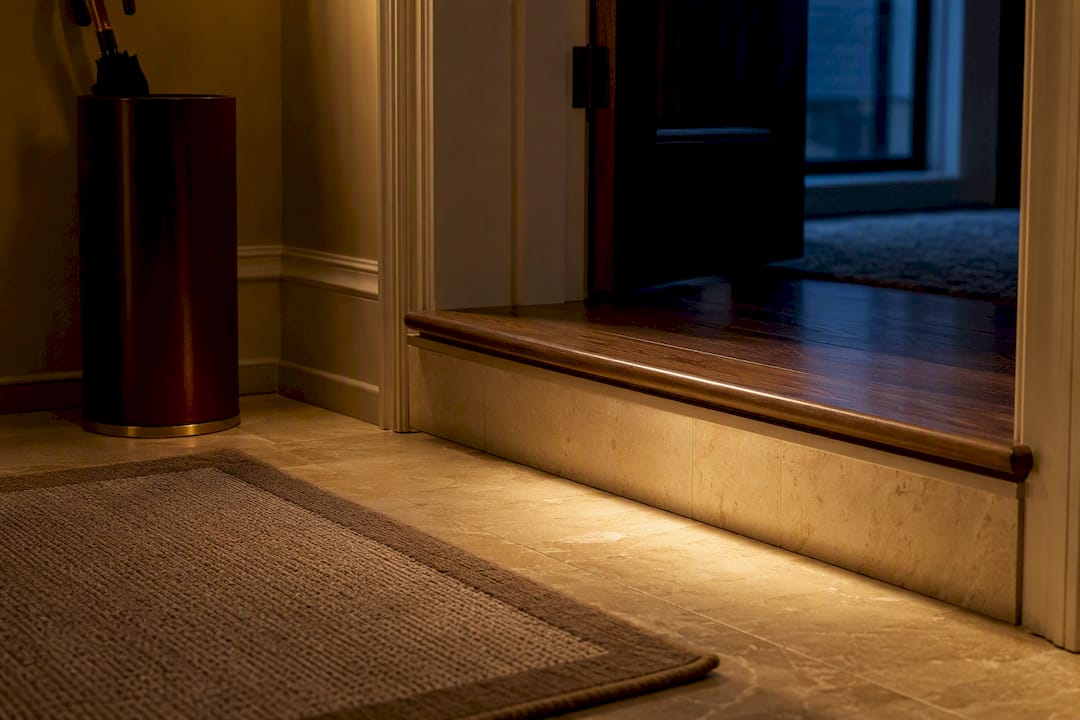
Motion-sensor lighting solves a specific safety gap: the seconds you spend fumbling for a switch in the dark while carrying something. A motion-activated sconce or overhead fixture removes that gap entirely.
Finally, keep pathways clear of hanging pendants that sit lower than 7 feet. It’s a sizing rule from earlier in this guide, but it’s worth repeating here specifically because it’s a safety issue, not just a proportion issue.
Energy Efficiency and Sustainable Lighting for Entryways
Entryway fixtures often stay on for hours at a time, whether that’s a porch-adjacent sconce left on for security or an overhead light that runs every time someone comes and goes. That makes efficiency choices here add up faster than in rooms used only occasionally.
LED bulbs remain the clear standard for sustainable entryway lighting. They use a fraction of the electricity that incandescent or halogen bulbs need for the same brightness, and they last years longer, which cuts down on packaging waste and replacement trips to the store.
Dimmers do double duty for sustainability. Beyond mood, a dimmed fixture running at 50% draws meaningfully less power than one at full brightness, and most evenings don’t call for full brightness anyway. Pairing a dimmer with warm 2700K to 3000K LEDs gives you both the aesthetic and the energy savings in one move.
Motion sensors and smart scheduling cut waste even further by making sure lights aren’t running in an empty entryway all day. A sensor-triggered sconce that only activates when someone walks through is lighting exactly when it’s needed and nothing more.
If you’re shopping for new fixtures, look for ENERGY STAR rated options where available, and consider fixtures designed specifically for LED bulbs rather than converted incandescent designs, since purpose-built LED fixtures tend to manage heat and light distribution more efficiently.
Maintenance Tips to Keep Entryway Lighting Looking Its Best
Entryway fixtures collect dust and grime faster than lighting tucked away in bedrooms or living rooms, mostly because the entry is a transition zone exposed to outdoor air every time the door opens.
Wipe down glass shades, metal finishes, and exposed bulbs every few weeks with a soft, dry microfiber cloth. For glass or crystal elements, a mix of mild soap and water on a damp cloth handles grease and fingerprints without leaving streaks, just dry it thoroughly afterward to avoid water spots on metal hardware.
LED bulbs last considerably longer than the incandescent bulbs they replaced, often rated for years of regular use, so bulb replacement in an entryway becomes an occasional task rather than a monthly chore. Still, check bulbs seasonally, since entryway fixtures tend to run more hours per day than lighting elsewhere in the home.
Dust buildup inside a fixture’s shade or globe can measurably dim its output over time, especially with frosted or textured glass that traps particles. If a fixture seems dimmer than it used to be, cleaning it before assuming the bulb has failed often solves the problem.
Check any mounting hardware, chains, or canopy screws on hanging pendants and chandeliers once or twice a year, since the door traffic and temperature swings near an entry can loosen hardware faster than in more climate-stable rooms.
Why the Idea Bank Matters More Than the Rulebook
Most lighting advice treats entryways like a math problem: get the lumens right, get the spacing right, done. That’s necessary, but it’s not sufficient, and it’s why so many technically correct entryways still feel flat. The sizing rules in this guide matter, but they’re guardrails, not the destination.
What the conventional advice underplays is how much a single well-chosen focal fixture does for a room’s personality compared to getting every spec perfect. A slightly oversized pendant with real character beats a perfectly sized, forgettable flush mount nearly every time. I’d rather see a homeowner nail the style match and be slightly off on the diameter formula than the reverse.
If you take one thing from this guide, prioritize warm bulb temperature and a dimmer before you obsess over fixture brand or finish. Those two choices affect how the space feels every single day, while the fixture itself, however striking, only matters when the lights are actually on and set to the right glow.
— Norm Blain
Shop Entryway Fixtures Built for Real Homes
You can shop a variety of lighting styles online without hunting across a dozen sites to find a fixture that matches your ceiling height, finish, and budget. The selection spans everyday pieces to premium statement chandeliers, sorted by fixture types and styles this guide walks through.
Some retailers offer assurances to make buying lighting online less stressful, such as free shipping thresholds, easy returns if the scale or finish isn’t quite right once it’s hanging, secure checkout, price matching, and financing options for bigger statement pieces. That combination matters most on higher-ticket chandeliers, where getting the size or metal tone wrong is an expensive mistake to live with.
Start by browsing the full lighting and decor collection to see finishes and silhouettes side by side, or check out the entryway chandelier idea gallery for focal fixture inspiration before you settle on a size and finish.
Sources
For deeper detail on spacing, bulb specs, and layered lighting principles referenced throughout this guide, see Curated by Hower, Home Improvement Geek, Amicolight, and Archiproducts. For fixture shopping, browse LightsThings or explore high-ceiling lighting guidance and how entry lighting pairs with door and trim styling.
- Entryway Lighting: First Impressions in Three Layers
- Hallway Lighting Ideas That Actually Work in 2026 | Home Improvement Geek
- Entryway Lighting That Makes a First Impression: Ideas & Fixture Guide – Amicolight
- Lighting a hallway