Ambient lighting is the soft, even glow that fills a whole room, and task lighting is the brighter, focused light aimed at one activity, like chopping vegetables or reading a novel. Rely on ambient light for general comfort and mood, and layer in task lighting wherever your eyes need to focus. Keep both warm, in the 2700 to 3000 K range, for a cozy feel instead of a clinical one.
TL;DR:
- Proper placement of recessed and chandelier ambient lighting ensures even coverage and avoids dark corners, especially with fixtures spaced four to six feet apart.
- Task lighting should be adjustable and positioned to minimize shadows and glare, with specific brightness levels tailored to activities like reading or cooking.
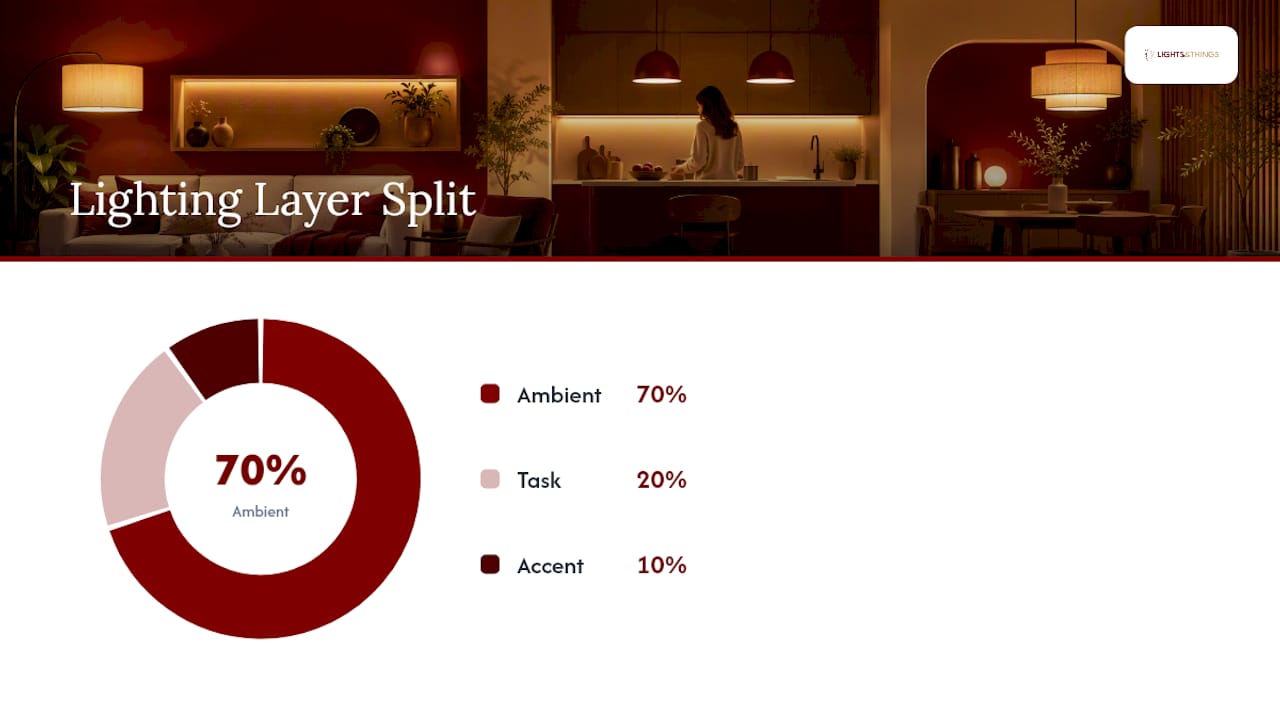
- Layering lighting with a recommended 70/20/10 split among ambient, task, and accent lights creates a balanced room that can be easily adapted with dimmers and separate switches.
- Maintaining consistent color temperatures between 2700K and 3000K across all fixtures prevents mismatched tones and superficial room finish issues.
- Always choose dimmable, replaceable bulb fixtures and plan installation details carefully to avoid flickering, improper Kelvin ratings, or mismatched finishes that diminish the room’s look.
Table of Contents
- Ambient vs Task Lighting: A Quick Comparison
- What Is Ambient Lighting, and Where Should It Go?
- What Is Task Lighting, and How Bright Should It Be?
- How to Layer Ambient, Task, and Accent Lighting
- Room-by-Room Lighting Examples
- What Designers Actually Recommend on Color and Control
- Lighting Buying and Installation Checklist
- A Lighting Editor’s Take on Getting This Right
- Shop Ambient and Task Lighting at Lights & Things
- Sources
Ambient vs Task Lighting: A Quick Comparison
The fastest way to tell these two apart is to ask what job the light is doing. Ambient light fills a room evenly so you can move through it comfortably. Task light aims at one spot so you can actually see what you’re doing there.
- Purpose: Ambient covers the whole room; task lighting supports one specific activity.
- Direction and beam: Ambient light is diffused and bounces softly off walls and ceilings; task light is directed and concentrated.
- Typical fixtures: Ambient comes from chandeliers, recessed cans, and pendants; task lighting comes from desk lamps, under-cabinet strips, and vanity bars.
- Best for: Ambient sets the mood for gathering and relaxing; task lighting is best for reading, cooking, or grooming.
- Controls: Both benefit from dimmers, but task fixtures should also let you adjust the angle, not just the brightness.
What Is Ambient Lighting, and Where Should It Go?
Ambient lighting is your base layer. It’s the light that keeps a room from feeling dark or uneven when no one’s doing anything in particular, just existing in the space. Most homes lean on chandeliers, pendants, recessed cans, or cove lighting to deliver it, spaced so no corner goes noticeably darker than the rest of the room.
A few placement basics make a real difference:
- Space recessed lights roughly four to six feet apart for even coverage, adjusting for ceiling height.
- Center a chandelier or large pendant over the room’s main gathering point, not off to one side.
- Use flush or semi-flush mounts in rooms with low ceilings where a hanging fixture would feel cramped.
- Add a dimmer to every ambient circuit so brightness can shift with the time of day.
Diffusers, frosted globes, and fabric shades matter more than people expect. Bare bulbs create harsh, distracting glare, while diffused light spreads softly and feels far more livable.
Pro Tip: Stick to bulbs rated between 2700K and 3000K for ambient fixtures. Anything higher starts to feel like an office waiting room instead of a living room.
What Is Task Lighting, and How Bright Should It Be?
Task lighting is the focused light you switch on to actually get something done: reading fine print, dicing an onion, applying makeup, or reviewing spreadsheets. It’s brighter and more directional than ambient light, and it’s meant to land exactly where your hands and eyes are working.
Common task fixtures include under-cabinet LED strips in kitchens, adjustable desk lamps in home offices, vanity bars around bathroom mirrors, and swing-arm sconces beside a reading chair. What they share is adjustability. Designers favor fixtures you can angle or dim so the light hits the surface, not your eyes.
Brightness needs vary by task, and going too dim is one of the most common mistakes homeowners make:
These IES-referenced ranges are a starting point, not a hard rule, but they explain why a single ceiling fixture rarely cuts it for detailed work.
- Mount under-cabinet strips at the front edge of upper cabinets to avoid shadowing your own hands.
- Position desk lamps to the side, not directly overhead, to cut screen glare.
- Choose dimmable, adjustable-head fixtures wherever the same spot serves more than one task.
How to Layer Ambient, Task, and Accent Lighting
Building a lighting scheme in order keeps you from ending up with mismatched fixtures and one overworked overhead light. Start broad, then narrow in.
- Install your ambient layer first. This is the foundation, and everything else builds on it.
- Add task lighting at every point where an activity actually happens: the counter, the desk, the reading chair.
- Finish with accent lighting on artwork, shelving, or architectural details for depth.
A 70/20/10 split among ambient, task, and accent light is a useful starting guideline, though it shifts depending on the room’s job. A home office might lean harder on task light, while a living room leans harder on ambient and accent.
Wire ambient and accent fixtures to separate switches or a smart scene where possible. This is what lets you shift mood without losing function at your desk or counter.
Pro Tip: Keep every bulb in a room within the same Kelvin range. Mixing a 3000K lamp with a 5000K overhead is one of the fastest ways to make a “finished” room look unfinished.
Room-by-Room Lighting Examples
Seeing how the layers stack in a real room makes the whole system click faster than any rule of thumb.
- Kitchen: Recessed ambient lighting overhead, under-cabinet task strips along the counters, and one or two pendants over the island for both light and style.
- Living room: A central ambient source, like a flush mount or chandelier, paired with a floor or table lamp near seating for reading, plus accent lighting aimed at art or shelving. Our living room lighting checklist walks through fixture pairings in more detail.
- Bedroom: Soft, dimmable ambient light overhead and bedside task lighting from swing-arm lamps or wall sconces, so one partner can read without waking the other.
- Home office: A strong, adjustable desk lamp for the work surface, backed by ambient light in the room to reduce the harsh contrast between a bright screen and a dark background.
What Designers Actually Recommend on Color and Control
Designers circle back to the same handful of rules across nearly every project, and they’re worth borrowing wholesale.
- Keep residential bulbs under roughly 3000K; anything cooler reads as commercial, not comfortable.
- Install dimmers on ambient and accent circuits at minimum, since flexible control is what makes one room serve multiple purposes.
- Use chandeliers or large pendants as your ambient anchor, then let task fixtures do the precision work with adjustable heads or arms.
- Avoid bare bulbs entirely. A shade, globe, or diffuser is a five-dollar fix for a room that otherwise looks unfinished.
For more on shifting a room away from a single harsh overhead fixture, see our guide on transitioning to layered ambient lighting.
Lighting Buying and Installation Checklist
Before you order fixtures or call an electrician, run through this list. It catches most of the mistakes homeowners make when shopping under pressure.
- Check the lumen output, not just the wattage. Two bulbs at the same wattage can produce very different brightness.
- Confirm the Kelvin rating on the packaging. 2700K to 3000K for ambient and most living spaces; slightly cooler is fine for task-heavy work areas.
- Buy dimmable fixtures and bulbs by default, even if you don’t plan to dim right away.
- Ask whether the fixture takes a standard replaceable bulb or is a sealed integrated LED unit, since that affects long-term maintenance and lifespan.
- Plan mounting height and spacing before installation, and put ambient and task circuits on separate switches.
- Hire a licensed electrician for any new wiring, additional circuits, or recessed lighting that requires cutting into the ceiling.
Pro Tip: A non-dimmable LED paired with a dimmer switch will flicker or hum. Match the bulb to the switch before you install anything.
Watch for red flags like fixtures with no stated Kelvin rating or a “warm white” label that turns out to be closer to 4000K once installed. Mismatched color temperatures across a single room are one of the most common, and most fixable, lighting complaints.
A Lighting Editor’s Take on Getting This Right
Most homeowners over-invest in one dramatic ambient fixture and under-invest in task lighting, then wonder why the kitchen still feels dim at the counter. Fix one room at a time, add a dimmer before you add another fixture, and let the Lights & Things blog fill in the gaps as you go.
— Norm Blain
Shop Ambient and Task Lighting at Lights & Things
If the checklist above left you wanting fixtures that actually deliver on it, that’s exactly where One Day Doors & Closets’ guide to choosing white interior doors can help with selecting finishes that complement your lighting choices. Our decorative lighting collection is built around the warm, layered look this guide recommends, from statement chandeliers to task-ready lamps, so you’re not hunting across a dozen sites to match Kelvin ratings and finishes.
Browsing for a base-layer anchor piece? The ceiling lighting collection covers everything from flush mounts to showpieces like the Crystal Chandelier Double Helix, which works as a striking ambient centerpiece over a dining table or entryway. Every order ships with easy returns and financing options, so you can commit to the piece you actually want instead of settling for the safest one. Start by browsing the collection that matches the room you’re updating first, and build your layers from there.
Sources
- Mood Lighting 101: Expert Tips on How to Illuminate a Home
- Ambient Lighting Basics: How to Layer Light Throughout Your Home
- Lighting design for interiors: layers, sources, and strategies