Natural materials raise the perceived quality of light by changing how it scatters, absorbs, and colors a room — producing softer diffusion, richer shadow, and a warmer visual temperature than most synthetic shades ever achieve. That single fact explains why a rattan pendant feels so different from a plastic globe, and why an alabaster sconce reads as calming rather than clinical.
Three mechanisms drive this effect:
- Diffusion and glare reduction: Fibrous and translucent natural materials scatter light in multiple directions, softening harsh hotspots and spreading illumination more evenly across a space.
- Warm color and reflectance: Natural pigments, grain, and mineral tones shift emitted light toward amber and cream, raising perceived warmth without changing the bulb’s actual color temperature.
- Texture and shadow depth: Surface irregularities cast layered shadows that add visual depth, making a lit room feel dimensional rather than flat.
Table of Contents
- How do natural materials actually change the quality of light?
- What each natural material does to the light it emits
- Which design styles use natural-material lighting, and where do they work best?
- How to pick bulbs, position fixtures, and layer lighting
- Care, durability, and safety for natural-material fixtures
- What does research say about sustainability and indoor health?
- Why designers choose natural-material fixtures, and how LightsThings curates them
- How natural materials affect indoor air quality and health
- How natural materials shape thermal comfort and acoustics
- Key Takeaways
- The case for natural-material lighting is stronger than most people realize
- Find your natural-material fixture at LightsThings
- Useful sources and further reading
How do natural materials actually change the quality of light?
The short answer is physics, but the effects are deeply perceptual. Three properties determine what a material does to light: diffusion (scattering), reflectance (bouncing), and absorptance (converting light to heat). Synthetic shades tend to have uniform surfaces that either reflect sharply or transmit flatly. Natural materials rarely behave that way.
Diffusion vs. reflection vs. absorption — diffusion scatters light in many directions at once, which is why a linen shade produces a soft, even glow rather than a bright spot. Reflectance determines how much light bounces back into the room; polished stone reflects more than raw wood, which absorbs more. Absorptance matters for warmth: darker, denser materials like walnut or slate absorb more light energy, producing a moodier, lower-lumen output that reads as intimate.
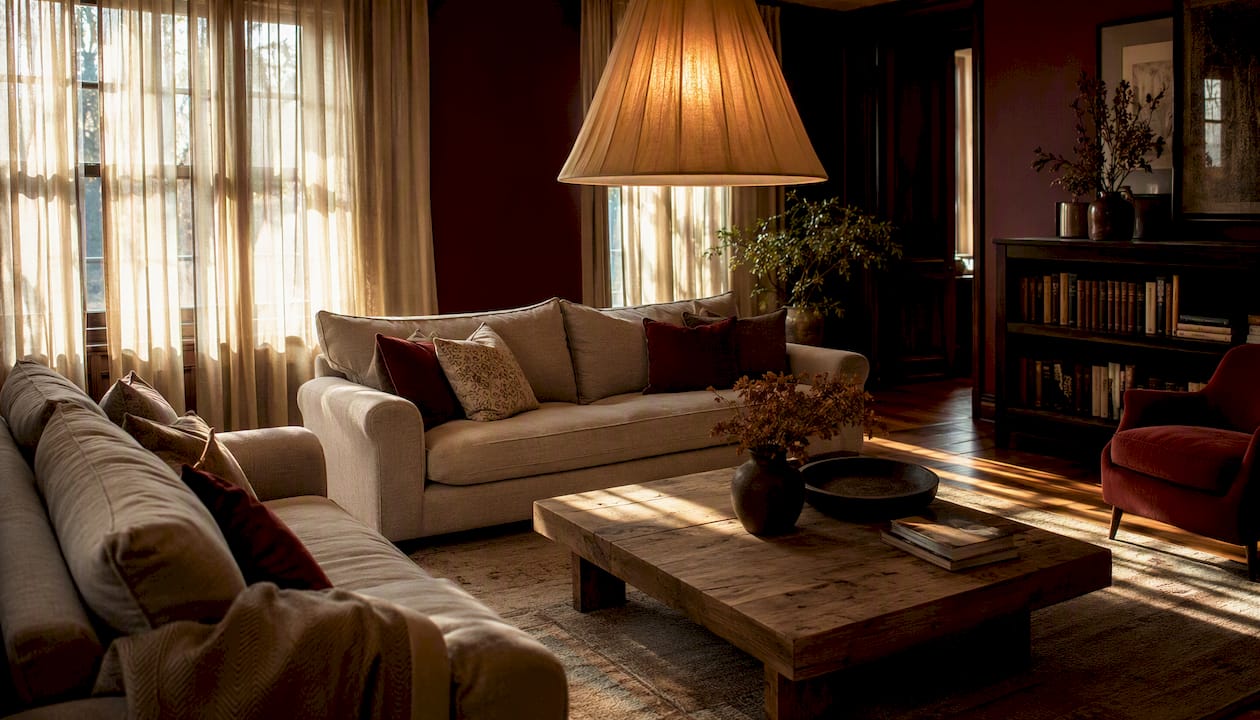
Surface texture amplifies all three effects. A woven rattan pendant has hundreds of small gaps and fiber edges that each catch and redirect light differently. The result is a shadow pattern on the ceiling that shifts subtly as you move through the room. Translucent materials like paper or thin wood veneer add another dimension: light passes through them but slows and diffuses, creating a gradient from bright at the center to warm amber at the edges.
Natural pigments and grain affect color rendering in a way that matters for how your skin, food, and furnishings look under the light. Wood grain and natural fiber tones tend to absorb cooler blue wavelengths slightly more than warm ones, nudging the apparent color temperature of the emitted light toward the 2700K–3000K range even when the bulb itself sits at 3000K.
Pro Tip: Pair a translucent natural-material shade (linen, paper, thin wood veneer) with a dimmable LED at 2700K. Dimming shifts the perceived color temperature warmer still, letting you tune the ambiance from “relaxed afternoon” to “late-evening refuge” without swapping bulbs.
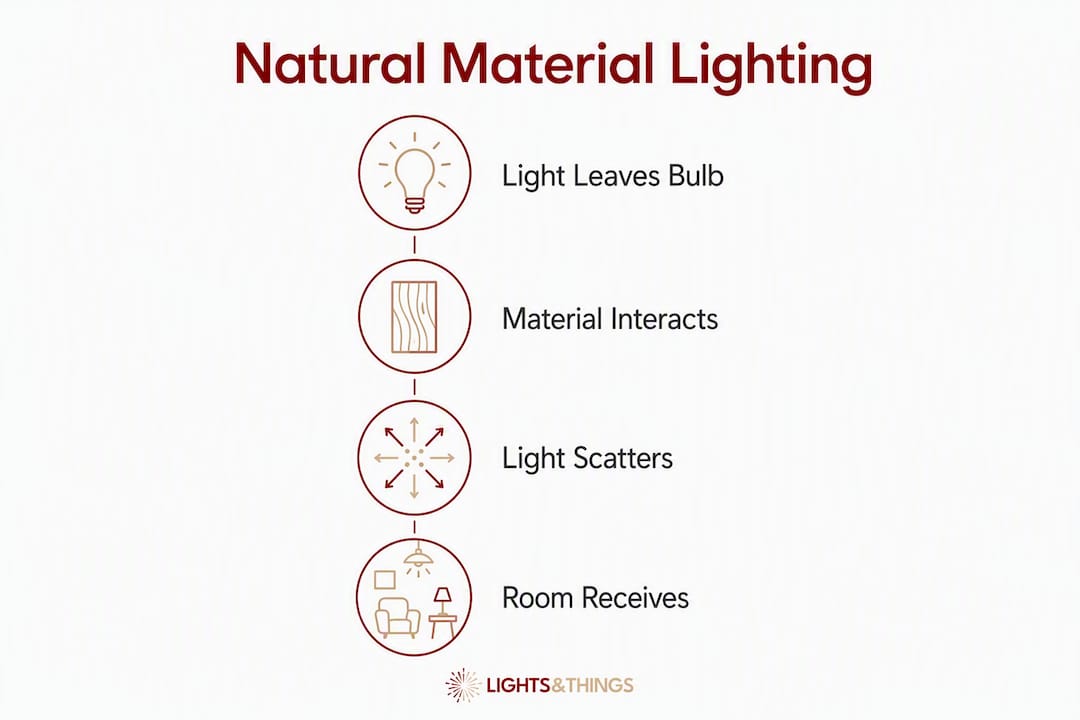
Picture it simply: light leaves the bulb, hits the material, and the material decides what the room gets. A synthetic shade passes most of that light through unchanged. A natural material intercepts it, colors it, scatters it, and hands the room something richer.
What each natural material does to the light it emits
Every material has a signature effect. Knowing those signatures lets you shop with intention rather than guessing from product photos.
| Material | Primary visual effect | Practical notes |
|---|---|---|
| Rattan / woven fiber | Projected shadow patterns; warm, dappled ambient | Best in living rooms and dining areas; avoid high-humidity spaces |
| Linen / cotton fabric | Soft, even diffusion; warm white glow | Versatile for bedrooms and reading nooks; dust regularly |
| Paper (washi, rice paper) | Gentle translucency; cream-to-amber gradient | Fragile; keep away from high-traffic areas and moisture |
| Wood (solid / veneer) | Warm amber transmission or directional reflection | Veneer glows; solid wood directs downward; seal for kitchens |
| Alabaster / natural stone | Uneven warm diffusion; subtle surface gradients | Heavy; confirm ceiling support; avoid damp rooms |
| Capiz / sea shell | Soft shimmer; layered, opalescent glow | Coastal and bohemian styles; handle with care during cleaning |
| Ceramics / clay | Opaque or semi-opaque; focused downlight with warm rim | Durable; wide style range from rustic to modern |
| Natural crystal | Prismatic sparkle; scattered color points | Statement pieces; pairs best with clear, bright sources |
Rattan and open-weave fibers are the most dramatic performers. Open-weave pendants throw patterned shadows across ceilings and walls that designers call “projected nature,” a biophilic effect that makes a room feel alive. Pair them with a dimmer: at full brightness the pattern is bold; dimmed to 40%, it becomes subtle and calming.
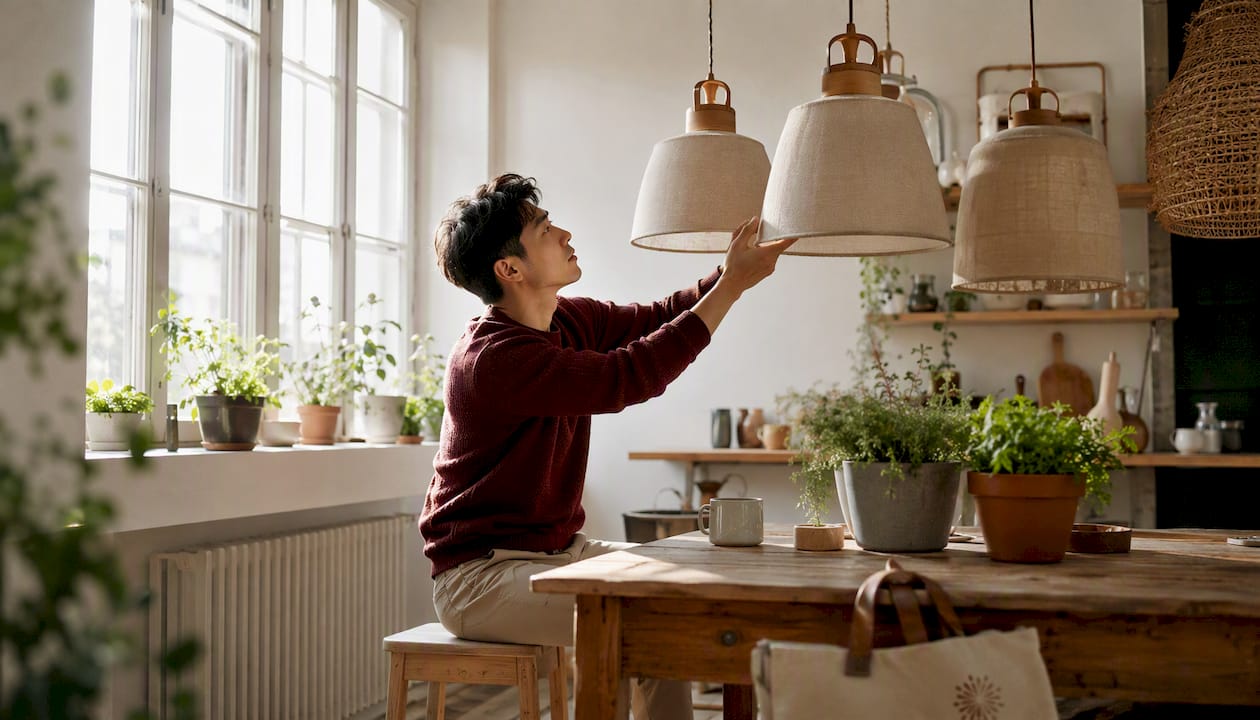
Linen and paper prioritize softness over drama. A linen drum shade over a dining table creates the kind of diffused, flattering light that makes food and faces look their best. Paper shades (washi or rice paper) are the most translucent of the group, producing a lantern-like glow that works beautifully in bedrooms and entryways.
Wood behaves differently depending on thickness. A thin veneer pendant transmits warm amber light through its grain, almost like a stained-glass effect at low wattage. Solid wood blocks most light and directs it downward or outward through cutouts, making it better suited to task-adjacent fixtures like reading sconces.
Alabaster transmits warm, amber-cream tones and produces subtle gradients across its surface because density varies across the stone. That unevenness is the point: no two alabaster fixtures look identical when lit, and the variation is what makes them feel luxurious rather than manufactured.
Capiz shell layers thin, translucent panels to create a soft shimmer that catches and releases light as air moves through a room. It suits coastal and bohemian spaces where a little movement and opalescence read as relaxed rather than fussy.
- For ceramics: look for a semi-opaque glaze if you want a warm rim glow; matte finishes absorb more and produce a softer, more directional output.
- For natural crystal: the prismatic sparkle works best with a clear, higher-lumen source since the material itself does not diffuse — it refracts and scatters color points across the room.
Which design styles use natural-material lighting, and where do they work best?
Natural-material fixtures anchor several of the most popular residential styles right now, and each style uses them slightly differently.
Eco-Scandi pairs raw wood and linen with white walls and minimal clutter. The lighting goal is even, calm ambiance with no harsh shadows. Linen pendants and wood-based table lamps fit perfectly; the material warmth offsets the coolness of white walls.
Japandi (the Japanese-Scandinavian hybrid) favors restraint and craftsmanship. A single ceramic pendant or a washi paper lantern over a low dining table captures the style’s emphasis on intentional simplicity. The fixture is meant to be noticed, not multiplied.
Bohemian and global eclectic styles welcome rattan, capiz, and woven fiber in abundance. Layering two or three pendant heights in a living room corner, mixing rattan with macramé, creates the collected, well-traveled look the style demands.
Coastal interiors lean on capiz shell, driftwood-finish ceramics, and natural linen to echo the textures of the shore. Bathrooms and entryways benefit most here, where a single capiz pendant or a ceramic wall sconce sets the tone without overwhelming a smaller space.
Modern rustic uses wood and stone to add warmth to otherwise contemporary rooms. An alabaster sconce flanking a fireplace or a solid-wood pendant over a kitchen island grounds the space without making it feel dated.
| Material | Best room | Why it works there |
|---|---|---|
| Rattan / woven fiber | Living room, dining room | Shadow patterns add life to larger social spaces |
| Linen / paper | Bedroom, reading nook | Soft diffusion supports relaxation and sleep |
| Wood veneer | Dining room, entryway | Warm amber glow flatters faces and creates welcome |
| Alabaster / stone | Living room, bedroom | Calm gradients suit spaces meant for unwinding |
| Capiz shell | Coastal bathroom, entryway | Shimmer and lightness work in smaller, transitional spaces |
| Ceramics | Kitchen, hallway | Durable and directional; handles humidity better than fiber |
How to pick bulbs, position fixtures, and layer lighting
Getting the bulb and placement right matters as much as the material itself. A cold 6500K lamp in a rattan pendant undermines the intended biophilic effect entirely — the warm shadow pattern the material creates looks gray and flat instead of golden.
Bulb recommendations
Choose a dimmable LED with a color temperature of 2700K–3000K for almost every natural-material fixture. A CRI (Color Rendering Index) of 90 or above ensures that the wood grain, fiber texture, and stone gradients in your fixture read with their full depth and richness. Avoid anything above 3500K in a natural-material context; cooler light strips the warmth the material is designed to add.
Dimming is non-negotiable for open-weave and translucent materials. The shadow patterns rattan and paper create are most beautiful at 30%–60% brightness; full brightness can make them feel busy rather than calming.
Placement rules
- Pendants over dining tables: hang the bottom of the shade 28–34 inches above the tabletop for a standard 8-foot ceiling.
- Wall sconces: center them at 60–66 inches from the floor for general use; lower for bedside reading (48–52 inches).
- Open-weave pendants: position them at least 12 inches from the nearest wall so shadow patterns have room to spread.
- Closed-weave or opaque fixtures: place them closer to the task area since most light exits downward.
Layering recipe
Design guidance for biophilic lighting recommends a formula of three ambient sources, two task sources, and one accent source for a balanced residential scheme. In practice for a living room, that means:
- Three rattan or linen pendants (or a combination) as the ambient anchor.
- Two wood-based or ceramic table lamps for task and reading zones.
- One accent source (a small uplighter or a picture light) to highlight a wall texture or artwork.
Statistic callout: Office workers exposed to optimized daylight and views slept 37 minutes longer and scored 42% higher on cognitive assessments than those behind traditional blinds — a finding that underscores why mimicking natural light quality indoors, through both material choice and warm, dimmable sources, is worth the investment.
Care, durability, and safety for natural-material fixtures
Natural materials are not fragile, but they do have specific needs. Knowing them upfront saves you from a fixture that looks tired after one season.
Cleaning by material:
- Linen and paper: dust with a soft brush or low-suction vacuum attachment monthly. Never use a damp cloth on paper shades; moisture warps the fibers permanently.
- Wood and veneer: wipe with a barely damp microfiber cloth, then dry immediately. A light coat of furniture wax once or twice a year protects the finish.
- Rattan and woven fiber: use a soft brush for dry dust, and a lightly damp cloth for sticky residue. Let it air-dry completely before switching the light back on.
- Alabaster and stone: wipe with a dry or very slightly damp cloth. Avoid acidic cleaners, which etch the surface.
- Capiz shell: dust gently with a soft cloth. The shells are thin and can crack under pressure.
Durability and placement limits:
Humidity is the main enemy of fiber, paper, and wood. Avoid rattan, linen, and paper pendants in bathrooms or above kitchen ranges where steam is regular. Ceramics and sealed stone handle humidity far better. UV exposure fades natural fibers over time; position fiber fixtures away from direct sun if possible.
Wood and rattan can attract insects in some climates. Inspect annually and treat with a cedar-based repellent if you notice any activity.
Safety:
Always check the fixture’s maximum wattage rating and stay below it. Natural materials sit closer to the bulb than many synthetic shades, so heat management matters. LED bulbs run significantly cooler than incandescent equivalents, making them the safer choice for enclosed or semi-enclosed natural-material fixtures. Look for UL- or ETL-listed fixtures, which have been tested for heat clearance and electrical safety.
Pro Tip: Wood and natural textiles are hygroscopic — they absorb and release moisture from the air. This behavior moderates indoor humidity passively, which can make a room feel more comfortable without adjusting the thermostat. It also means these materials “breathe” with your home’s seasons, so minor dimensional changes in wood fixtures are normal, not defects.
What does research say about sustainability and indoor health?
The case for natural materials goes well beyond aesthetics. A growing body of research connects them to measurable improvements in indoor air quality, humidity balance, and psychological wellbeing.
Statistic callout: A study published in Environmental Health Perspectives found that natural-material interiors lowered stress activation and increased perceived safety453) compared to synthetic-dominated spaces, measured through both affective scales and physiological indicators.
Indoor air quality: Untreated or minimally processed wood, stone, and natural textiles emit fewer VOCs than many synthetic laminates and composites. VOC off-gassing from mass-produced synthetic fixtures can accumulate in poorly ventilated rooms; choosing natural materials reduces that risk, particularly in bedrooms where you spend eight or more hours at a time.
Wellbeing and sleep: A systematic review of lighting in the home found positive associations between natural light exposure and improved outcomes across physical health, mental health, and sleep. Mimicking natural light quality indoors — through warm, diffused sources and materials that soften artificial light — supports the same circadian cues.
Sourcing checklist:
- FSC certification on wood fixtures confirms responsible forest management.
- Reclaimed or recycled content labels indicate lower embodied carbon.
- OEKO-TEX Standard 100 on linen and cotton shades confirms the textile is free from harmful substances.
- Red flags: “composite wood” or “engineered fiber” without further specification can indicate binders with high formaldehyde content; ask the retailer for the material data sheet.
Pairing eco-friendly area rugs made from natural fibers with natural-material lighting creates a layered, low-VOC interior that works as a cohesive system rather than isolated choices.
Why designers choose natural-material fixtures, and how LightsThings curates them
Designers reach for natural materials in lighting for reasons that go beyond trend. The core rationale is biophilia: humans are wired to respond positively to organic textures, grain, and irregularity. A fixture made from rattan or alabaster connects a room to the natural world in a way that a smooth, uniform synthetic shade simply cannot replicate.
Material irregularities — grain, density variations, small translucencies — make natural fixtures feel like small sculptures. When lit, those irregularities create gradients and depth that homogeneous synthetic shades cannot achieve. When the light is off, the fixture still reads as a decorative object worth looking at. That dual role (functional light source and daytime sculpture) is what justifies the investment in a quality natural-material piece.
What to look for when shopping:
- Material origin: the product description should name the specific material (e.g., “natural rattan,” “hand-woven abaca”) rather than a generic term like “woven shade.”
- Finish and treatment: sealed wood or treated fiber lasts longer; untreated materials have lower VOC risk but need more care.
- Bulb compatibility: confirm the maximum wattage and whether the fixture is rated for enclosed bulbs (relevant for LED retrofit bulbs).
- Dimmer compatibility: check that the fixture’s wiring supports a standard leading-edge or trailing-edge dimmer.
- Certification: UL or ETL listing for safety; FSC or OEKO-TEX for material sourcing.
LightsThings curates pendants, sconces, and table lamps where the material is the design statement. When browsing, filter by material type and cross-reference the spec sheet for bulb type and maximum wattage before adding to cart. The decorative lighting buying guide on the LightsThings blog walks through room-by-room sizing and placement in more detail.
How natural materials affect indoor air quality and health
The connection between natural materials and indoor air quality is direct. Synthetic materials, particularly those made with adhesives, laminates, or plastic coatings, can off-gas VOCs including formaldehyde and benzene into the air over time. Natural materials like solid wood, stone, linen, and rattan do not carry those same chemical loads when minimally processed.
In a bedroom, where a fixture runs for several hours each evening and the room is often closed overnight, this distinction matters. Choosing a linen or wood-based fixture over a plastic-coated alternative reduces the cumulative VOC load in the space. Research on bio-based building materials confirms that material selection has a measurable effect on indoor environment quality, including air quality, thermal comfort, and acoustic performance.
Beyond chemistry, the psychological effect of natural materials on perceived air quality and comfort is real. Interiors that incorporate organic textures and warm, diffused light are consistently rated as more comfortable and less stressful than their synthetic counterparts, even when measured air quality is identical. The perception of naturalness itself contributes to wellbeing.
How natural materials shape thermal comfort and acoustics
Lighting fixtures are not the first thing most people think of when considering room acoustics or thermal comfort. They should be.
Thermal comfort: Natural materials like wood and stone have lower thermal conductivity than metals and most plastics. A wood-based pendant or a ceramic table lamp does not radiate heat into the room the way a metal shade does, keeping the immediate environment around the fixture more comfortable. The hygroscopic behavior of wood and natural textiles also plays a role: by absorbing and releasing moisture, these materials help stabilize the humidity level in a room, which directly affects perceived thermal comfort. A room at 68°F with balanced humidity feels warmer and more comfortable than the same temperature in a dry, synthetic-heavy space.
Acoustics: Fibrous materials absorb sound. A cluster of rattan pendants or a set of linen shades in a dining room does not replace acoustic panels, but it does contribute to the room’s overall sound absorption. Hard, smooth surfaces (glass, polished metal, plastic) reflect sound and increase reverberation; natural fiber and fabric surfaces absorb it. In open-plan spaces where echo is a persistent problem, adding natural-material fixtures is a low-effort way to soften the acoustic environment alongside other natural-fiber furnishings.
The combination of thermal moderation and acoustic softening is part of why rooms with natural-material lighting consistently feel more comfortable than their specifications alone would predict. The materials are doing quiet work that goes unnoticed until you remove them.
Key Takeaways
Natural materials raise light quality by scattering, coloring, and texturing illumination in ways no uniform synthetic shade can replicate, making them the most effective single upgrade for residential ambiance.
| Point | Details |
|---|---|
| Start with one ambient natural fixture | A rattan or linen pendant with a dimmer is the highest-impact first step for any room. |
| Match bulb to material | Use a 2700K–3000K dimmable LED with CRI 90+ to preserve the material’s warmth and texture. |
| Layer three ambient, two task, one accent | This biophilic layering formula creates depth and function without overloading the space. |
| Check certifications before buying | FSC wood, OEKO-TEX textiles, and UL/ETL-listed fixtures confirm quality and safety. |
| Browse LightsThings for curated options | LightsThings offers natural-material pendants, sconces, and table lamps with full spec sheets and bulb compatibility notes. |
The case for natural-material lighting is stronger than most people realize
Most conversations about natural-material lighting stop at aesthetics: it looks warm, it feels organic, it photographs well. That framing undersells what is actually happening. The material science, the psychophysiology, the acoustic and thermal effects — these are not decorating bonuses. They are the reason a room with a rattan pendant and a linen table lamp feels genuinely different to be in, not just different to look at.
What I find most underestimated is the dual-role value. A well-chosen natural-material fixture works as a sculptural object during the day and as a light-shaping tool at night. That means you are not just buying illumination; you are buying a piece of decor that earns its place around the clock. Synthetic fixtures rarely achieve that. They disappear when the light is off.
The practical implication for shoppers is this: invest in one quality natural-material ambient fixture before you buy three mediocre ones. A single rattan pendant with a good dimmer and the right bulb will do more for a room’s atmosphere than a collection of undifferentiated shades. Start there, then layer.
Find your natural-material fixture at LightsThings
LightsThings brings together decorative lighting where the material is the design statement, not an afterthought. The decorative lighting collection includes pendants, chandeliers, and ceiling fixtures across rattan, ceramic, and stone-inspired finishes, each listed with full bulb compatibility specs so you can match the right LED before it arrives. For task and accent layers, the floor and table lamp collection covers wood-based and fabric-shaded options that pair cleanly with a natural-material ambient anchor. Free shipping thresholds, easy returns, and price matching mean you can shop with confidence, not guesswork. Browse by material, check the spec sheet, and build your layered scheme from there.
Useful sources and further reading
The sources below informed this article and are worth bookmarking if you want to go deeper on any specific topic.
- Lighting in the Home and Health: A Systematic Review (PMC) — A comprehensive review of evidence linking home lighting to physical health, mental health, and sleep outcomes.
- The Impact of Optimized Daylight and Views on Sleep Duration and Cognitive Performance (PMC) — The office study behind the 37-minute sleep improvement and 42% cognitive assessment finding; directly applicable to residential daylighting strategy.
- A Literature Review of the Effects of Natural Light on Building Occupants (NREL) — A foundational technical review of how natural light affects occupant wellbeing, productivity, and comfort.
- Materiality and Mind: Psychological Effects of Natural vs. Synthetic Building Materials — Mixed-method research measuring stress and perceived safety in natural vs. synthetic interiors.
- The Potential Impacts of Using Bio-Based Building Materials on Human Health and Wellbeing — Covers how material selection affects indoor environment quality across air, thermal, acoustic, and visual dimensions.
- How Lighting Defines Interior Style: A 2026 Guide (LightsThings) — LightsThings’s own guide to matching lighting choices with interior style, useful for translating material decisions into room-wide design.