A luxury bedroom look comes down to three things: a correctly scaled statement fixture, lighting layered at multiple heights, and warm dimmable sources around 2700K with a CRI above 90. Get those three right and the room reads as intentional, not assembled. Everything else, including finish choices and control systems, builds on that foundation.
Here are the three quickest levers to start with:
- Statement fixture — one overhead piece that anchors the bed and sets the material tone
- Layered sources at multiple heights — ceiling, wall, and floor level working together
- High-CRI warm LEDs on dimmers — the technical backbone that makes every surface look its best
| Quick Action | Effort | Cost Tier |
|---|---|---|
| Swap bulbs to warm dimmable high-CRI LEDs suitable for cozy bedrooms | Low | Low |
| Add bedside pendants or sconces on a separate dimmer | Medium | Medium |
| Install a statement chandelier scaled to room dimensions | Medium | High |
Table of Contents
- 12 Luxury Bedroom Lighting Design Examples You Can Copy
- How to layer ambient, task, and accent lighting for depth and mood
- Scale and placement rules for luxury fixtures
- Materials, finishes, and bulb specs that read as luxury
- Curated LightsThings picks that match these examples
- How to keep luxury lighting efficient without losing the look
- Maintenance tips to keep your fixtures looking pristine
- How to match your lighting to your bedroom’s style
- Combining natural light with artificial lighting for the best result
- Key Takeaways
- The case for restraint in luxury bedroom lighting
- LightsThings makes it faster to find the right fixture
- Sources and further reading
12 Luxury Bedroom Lighting Design Examples You Can Copy
These examples are drawn from designer-approved projects and translate directly into U.S. bedrooms. Each one notes the look, why it reads as luxury, the key technical spec, and where to source a similar piece.
-
Sculptural chandelier centered over the bed. A tiered brass or aged-iron chandelier hung directly above the mattress, not the geometric center of the room, creates an immediate focal point. Designers treat statement fixtures as the jewelry of a room: one well-chosen piece anchors the composition and allows every other layer to stay quiet. Spec: 2700K warm white, dimmable driver, a minimum scaled diameter suitable for a queen bed. Shop LightsThings’s ceiling lighting collection for tiered and sculptural options.
-
Pendant clusters replacing bedside table lamps. Suspending two pendants from the ceiling on either side of the bed frees the nightstand surface and pulls the eye upward. Bedside pendants create a cleaner, more resolved bedside condition than table lamps sitting on a crowded surface. Hang them so the bottom of the shade sits comfortably above the mattress top, at a height optimal for reading without glare.
-
Integrated perimeter LED reveal at the ceiling. A concealed LED strip housed in an aluminum channel inside a tray or cove ceiling traces the room’s perimeter with a thin ribbon of warm light. Hidden indirect illumination defines architectural shapes and preserves rich atmosphere after dark instead of producing a flat, bright room. Use CRI ≥ 90 strips for accurate color rendering on plaster and fabric.
-
Headboard backlighting. An LED strip recessed behind or below the headboard casts a warm halo that separates the bed from the wall and adds depth without any visible fixture. This works especially well with upholstered headboards in linen or velvet, where the light grazes the texture and makes the material come alive. Keep the strip on its own dimmer circuit so you can dial it back to near-off for sleep.
-
Venetian plaster ceiling with concealed perimeter LED. Pairing a three-pass Venetian plaster ceiling with a concealed perimeter LED lets the ceiling participate as a design surface. The light rakes across the plaster texture, creating movement and depth that a standard painted ceiling simply cannot match. The fixture disappears; the surface becomes the feature.
-
Commissioned wall sconces flanking the headboard. Hardwired sconces at 60–65 inches from the floor on either side of the bed provide task light for reading and accent light for the wall finish. Choosing sconces with a shared patina or material language as the chandelier, even if the forms differ, creates cohesion without forcing a matched set.
-
Floor lamp reading corner. A tall arc or column floor lamp positioned beside an upholstered chair in the corner of the room adds a third height of light and defines a secondary zone within the suite. A sculptural matte black floor lamp or a slender brass column both work; the key is choosing a shade material that diffuses rather than directs. See LightsThings’s guide to modern floor lamps for scale and finish guidance.
-
Linen-shade table lamps on matching nightstands. A pair of ceramic or stone-base table lamps with natural linen shades produces a warm, diffused glow that flatters both skin tones and bedding. The shade material does as much work as the bulb: linen filters light softly, while a tight drum shade in a dark fabric creates a moodier, more directional pool.
-
Recessed downlights on a dimmer grid. A grid of recessed 2700K, CRI ≥ 90 downlights provides the ambient base layer without any visible fixture. The trick is to keep them on a separate dimmer from accent and task sources so you can drop the ambient layer to near-zero in the evening while sconces and bedside lights carry the mood.
-
Glass pendant cluster above a seating area. In a larger primary suite with a seating corner, a cluster of clear or smoked glass pendants hung above a round table or ottoman creates a second lighting moment. The transparent shades feel visually light even when grouped, and they catch and refract warm light in a way that opaque shades cannot.
-
Slim wall lights tracing the room’s perimeter. Thin, low-profile wall lights placed at intervals along the side walls draw a horizontal line of light that makes the room feel wider and more measured. This approach works particularly well in rooms with dark paneling or deep-toned wallcoverings, where the light separates the wall plane from the floor.
-
Layered recessed plus cove lighting for a spa-like suite. Combining a shallow cove detail at the ceiling perimeter with a central recessed grid and bedside sconces creates three independent dimmer zones. Set the cove to 20–30% in the evening, the recessed grid to off, and the sconces to 50–60% for a genuinely spa-like atmosphere. This is the most technically involved setup, but it produces the most flexible and luxurious result.
Pro Tip: When photographing or staging your bedroom lighting, turn off the overhead ambient layer entirely and shoot with only the accent and task sources on. This is how designers capture the mood of a room, and it also shows you exactly how well your layering is working.
How to layer ambient, task, and accent lighting for depth and mood
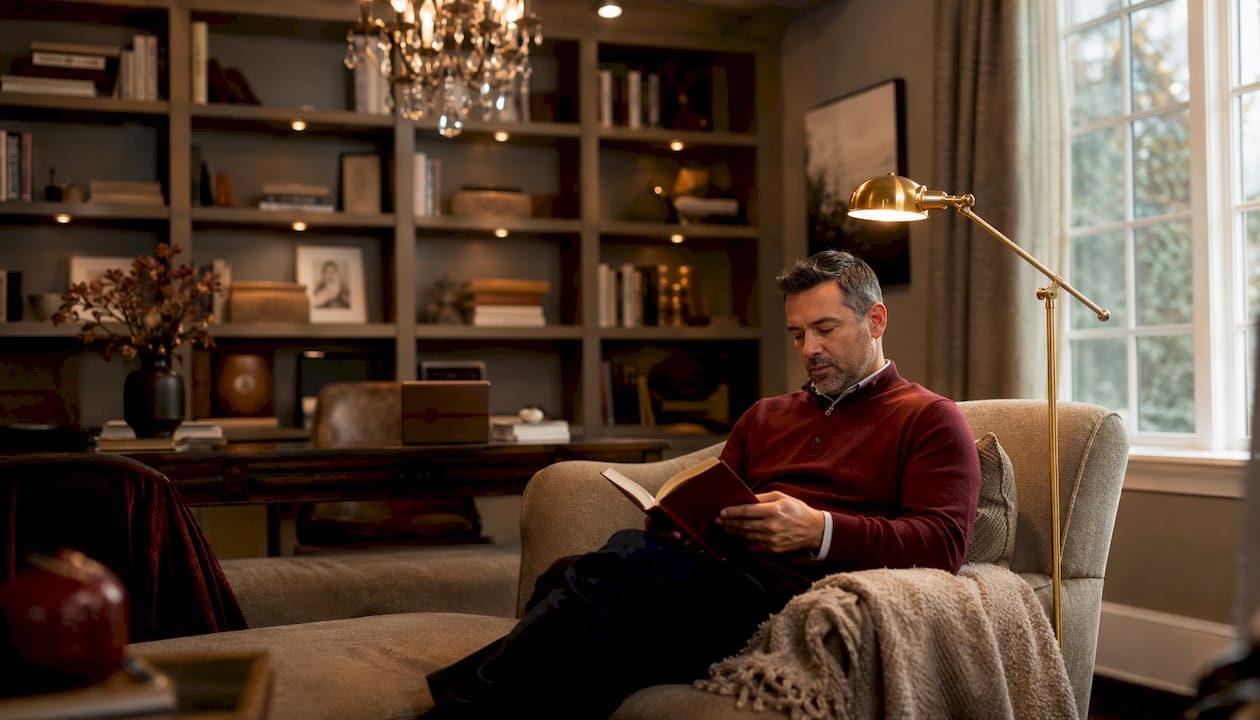
Layering is the single biggest design lever after fixture selection. A room with one overhead source, no matter how beautiful the fixture, reads as flat. A room with multiple independent lighting layers reads as designed.
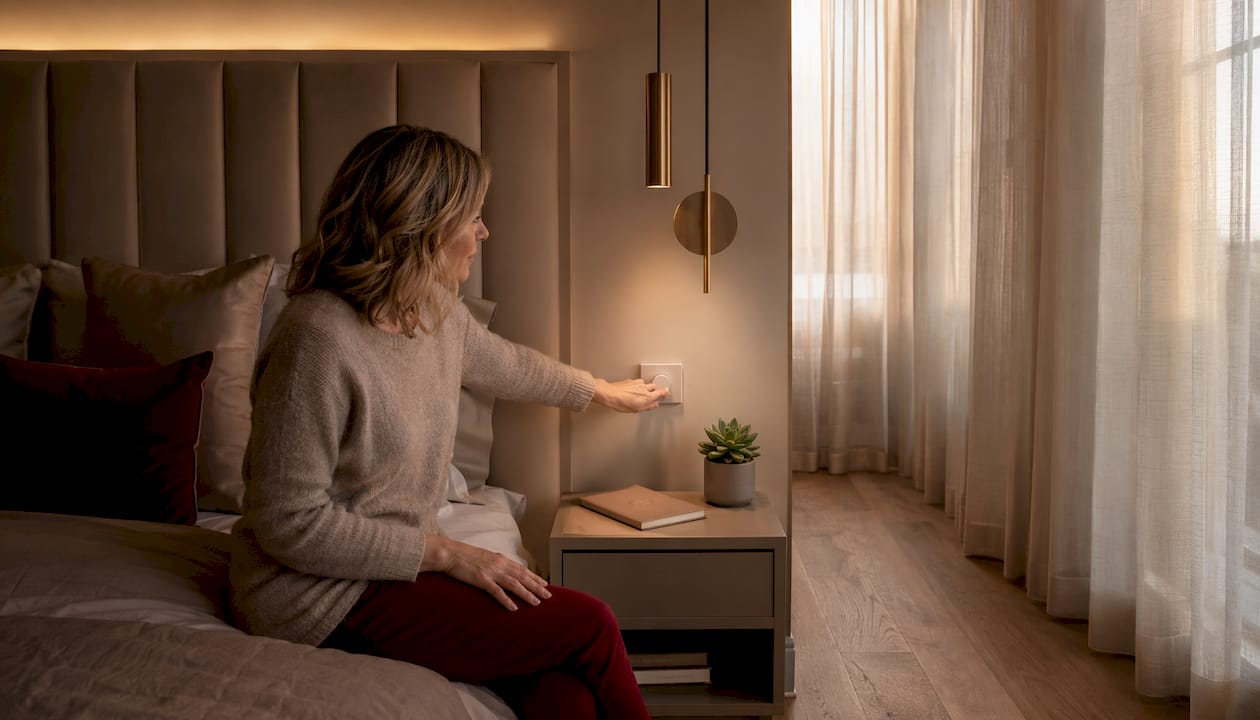
Ambient light is the base: recessed downlights, a central ceiling fixture, or a cove LED strip that fills the room with even, low-glare illumination. In a bedroom, keep this layer dimmable and set it at a comfortable moderate level in the evening. Task light is directional: bedside sconces, adjustable pendants, or a reading floor lamp that puts focused light where you need it without flooding the whole room. Accent light is the mood layer: headboard backlighting, perimeter LED strips, and any source that grazes a textured surface or defines an architectural detail.
The control strategy matters as much as the fixtures. Wire each layer to its own dimmer, or use a scene-capable smart control system such as Lutron Caseta or a Leviton Decora Smart dimmer. A single bedside scene controller that dims the ambient layer to zero and brings the accent layer to 20% takes about 30 seconds to install and transforms the evening experience. Accent layers are typically set below ambient levels to produce contrast without losing detail.
For ergonomics, place at least one dimmer switch within arm’s reach of the bed. A dual-gang plate at the bedside, or a wireless scene remote on the nightstand, means you never have to get up to adjust the room. Placing light at multiple heights creates a rhythm of illumination that avoids harsh glare and makes the room feel considered from every angle.
Pro Tip: Think of your bedroom lighting in three horizontal bands: ceiling level (ambient), mid-wall level (sconces and pendants), and floor/table level (lamps). If any band is missing, the room will feel incomplete regardless of how good the individual fixtures are.
Scale and placement rules for luxury fixtures
Getting the scale right is what separates a fixture that looks intentional from one that looks like an afterthought. These rules apply directly to U.S. bedroom sizes.
Chandelier diameter rule: Add the room’s length and width in feet, then convert that number to inches. That figure is your target chandelier diameter.
- 10 × 12 ft room: 10 + 12 = 22 → target diameter ≈ 22 inches
- 12 × 14 ft room: 12 + 14 = 26 → target diameter ≈ 26 inches
- 14 × 16 ft room: 14 + 16 = 30 → target diameter ≈ 30 inches
Pendant drop for standard ceilings (8–9 ft): The bottom of the fixture should hang at a height that remains safely above head level when centered over the bed. For a 9 ft ceiling, a drop of about two feet may work well. For vaulted or tray ceilings (10–12 ft), you can extend the drop by a few feet for drama, but keep the bottom of the fixture above the top of the headboard.
Bedside pendant height: Hang the bottom of the shade 12–15 inches above the top of the mattress. For a typical mattress height, that puts the shade bottom at a comfortable reading level from the floor, which is comfortable for reading without shining directly into your eyes.
Platform beds and tall headboards: A platform bed sits lower, so drop bedside pendants slightly to maintain the 12–15 inch clearance. With a tall headboard, shift to hardwired sconces mounted at a height comfortable for reading without visual competition from the headboard rather than pendants, which can visually compete with the headboard’s height. For a ceiling fixture sizing guide, LightsThings covers the calculations in more detail.
Dual bedside layouts: Two pendants flanking the bed almost always read better than one central fixture at the bedside level, because they frame the headboard symmetrically. Reserve a single central fixture for the overhead position.
Materials, finishes, and bulb specs that read as luxury
Tactile shades and warm finishes carry as much visual weight as the fixture’s form. A beautifully shaped chandelier with a cheap white plastic diffuser reads as budget; the same form with a hand-stitched linen shade or a stone diffuser reads as considered. The materials that consistently signal luxury in U.S. bedroom projects include natural linen, parchment, aged brass, brushed bronze, unlacquered brass (which patinas over time), and hand-blown glass.
For bulb specs, the two numbers that matter most are color temperature and CRI. Designers recommend approximately 2700K for bedroom lighting: warm enough to flatter skin tones and textiles without the orange cast of older incandescent bulbs. CRI above 90 means colors render accurately, so your bedding, wall finish, and wood tones look the way they should rather than washed out. Both specs apply to every source in the room, including LED strips.
| Bulb Type | Kelvin | CRI | Dimmer Compatible | Best Use |
|---|---|---|---|---|
| LED bulb | 2700K | ≥90 | Yes (leading-edge) | Table lamps, sconces |
| GU10 LED | 2700K | ≥90 | Yes (trailing-edge) | Recessed downlights |
| Integrated LED module | 2700K | ≥90 | Driver-dependent | Pendants, chandeliers |
| LED strip (aluminum channel) | 2700K | ≥90 | Yes (PWM dimmer) | Cove, headboard, perimeter |
For LED strips specifically, house them in aluminum extrusion channels with frosted diffusers to eliminate visible diodes and produce an even line of light. Run them on a PWM-compatible dimmer or a tunable driver for future flexibility. Choose fixtures with replaceable LED modules or accessible drivers: in a premium bedroom, you want to be able to service the light source without replacing the entire fixture.
Energy efficiency and aesthetics are not in conflict here. A high-CRI 2700K LED uses a fraction of the energy of the incandescent it replaces and lasts far longer, provided it has proper thermal housing. Avoid cheap LED drivers that flicker at low dim levels; specify drivers rated for smooth dimming down to 1–5% for the best atmosphere control.
Pro Tip: Before committing to a finish, request a physical sample and hold it under your bedroom’s actual light source at night. Aged brass reads very differently under 2700K versus 3000K, and a finish that looks perfect in a showroom can read orange or flat in your specific room.
Curated LightsThings picks that match these examples
LightsThings focuses on decorative, style-driven lighting for residential spaces, which makes it a practical starting point for sourcing the looks described above. The catalog spans statement chandeliers and pendants through to linen-shade table lamps and floor lamps, with a premium tier of pieces priced well above $1,000 for readers who want a true investment fixture.
- Statement chandeliers: Look for tiered or sculptural forms in aged brass or brushed bronze. Check the listed diameter against the room-size formula above before ordering. LightsThings’s ceiling lighting collection is the right starting point.
- Bedside pendants: Prioritize adjustable cord length and a shade material (linen, parchment, or hand-blown glass) that diffuses at 2700K. Confirm dimmer compatibility in the product specs.
- Linen-shade table lamps: A ceramic or stone base with a natural linen drum shade is the most versatile bedside lamp for a luxury bedroom. Check the shade diameter against your nightstand width; the shade should not overhang the table edge.
- Floor lamps for reading corners: A slender brass column or arc lamp with a linen shade works in most luxury bedroom styles. See LightsThings’s bedroom lamp styles guide for ranked options by style.
- High-CRI LED strips: Confirm CRI ≥ 90 and 2700K in the product listing. Purchase aluminum channel and frosted diffuser separately if not included.
- Premium statement pieces: For readers ready to invest in a fixture that anchors the room for years, LightsThings’s $550-and-up exclusive collection covers the higher-ticket end of the catalog.
When reviewing any product page, check four things: overall dimensions (width, height, and canopy size), driver or bulb access for future servicing, dimmer compatibility notes, and lead time if the piece is made to order.
How to keep luxury lighting efficient without losing the look
LED technology has made energy efficiency a non-issue for luxury lighting, provided you specify correctly. A well-chosen 2700K, CRI ≥ 90 LED uses 75–80% less energy than an equivalent incandescent and produces the same warm, flattering light. The aesthetic cost is zero when the driver and dimmer are matched properly.
The practical steps are straightforward. Replace any remaining incandescent or halogen sources with dimmable LED equivalents rated at 2700K and CRI ≥ 90. For recessed downlights, use IC-rated LED modules with proper thermal housing so heat dissipates correctly and the driver lasts. For LED strip installations, choose strips with a high lumen-per-watt rating and house them in aluminum channels, which act as heat sinks and extend strip life significantly.
Smart dimming adds another layer of efficiency. A Lutron Caseta or similar scene-control system lets you set maximum brightness levels per scene, which means the ambient layer rarely runs at 100% in a bedroom context. Running fixtures at 60–70% of maximum not only saves energy but also extends LED driver life and produces a more flattering light level for the space.
Maintenance tips to keep your fixtures looking pristine
Luxury fixtures stay looking their best with a consistent, light-touch routine rather than occasional deep cleaning. Dust is the primary enemy: it settles on shades, diffusers, and metal arms and dulls the finish over time.
For fabric shades (linen, parchment, silk), use a soft brush attachment on a low-suction vacuum every two to three weeks. Never use water or liquid cleaners on natural fabric shades; moisture causes warping and staining. For glass diffusers and pendants, a microfiber cloth slightly dampened with distilled water removes fingerprints and dust without streaking. Dry immediately with a second clean cloth.
Metal finishes require the most care. Unlacquered brass and aged bronze develop a patina naturally, which is part of their appeal. Wipe them with a dry microfiber cloth to remove dust. If you want to slow the patina, apply a thin coat of Renaissance Wax once or twice a year. Avoid abrasive cleaners on any warm metal finish; they remove the surface treatment and cannot be reversed. For LED strip installations, check the aluminum channel and diffuser for dust buildup every six months, as accumulated dust reduces light output and can affect thermal performance.
How to match your lighting to your bedroom’s style
The fixture categories above work across styles, but the specific forms, finishes, and materials shift depending on the room’s design language.
Modern luxury: Clean geometry, matte black or brushed nickel finishes, integrated LED modules, and minimal ornamentation. A geometric chandelier with strong lines, paired with slim hardwired sconces and recessed downlights, fits this register precisely. Avoid ornate shades; prefer drum or cylinder forms in linen or frosted glass.
Classic and traditional: Tiered crystal or glass chandeliers, antique brass or polished nickel finishes, pleated fabric shades, and symmetrical sconce placement. The key is proportion: a traditional chandelier needs enough visual weight to hold its own against crown molding and paneled walls.
Art Deco: Geometric forms with warm gold or champagne finishes, smoked or amber glass shades, and strong vertical lines. Sconces with fan or sunburst shapes and pendants with faceted glass work well. Keep the palette tight: two metals maximum, and let the fixture forms carry the decorative load.
Organic and transitional: Natural materials take the lead here. Linen, rattan, hand-blown glass, and unlacquered brass all fit. Forms can be more relaxed and asymmetric. A sculptural ceramic table lamp base, a woven pendant, and a simple arc floor lamp in aged brass create a cohesive organic-luxury palette without feeling precious.
Across all styles, the rule from the BLUF holds: one statement fixture, layered sources, and warm dimmable LEDs. The style lives in the material and form choices, not in a different technical approach.
Combining natural light with artificial lighting for the best result
Natural light and artificial light work best when they are treated as partners, not competitors. The goal is a room that reads beautifully at every hour, from morning sun through late evening.
During the day, sheer linen or silk curtain panels filter direct sunlight into a soft, diffused glow that flatters the same surfaces your 2700K LEDs will illuminate at night. Layered curtains, a sheer panel plus a heavier drape, give you independent control over daylight and privacy without sacrificing either. The vertical height of floor-to-ceiling curtains also pulls the eye upward and makes the room feel taller, which is the same visual effect a well-hung chandelier achieves.
At dusk, the transition matters. Rather than switching from full daylight to full artificial light, bring the accent and task layers on first at low levels while there is still ambient daylight. This gradual transition prevents the jarring shift that makes a room feel suddenly artificial. By the time the room is fully dark outside, your layered lighting scheme is already set and the room feels continuous, not switched.
Mirrors placed opposite windows double the daylight during the day and reflect the warm glow of sconces and pendants at night. A large framed mirror or a mirrored wardrobe panel on the wall opposite the primary window is one of the most cost-effective ways to amplify both natural and artificial light simultaneously.
Key Takeaways
A luxury bedroom lighting scheme requires one correctly scaled statement fixture, three independent dimmer zones, and warm 2700K, CRI ≥ 90 LEDs at every source.
| Point | Details |
|---|---|
| Start with a statement fixture | Use the room-size formula (length + width in feet = diameter in inches) to scale correctly. |
| Layer three independent zones | Ambient, task, and accent on separate dimmers; set accent below ambient for contrast. |
| Specify 2700K, CRI ≥ 90 throughout | Applies to GU10s, integrated modules, and LED strips for consistent warm rendering. |
| Match materials across layers | A shared patina or finish language across fixtures creates cohesion without identical pieces. |
| LightsThings for curated picks | The ceiling lighting and $550-and-up collections cover statement chandeliers through premium bedside pieces. |
The case for restraint in luxury bedroom lighting
Most bedroom lighting mistakes come from adding too much, not too little. A room with five different fixture styles, mismatched finishes, and no dimming control does not read as layered; it reads as busy. The projects that consistently photograph well and feel genuinely luxurious share one quality: every fixture earns its place, and the ones that do not are edited out.
The most underused strategy in residential bedroom lighting is specifying a shared material language across layers rather than buying a matched set. A brushed bronze chandelier, a pair of aged brass sconces, and a linen-shade table lamp with a bronze base do not match, but they speak the same warm-metal language. That coherence reads as intentional and curated in a way that a perfectly matched three-piece set rarely does. Commissioned or custom-finish fixtures take this further: specifying the same patina photographically across multiple fixture types creates visual cohesion that off-the-shelf matching cannot replicate.
The other thing most guides underemphasize is the ceiling as a design surface. A plain white ceiling with a chandelier hung from it is a missed opportunity. A tray ceiling, a Venetian plaster finish, or even a simple painted detail gives the perimeter LED or the chandelier something to work with, and the room gains a dimension that no amount of additional fixtures can substitute for. Start there, then add fixtures. The homeowner’s guide to luxury lighting design at LightsThings covers this principle in depth if you want to go further.
LightsThings makes it faster to find the right fixture
Sourcing the looks described in this article one fixture at a time across multiple retailers is time-consuming. LightsThings curates decorative, style-driven lighting specifically for residential spaces, which means the catalog is already filtered for the aesthetic quality and finish standards a luxury bedroom requires.
For statement chandeliers and ceiling fixtures, start with the ceiling lighting collection, where you can filter by finish and style. For premium investment pieces, the $550-and-up exclusive collection covers the higher end of the catalog, including pieces with the material quality and scale that anchor a primary suite. On each product page, check the listed dimensions against the room-size formula above, confirm dimmer compatibility, and note the lead time for made-to-order pieces. LightsThings also offers price matching and financing, so a statement fixture that fits the room properly does not have to wait. Browse the full decorative lighting range to find bedside pendants, sconces, and table lamps that complete the layered scheme.
Sources and further reading
- Architectural Digest: 27 Bedroom Lighting Ideas — Designer-curated image gallery with commentary on fixture selection, scale, and layering; the primary source for the statement-fixture-as-jewelry framing and bedside pendant guidance used throughout this article.
- Ariid: Venetian Plaster Kirkland Master Suite — Bespoke project case study covering Venetian plaster ceiling integration, concealed perimeter LED, and custom-finish coherence across fixture layers.
- Amitis Design: Luxury Master Bedroom Dubai — High-end project documentation emphasizing hidden indirect illumination, editing for visual weight, and concealed LED as an architectural tool.
- Jamesmodern: Luxury Bedroom Lighting Guide — Spec-driven guide covering CRI requirements, aluminum channel installation for LED strips, dimming ratios, and driver selection for luxury residential projects.
- LUXE Interiors + Design: Bedroom Lighting Ideas — Designer project gallery featuring sculptural floor lamps, pendant clusters, and chandelier selections from named U.S. interior designers.
- LightsThings: What Is Luxury Lighting Design? — LightsThings’s foundational homeowner guide on luxury lighting principles, purchasing cues, and design language; the recommended next read for deeper coverage of the concepts introduced here.