The most useful lamp shade shapes to know are drum, empire, coolie, bell, globe, bowl, cylinder, cone, square, oval, and tulip, and each one throws light differently. The shape you pick decides whether light spreads softly around a room or beams down onto a book. Get the shape right for the job, then size it using the lampshade rule, and the fixture will look balanced and function the way you need it to.
TL;DR:
- Most shades should be 2 to 3 inches wider than the base’s widest point for proper proportion and visual balance.
- Flared and tapered shapes like empire and coolie direct light downward for task or accent lighting.
- Rounded or closed profiles like globes and bowls disperse light in all directions, ideal for filling larger spaces with ambient light.
- Material choices, such as translucent fabrics or opaque glass, significantly affect light softness, glare, and color warmth.
- Shopping by shape within a dedicated lighting retailer simplifies selecting the best design and size for your room.
Table of Contents
- What Are the Different Lamp Shade Shapes?
- How Shade Shape Changes the Direction and Quality of Light
- The Lampshade Rule: Sizing and Proportion That Actually Work
- Materials and Finishes That Change Brightness and Glare
- Matching Shade Shape to Lamp Bases and Rooms
- Why You Can Trust This Guide
- A Designer’s Note on Shade Trends
- Ready to Shop by Shape? Here’s Where to Start
- Sources
- FAQ
What Are the Different Lamp Shade Shapes?
Once you start looking, you’ll notice these shapes everywhere, but knowing what each one actually does for your light changes how you shop. Below is a practical rundown of the most common lamp shade types and where each one earns its keep.
- Drum: Straight sides, equal top and bottom width. Casts light both up and down for even, ambient glow. Works on nearly any table or floor lamp in a living room or bedroom.
- Empire: Narrower at the top, wider at the bottom, tapered sides. Directs more light downward, which makes it a strong pick for reading lamps and desks.
- Coolie: A shallow, wide, cone-like shade, more exaggerated than empire. Concentrates light downward with a graphic, mid-century look, common on pendants and accent lamps.
- Bell: Curved sides that flare gently outward, like an upside-down bell. Produces a soft, diffused glow, well suited to bedside and vanity lamps.
- Globe: A fully rounded, enclosed sphere. Scatters light in every direction, which makes it popular for pendants over kitchen islands and entryways.
- Bowl/dome: An inverted dome that opens downward. Sends most of its light down and slightly outward, often seen on ceiling fixtures and torchieres.
- Cylinder: Similar to drum but usually taller and narrower. Delivers focused, columnar light, good for narrow console lamps.
- Cone: A tighter, steeper taper than empire. Pushes light sharply downward, useful for task lighting in home offices.
- Square/rectangular: Flat panels instead of a curved profile. Reads as modern and architectural, and pairs well with square or geometric bases.
- Oval: An elongated take on the drum, wider than it is deep. Fits nicely on console tables and narrow surfaces where a round shade would feel too bulky.
- Tulip: Curves inward at the top like a flower bud. Creates a soft, romantic glow and works well in traditional or transitional bedrooms.
| Shape | Light behavior | Best for |
|---|---|---|
| Drum | Even, up and down | Living room table lamps, bedroom |
| Empire | Downward, focused | Reading lamps, desks |
| Coolie | Strong downward | Pendants, accent lamps |
| Bell | Soft, diffused | Bedside, vanity |
| Globe | Omnidirectional | Kitchen island pendants, entryways |
| Bowl/dome | Downward and outward | Ceiling fixtures, torchieres |
| Cylinder | Focused, columnar | Console lamps |
| Square/rectangular | Directional, architectural | Modern offices, geometric bases |
Visual glossaries group these twelve silhouettes by profile family, which is the fastest way to predict how a shade will behave before you ever plug in the lamp.
How Shade Shape Changes the Direction and Quality of Light
Shape matters less than profile family once you understand what’s actually happening to the light and interior finishes. Lamp shades generally fall into four profile families, and each one predicts light throw more reliably than the shape’s name alone.
- Straight-sided (drum, cylinder): light escapes evenly at the top and bottom, giving you balanced ambient light with minimal glare.
- Flared or tapered (empire, coolie, cone): light concentrates and travels downward, which is why these shapes are common choices for task lamps meant for reading or desk work.
- Curved (bell, tulip): the gentle curve softens and diffuses light, reducing harsh contrast, ideal for a bedside lamp you don’t want blasting you awake.
- Rounded/closed (globe, bowl): light disperses in nearly every direction, which suits a pendant meant to fill a whole kitchen island with glow.
A reading lamp needs a flared or tapered shade aimed down at the page. A pendant over an island wants a globe or bowl shape spreading light wide. A nightstand lamp does best with a curved shade that won’t glare into your eyes at midnight.
The Lampshade Rule: Sizing and Proportion That Actually Work
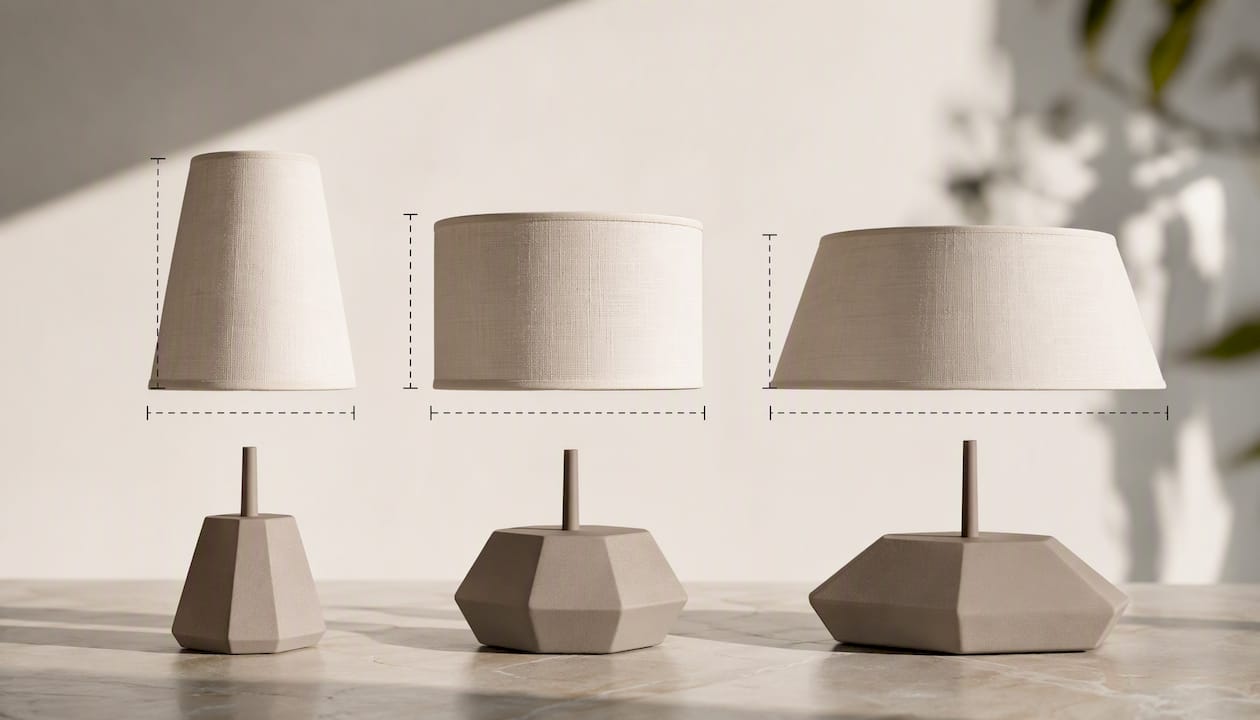
Get the proportions wrong and even the perfect shape looks off. The most reliable guideline, often called the lampshade rule, says the shade width should run about 2 to 3 inches wider than the lamp base at its widest point, and shade height should be about a third of the base height.
Measuring takes five minutes if you follow this order:
- Measure the lamp base from the bottom to just under the socket, excluding the harp.
- Measure the base’s widest diameter, whether that’s the foot or the belly of the lamp.
- Choose a shade whose bottom width extends 2 to 3 inches beyond that widest point on each side.
- Confirm the shade height covers roughly one-third of the total base height for visual balance.
- Check the fitter size matches your harp so the shade sits at the correct height above the socket.
Pro Tip: Size up slightly for ambient lamps meant to soften a whole room, and size down for task lamps where you want light aimed at a specific surface, not scattered across the ceiling.
Our table lamp height guide walks through base and shade measurements together if you want a deeper dive before you order.
Materials and Finishes That Change Brightness and Glare
Shape sets the direction of light, but material decides its color and intensity. Translucent fabrics and opal or opal-cased glass diffuse light and hide the bulb, producing a soft, even glow. Clear or seeded glass does the opposite, showing the bulb itself and throwing sharper, more directional highlights.
- Lined shades (often white or gold fabric) soften and warm the light; gold linings cast an amber tone that flatters skin and wood tones.
- Unlined shades let more raw light through, which can look striking but also more clinical.
- Glass shades run cooler to the touch on LED bulbs but still deserve clearance from higher-heat bulbs.
- Fabric shades need occasional dusting or a lint roller, and should sit a few inches from any bulb that runs hot.
Matching Shade Shape to Lamp Bases and Rooms
Geometry likes to match itself. A round base generally calls for a round shade, drum or cylinder, while square or rectangular bases pair naturally with square shades for a cleaner architectural line.
- Keep the shade’s widest point wider than the base’s widest point, never narrower.
- Let color and pattern on the shade echo one other element in the room, a rug, a throw pillow, rather than fighting for attention.
- In traditional rooms, curved shapes like bell and tulip feel at home; in modern spaces, drum and square hold their own better.
Pro Tip: Rules exist to be broken once you understand them. Pairing an unexpectedly curved shade with an angular, industrial base can be the one contrast that makes a room memorable instead of matched. Our floor lamp style guide has more on pairing shapes with bases if you’re starting from scratch.
Why You Can Trust This Guide
LightsThings is a direct-to-consumer retailer of decorative lighting and home decor, carrying everything from everyday accents to premium statement pieces. The company backs purchases with free shipping thresholds, easy returns, secure checkout, price matching, and financing, and pairs its lighting catalog with complementary decor so shoppers can furnish a whole look in one place. This guide is written by Norm Blain.

A Designer’s Note on Shade Trends
Drum shades have held their ground for over a decade because they flatter almost any base, but empire shapes are creeping back into favor for their sharper, more directional light in task settings. If you’re only buying one shade this year, drum is still the safest bet.
— Norm Blain
Ready to Shop by Shape? Here’s Where to Start
Once you know the shape and size you need, the fastest path is shopping a catalog built specifically for decorative lighting, rather than sifting through a general furniture store’s limited shade selection. LightsThings organizes its decorative lighting collection so you can browse by shape, filter by fitter size, and compare finishes side by side, whether you’re outfitting a single bedside lamp or restyling an entire living room.
Every order ships with free shipping thresholds and an easy return policy, so a shade that looks different in your room than it did on screen is never a permanent commitment. Price matching and financing options are also available for larger statement pieces. If you already have a base you love, our table lamp with shade page shows a finished pairing in action, and it’s a useful starting point if you’d rather buy shade and base together than mix and match.
Sources
- Lampshade Shapes: Visual Glossary of 12 Glass Shade Types
- Types of Lamp Shades: How to Select the Right One — The Spruce
- Lampshade — Wikipedia
- Choosing the Right Table Lamp Shade — Lowe’s
FAQ
What are different lamp shade shapes called?
The most common names are drum, empire, coolie, bell, globe, bowl or dome, cylinder, cone, square or rectangular, oval, and tulip, each tied to a distinct light behavior.
How do you pick a lamp shade shape?
Match the shape to the job: flared or tapered shapes like empire and coolie for focused task light, curved shapes like bell for soft diffused glow, and rounded shapes like globe for light that spreads in every direction.
What are the different types of lamp shades?
Beyond shape, shades vary by material and lining. Fabric shades with a lined interior diffuse and soften light, while glass shades, especially opal or seeded glass, change how visible the bulb is and how sharp the light appears.
What is the lampshade rule?
The lampshade rule is a sizing guideline stating the shade width should extend about 2 to 3 inches wider than the lamp base at its widest point, with shade height at roughly one-third of the base height.
Does LightsThings sell lamp shades in different shapes?
Yes, LightsThings carries table and floor lamps across multiple shade shapes and finishes within its decorative lighting collection, with filtering by size and style to help you find the right fit.