Accent pieces are the decorative elements that give a room its personality, depth, and visual finish beyond the foundational furniture. Interior designers define them as objects that prioritize visual character over core utility, including sculptural side tables, statement lighting, textiles, and decorative objects. Understanding how accent pieces complete a room means recognizing that layering these elements creates the visual movement and hierarchy that separates a “furnished” space from a truly realized interior. Without them, even the most expensive sofa sits in a room that feels unfinished. With the right accents, every corner earns its place.
How accent pieces complete a room: types and categories
Accent pieces fall into two broad categories: sculptural furniture and decorative accessories. Sculptural furniture includes items like accent chairs, side tables, stools, and console tables. These pieces carry some function but exist primarily to add form, material contrast, and visual weight to a space.
Decorative accessories cover a wider range:
- Lighting: Pendant fixtures, table lamps, floor lamps, and wall sconces. Statement lighting acts as a focal point that sets mood and draws the eye upward or across a room.
- Textiles: Rugs, throw pillows, blankets, and curtains. These add softness, warmth, and layered texture.
- Art and wall decor: Framed prints, mirrors, and gallery walls. They fill vertical space and reinforce the room’s color story.
- Small objects: Vases, candles, books, and trays. These connect the design narrative across surfaces.
- Sculptures and statues: Three-dimensional pieces that add silhouette variety and anchor shelves, consoles, or floors.
In 2026, the strongest design trend favors natural stones, warm woods, and textured surfaces. Travertine side tables, rattan stools, and matte ceramic vases are replacing glossy, uniform finishes. The goal is contrast: a smooth linen sofa reads more richly next to a rough-hewn stone sculpture than it does beside another smooth surface.
Pro Tip: Before buying any accent piece, identify what dimension is missing from your room. If everything is smooth and light, you need weight and texture. If everything is dark and heavy, you need something airy and organic.
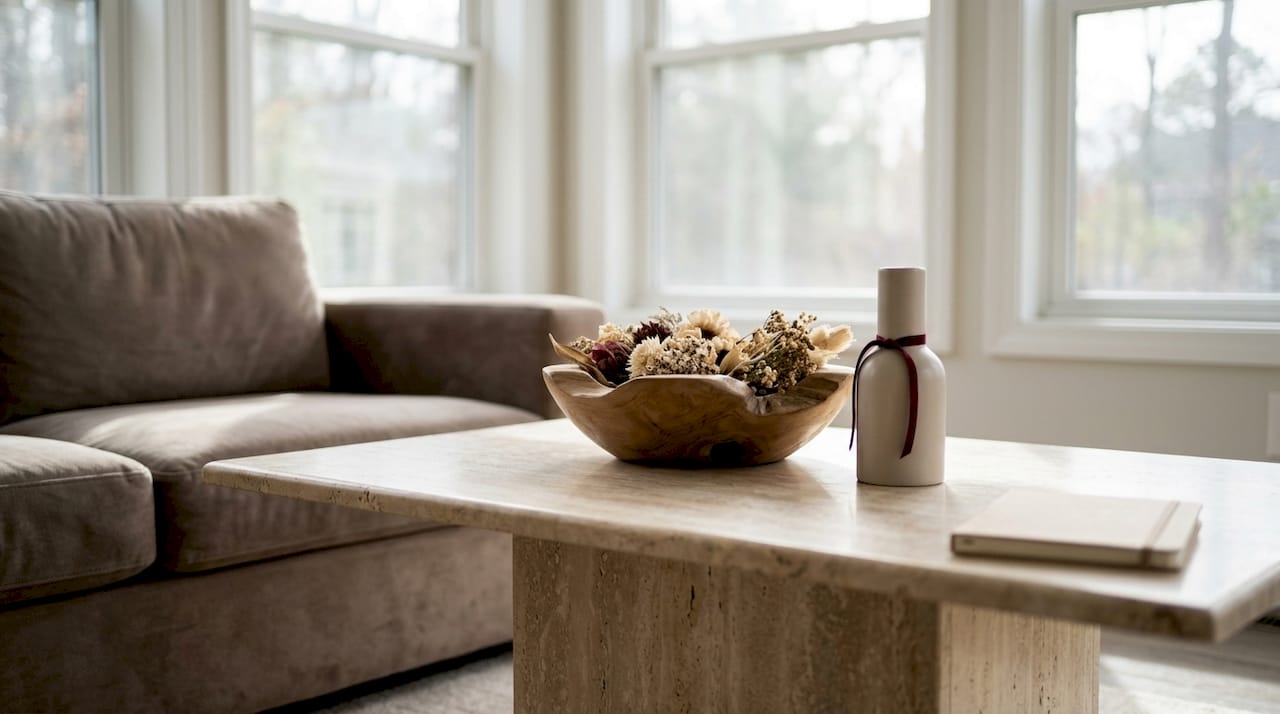
How do accent pieces transform the mood and visual balance of a room?
Accent pieces shift a room’s visual center of gravity without requiring a full renovation. Replacing a generic lamp with a sculptural floor fixture changes how every other element in the room is perceived. That single swap rewires the interior narrative.
The design principle at work is layering. A well-layered room moves through three levels: foundational pieces like sofas and beds, mid-level pieces like rugs and side tables, and personal accent items like art and objects. Rushing or skipping layers produces rooms that feel flat and impersonal, regardless of how much was spent on the furniture.
Visual hierarchy guides where the eye travels. Accent pieces create stopping points that give the eye a path to follow. A tall floor lamp in a corner pulls the gaze upward. A bold rug anchors the seating area and defines the zone. A sculptural piece on a console table creates a destination at the end of a hallway.
“Accent pieces serve as the jewelry of the room. Statement lighting and sculptural objects act as focal points that enhance personality, while smaller accessories connect the design narrative across surfaces and zones.”
Scale and proportion matter as much as style. An accent piece that is too small disappears. One that is too large competes with the furniture instead of complementing it. The goal is contrast in one dimension while harmonizing in another. A marble accent table beside a linen sofa contrasts in material but harmonizes in scale and tone. That balance keeps the visual narrative coherent without creating noise.
Grouping follows the same logic. Odd-number groupings of three, five, or seven objects guide the eye across a surface more naturally than even pairs. An even grouping creates symmetry that stops the eye. An odd grouping creates movement that keeps it traveling.
What practical strategies should homeowners use when selecting accent pieces?
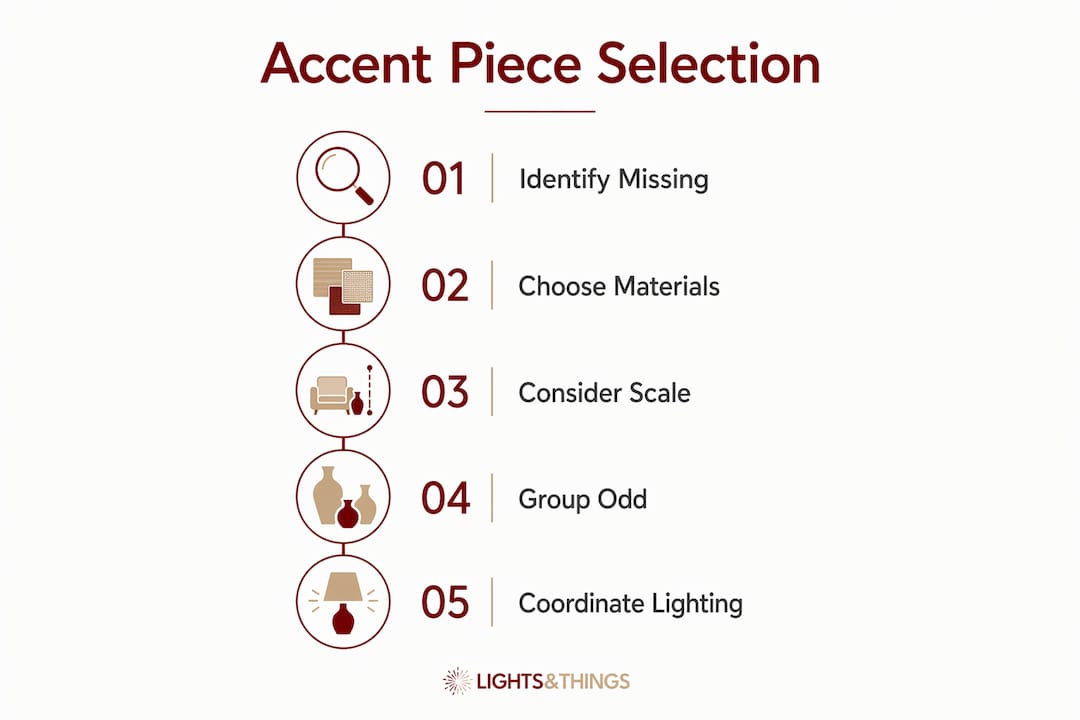
Selecting accent pieces well requires a process, not just an instinct. These steps give you a repeatable method that avoids the most common decorating mistakes.
- Audit what is missing. Walk through the room and identify gaps in texture, color, height, and warmth. A room with all low furniture needs vertical elements. A room with all cool tones needs something warm.
- Test scale before buying. Mark the floor space with painter’s tape and view the footprint from multiple angles before committing to a piece. This prevents the common mistake of buying something that looks right in a store but overwhelms the room at home.
- Choose contrast in one dimension. Select pieces that differ from your existing furniture in either material or tone, but not both at once. A warm wood table beside a cool gray sofa works. A bright red velvet stool beside a cool gray sofa beside a rough stone lamp is too much at once.
- Place pieces near context. Anchor accent pieces beside seating areas, at the end of sofas, or in empty corners. Floating a piece in the middle of a room without visual context disconnects it from the space.
- Edit before adding. Remove items from a surface before placing anything new. Editing is as important as styling. Removing items first maintains visual clarity and lets each piece stand out.
- Incorporate organic elements. Plants, dried botanicals, and natural fiber objects add softness and life that manufactured pieces cannot replicate. Even a single branch in a tall vase changes the energy of a corner.
Pro Tip: Coordinate your accent lighting with your decorative objects. A warm-toned table lamp beside a warm wood sculpture reinforces the material story. A cool LED pendant above a marble console does the same for a modern, minimal scheme.
The comparison below shows how two different approaches to accent selection produce very different results:
| Approach | Result |
|---|---|
| Many small, similar objects | Cluttered surfaces, no clear focal point |
| Fewer, varied sculptural pieces | Clear visual hierarchy, stronger impact |
| Matching materials throughout | Flat, uniform look with no depth |
| Contrasting materials in one dimension | Layered, curated feel with visual interest |
| Pieces placed without context | Disconnected, unanchored room |
| Pieces placed near seating or corners | Defined zones, better flow |
What are the biggest mistakes to avoid when using accent decor?
Most decorating mistakes with accent pieces come from one of two extremes: too much or too little. Both produce rooms that feel unresolved.
- Overcrowding surfaces. Too many small items create a scattered look that reads as clutter rather than curation. Fewer, larger sculptural pieces provide more visual impact and better anchor a space.
- Ignoring scale. A small vase on a large console disappears. A massive sculpture in a narrow hallway blocks flow. Scale mismatches are the most common reason a room feels “off” even when the individual pieces are beautiful.
- Matching everything too closely. When all accent pieces share the same material, finish, and tone as the main furniture, the room loses depth. Contrast is what creates the layered look that makes a space feel designed rather than assembled.
- Choosing only utility or only beauty. The best accent pieces do both. A sculptural side table holds a drink and adds form. A statement floor lamp provides light and creates a focal point. Pieces that do only one of these things work harder to justify their presence.
- Floating pieces without context. An accent piece placed in the center of a room with no relationship to furniture or architecture looks lost. Every piece needs a visual anchor: a wall behind it, a sofa beside it, or a rug beneath it.
- Skipping the edit. Adding new pieces without removing old ones is the fastest way to create visual noise. Treat editing as a regular practice, not a one-time event.
The recovery from any of these mistakes is the same: remove everything from the surface or zone, then reintroduce pieces one at a time, stopping when the composition feels balanced.
Key Takeaways
Accent pieces complete a room by adding the layered personality, material contrast, and visual hierarchy that foundational furniture alone cannot provide.
| Point | Details |
|---|---|
| Layer all three levels | Move from foundational furniture to mid-level pieces to personal accents for a fully realized interior. |
| Contrast in one dimension | Choose pieces that differ from existing furniture in material or tone, but not both simultaneously. |
| Group in odd numbers | Arrange three, five, or seven objects together to create natural visual movement across surfaces. |
| Edit before adding | Remove items from a surface before placing anything new to maintain visual clarity and impact. |
| Anchor every piece | Place accent pieces near seating, beside furniture, or in corners so they connect to the room’s flow. |
Why I think most homeowners underestimate the power of a single piece
Most decorating advice tells you to layer, layer, layer. I agree with that in principle. But the advice skips the more important truth: one well-chosen sculptural piece does more for a room than a dozen small accessories combined.
I have watched homeowners spend hours arranging trays, candles, and small objects on a console, then wonder why the room still feels incomplete. The answer is almost always that nothing in the room has enough visual weight to hold the space. A single sculptural accent piece with the right silhouette and material changes that immediately.
The trend toward sculptural forms and material contrast in 2026 is not just aesthetic. It reflects a genuine shift in how people want their homes to feel: curated and personal, not decorated and generic. That distinction matters. Curation means choosing fewer things with more intention. Decoration means filling space.
My honest advice is to invest in one or two statement pieces per room before buying any small accessories at all. Get the anchor right first. Then layer around it. The room will tell you what it needs next.
— Norm Blain
LightsThings: accent lighting and sculptural decor to finish any room
Completing a room’s look requires pieces with real visual weight and design intention. LightsThings carries a curated range of decorative accent lighting and sculptural decor built for exactly that purpose, from statement pendants and floor lamps to sculptures and statues that anchor a space with presence.
Whether you are filling an empty corner, adding warmth to a minimal scheme, or looking for a focal point that ties a room together, LightsThings offers options across every price point. The sculptures and statues collection includes three-dimensional pieces designed to shift a room’s visual center of gravity the moment they are placed. Free shipping, easy returns, and financing options make it straightforward to invest in pieces that last.
FAQ
What are accent pieces in interior design?
Accent pieces are decorative items that prioritize visual character over core utility, including sculptural furniture, statement lighting, textiles, art, and small objects. They complete a room by adding personality, texture, and visual hierarchy beyond the foundational furniture.
How many accent pieces should a room have?
The right number depends on the room’s size and existing furnishings, but restraint produces better results than abundance. Fewer, larger sculptural pieces create more visual impact than many small accessories, and groupings of three, five, or seven objects create the most natural compositions.
What is the role of accent lighting in completing a room?
Accent lighting serves as both a functional fixture and a decorative focal point. A well-chosen pendant or floor lamp draws the eye, sets mood, and reinforces the room’s material story in ways that overhead lighting alone cannot achieve. You can learn more in this accent lighting guide for homeowners.
How do I choose the best accent colors for a room?
A strong accent color scheme balances one strong shade, one soft shade, and one neutral. The accent color should contrast with the dominant palette without overpowering it, and it works best when repeated in at least two or three places across the room to create cohesion.
Why are accent pieces important even in a well-furnished room?
Even a room with high-quality furniture lacks depth and personality without accent pieces. Layering foundational, mid-level, and personal accent items is the process that produces the “curated calm” that distinguishes a designed interior from a simply furnished one.