For most tall stairwells, a cascading multi-tier or globe-cluster chandelier delivers the strongest visual and functional result. Keep two rules in mind: the fixture’s lowest point should clear the landing by at least 7 feet, and its length should fill roughly one-third to two-thirds of the vertical void. Below, you’ll find styled ideas by staircase type, exact sizing math, safety guidance, and a shopping checklist you can use the moment you start browsing.
TL;DR:
- Proper sizing ensures the chandelier’s lowest point is at least 7 feet above the landing and the fixture length fills one-third to two-thirds of the vertical space.
- Materials like crystal cascades are heavier and require more maintenance, while LED versions reduce cleaning and energy costs with flexible dimming options.
- Selection should match the stairwell architecture and finish, with finishes coordinating with railings and hardware, and styles fitting the home’s overall decor.
- Heavy or long-drop fixtures in tall stairwells often require professional reinforcement and careful planning for safe installation.
- Budgeting should account for fixture size and weight, installation complexity, and potential reinforcement, with options available to fit various price ranges.
Table of Contents
- Stairwell Chandelier Ideas for Every Staircase Type
- How Do You Size a Stairwell Chandelier Correctly?
- Which Chandelier Style and Finish Fits Your Home?
- Is It Safe to Install a Chandelier in a Stairwell?
- How Do You Choose the Right Stairwell Chandelier?
- How Much Does Stairwell Lighting Cost to Run?
- What Should You Budget for a Stairwell Chandelier?
- What Actually Matters When You’re Staring at 40 Chandelier Photos
- Shop Stairwell Chandeliers That Match Every Idea Above
- Where to Find More Stairwell Chandelier Inspiration
- Sources
- FAQ
Stairwell Chandelier Ideas for Every Staircase Type
The right fixture depends less on personal taste and more on the shape of your stairwell. A design that looks stunning in a photo can feel wrong once it’s hanging above your actual treads, so match the idea to your architecture first.
**For tall, double-height voids: **
- Cascading crystal drops fill vertical space dramatically and read as a true architectural focal point, which is why long-drop and tiered designs are the standard recommendation for two-story openings.
- Globe clusters in graduated sizes bring a softer, more modern silhouette to the same tall space without the formality of crystal.
- LED ring chandeliers, stacked in two or three tiers, suit minimalist homes that want scale without ornamentation.
For spiral or curved staircases:
- Spiral-metal sculptural fixtures echo the stair’s own curve and avoid the flat, static look a straight-drop chandelier can create in a rounded void.
- Staggered multi-tier cascades, with pendant heights following the stair’s rise, add movement instead of flattening the space visually.
For straight-run staircases:
- Linear pendant runs track the angle of the stringer and work especially well when the run is long and the ceiling isn’t dramatically high.
- Icicle drops in a narrow profile suit tight stairwells where a wide fixture would crowd the walking path.
For traditional or eclectic homes:
- Lantern-style chandeliers in aged bronze or black iron complement colonial and farmhouse staircases.
- Mixed-material sculptural pieces, combining wood, metal, and glass, work in eclectic homes where a single-material chandelier would look too matched.
A few practical notes worth flagging before you fall in love with a photo: crystal cascades are heavier and need more frequent dusting than glass or acrylic versions, and any fixture with dozens of small components takes longer to clean than one with a single shade. Integrated LED versions of these same shapes solve the maintenance problem directly, since Houzz’s staircase chandelier galleries show how often designers now pair traditional silhouettes with modern LED sources.
How Do You Size a Stairwell Chandelier Correctly?
Getting the dimensions right matters more here than in almost any other room, because a miscalculation isn’t just an aesthetic problem. It’s a headroom problem.
- Set your clearance floor first. The bottom of the fixture needs to sit at least 7 feet above the landing, with 7.5 to 8 feet preferred for comfortable clearance as people pass underneath.
- Calculate the vertical proportion. Measure floor to ceiling, then multiply that number by 0.33 and by 0.66. That range is your acceptable fixture length. A 20-foot void, for example, suggests a fixture between roughly 6.5 and 13 feet long.
- Check the width against the landing. Multiply the landing’s width by 0.5 to 0.66 to estimate a proportional fixture diameter. When you’re stuck between two sizes, go narrower. Losing a little visual impact costs less than crowding a walking path.
- Decide between one long-drop piece and multiple pendants. A single cascading chandelier suits a centered, symmetrical void, while a cluster of smaller pendants at staggered heights works better over an irregular landing or a curved run where one fixture can’t follow the geometry.
Run these numbers before you shop, and you’ll walk into any fixture decision already knowing which sizes to rule out.
Which Chandelier Style and Finish Fits Your Home?
Style choice comes down to matching the fixture to what’s already there: your railing finish, your ceiling height, and the general formality of the house. A glass-and-brass lantern looks out of place under a stark, modern skylight, just as a stripped-down LED ring can feel cold above an ornate wood staircase.
- Modern globe chandeliers suit clean lines, open risers, and metal or glass railings.
- Crystal cascades pair naturally with formal entryways, curved staircases, and traditional millwork.
- Ring chandeliers work in minimalist or transitional homes where you want scale without visual clutter.
- Industrial cage fixtures complement exposed brick, black iron railings, or loft-style stair voids.
- Lantern-style pieces fit colonial, farmhouse, and craftsman staircases best.
- Sculptural metal fixtures suit eclectic or art-forward interiors that want a conversation piece.
Material trade-offs matter as much as shape; coordinating these choices with your interior doors and trims helps maintain a cohesive architectural style throughout your home. Crystal and heavy glass deliver the most sparkle but add real weight to your mounting plan, while acrylic mimics the look at a fraction of the load. Metal finish should echo your railing or hardware; matching brass to brass, or black to black, keeps the whole stairwell feeling coordinated rather than assembled from unrelated parts. On bulbs, integrated LED sources reduce both maintenance and heat in these hard-to-reach fixtures. Aim for a warm 2700K to 3000K color temperature and a CRI above 90 so skin tones and wall colors read accurately from below.
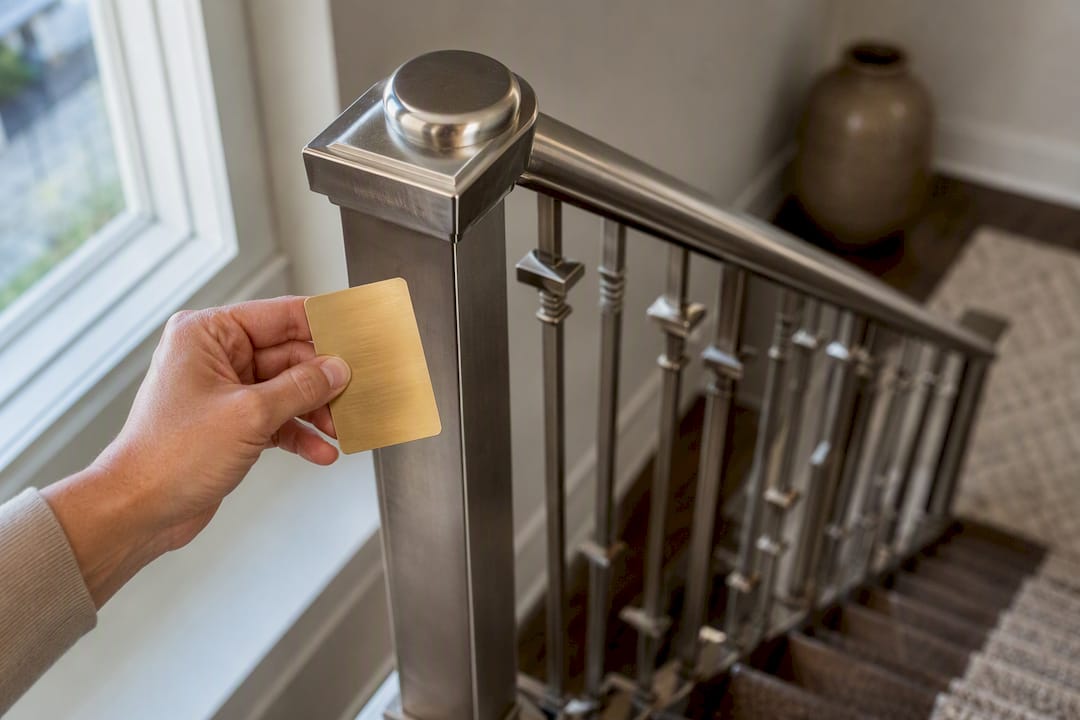
Pro Tip: If you’re unsure whether a finish will clash with your railing, hold a metal swatch or a photo of the fixture next to your banister in daylight. Warm-toned brass and cool-toned nickel rarely blend well in the same sightline.
Is It Safe to Install a Chandelier in a Stairwell?
Yes, but stairwell installations carry more structural and access complexity than a standard ceiling fixture, so plan for professional help before you buy.
- Hire a licensed electrician for any stairwell chandelier, and bring in a structural or rigging contractor when the fixture is heavy, the drop is long, or the ceiling anchor point is masonry rather than a joist.
- Plan access before installation day. Multi-level ladders or a small scaffold setup are usually safer and more stable than a single tall ladder balanced on stair treads.
- Wire in switches at both the top and bottom of the stairs so no one has to navigate steps in the dark to turn the fixture on.
- Level cascading tiers carefully. Uneven pendant heights are one of the most common install mistakes and are far easier to fix before the final ceiling patch than after.
- Use LED retrofits where possible and aim for 800 to 2000 lumens depending on stairwell size, which keeps ambient fill comfortable without overpowering the space.
How Do You Choose the Right Stairwell Chandelier?
Work through these five steps in order, and you’ll avoid the two most common regrets: buying a fixture too large for the clearance, and discovering after purchase that it needs to support the ceiling can’t provide.
- Measure the void and clearance path using the proportion math above.
- Decide the fixture’s visual role. Is it the room’s statement piece, or a supporting fixture alongside sconces and step lights?
- Confirm weight, mount type, and installer plan before you buy, not after delivery.
- Choose your bulb type and dimming setup, prioritizing LED and a warm color temperature.
- Check the return policy, warranty, and total budget so there’s room to adjust if the fixture doesn’t fit as expected once it’s in hand.
Before you finalize anything, ask the seller three direct questions: Is this fixture rated for high-ceiling suspension? What is the exact shipped weight? Does it require a canopy or secondary support point?
The clearance number to remember: keep the lowest point of any stairwell chandelier at least 7 feet above the landing. Every other decision on this list is negotiable. That one isn’t.
How Much Does Stairwell Lighting Cost to Run?
LED integration is the single biggest factor separating a stairwell chandelier that’s cheap to run from one that quietly inflates your electric bill. A traditional incandescent multi-bulb chandelier left burning for hours in an entryway draws considerably more power than the same fixture retrofitted with LED sources, and LED bulbs last dramatically longer, which matters more here than in most rooms.
Bulb access in a two-story stairwell is genuinely difficult. A fixture that needs bulb changes every few months becomes a recurring hassle involving a ladder, a helper, and real risk. LED sources rated for 15,000 to 25,000 hours or more turn that chore into something you handle once every few years instead of every few months. For a full comparison of how bulb type affects both cost and lifespan, our guide to LED versus incandescent bulbs breaks down the numbers room by room.
Dimming capability also affects efficiency in a practical way. A stairwell rarely needs full brightness all day. Dimming the chandelier during daylight hours and reserving full output for evening use extends bulb life further and keeps the fixture from feeling harsh when natural light is already doing most of the work. Layering in low-wattage step lights or sconces, as discussed earlier, lets you keep the chandelier dimmed most of the time while still maintaining safe visibility on the treads themselves.
What Should You Budget for a Stairwell Chandelier?
Stairwell chandeliers span a wide price range, and the fixture itself is usually only part of the total cost. Expect to pay more as drop length, material weight, and tier complexity increase. A compact LED ring or a modest glass cluster sits at the accessible end of the market, while a large crystal cascade or a heavily sculptural mixed-material piece designed for a genuine double-height void moves into premium territory, often well above $1,000.
Installation adds a separate line item that’s easy to underestimate. Electrician time for a standard fixture swap costs less than a job requiring new structural support, extended wiring runs, or scaffold access for a two-story void. If your existing junction box can’t support the fixture’s weight, budget for that reinforcement work before you fall in love with a heavy statement piece.
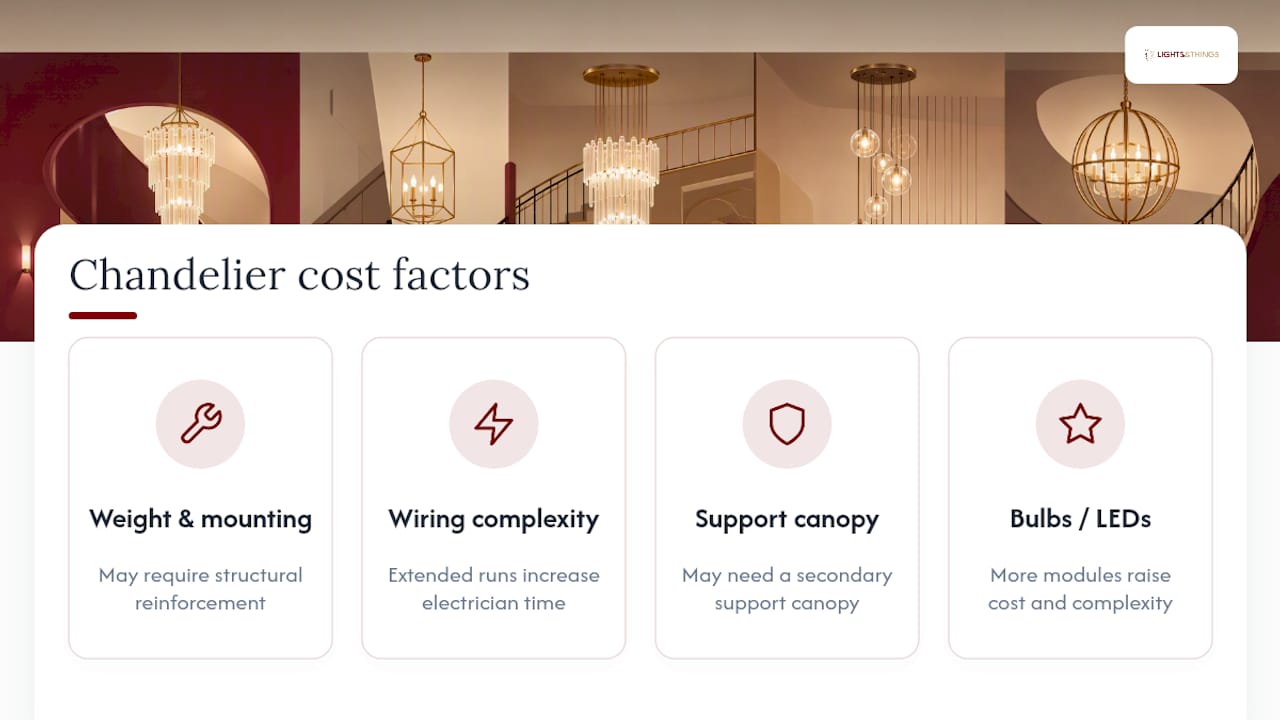
A few cost factors worth weighing before you set a number in your head: fixture weight and required mounting hardware, the complexity of the wiring run from an upper-floor ceiling, whether you need a secondary support canopy, and how many bulbs or LED modules the design requires. Financing options and price matching from some retailers can make a premium fixture more approachable without forcing a compromise on scale or style just to fit a tighter number.
What Actually Matters When You’re Staring at 40 Chandelier Photos
Most stairwell lighting advice treats scale as the main event and everything else as decoration. That’s backwards. Scale is the easiest problem to solve, since the math above gives you a hard number in under five minutes. The harder problem, the one that actually causes buyer’s remorse, is picking a fixture that looks incredible in an inspiration photo but doesn’t match the light your specific stairwell gets during the day.
A crystal cascade photographed under gallery lighting in a designer’s portfolio can look flat and lifeless in a stairwell that only gets afternoon sun from a single window. Sculptural metal pieces, by contrast, tend to hold their character in low light because their visual interest comes from shape rather than sparkle. Before you commit to a style based on a saved photo, think about what your stairwell actually looks like at 7 a.m. and at 9 p.m., not just in the flattering midday shot you screenshotted.
The other underrated factor is that a stairwell chandelier is almost never a single-fixture decision. Pairing it with wall sconces or step lights isn’t a nice extra. It’s what keeps the space usable and safe when the statement piece is dimmed low for ambiance rather than blasting full brightness every evening.
— Norm Blain
Shop Stairwell Chandeliers That Match Every Idea Above
A retailer with a catalog spanning ceiling lighting, floor and table lamps, and home decor can help you pair a statement chandelier with complementary sconces or a console lamp in one checkout instead of managing separate orders from separate sellers.

If you’re working with a tall, double-height void, filter by drop length first so you’re only browsing fixtures that actually meet the clearance math from earlier in this guide. For heavier crystal or mixed-material pieces, check the listed weight and installation requirements before you buy, since a secondary support canopy changes your electrician’s quote. Browse the full ceiling lighting and home decor collection to start narrowing options by size and finish, and if you want to round out the stairwell landing with a complementary piece, the floor and table lamp collection is worth a look while you’re there. Orders typically include a standard return policy and financing options, so sizing a premium fixture to your exact void doesn’t have to be a one-shot decision.
Where to Find More Stairwell Chandelier Inspiration
For deeper visual browsing, Houzz’s staircase chandelier galleries hold thousands of real installation photos across every style covered above. Philips Hue’s stair lighting guide covers smart LED layering for treads and landings, and if you’re weighing chandelier scale against your ceiling height, our own sizing guide walks through the math in more detail.
Sources
- Portfolio Staircase Lighting Guide: How to Light Your Stairs Safely and Beautifully
- Staircase Chandelier - Photos & Ideas
- Smart stairs lighting ideas for homes | Philips Hue
FAQ
What is a good traditional chandelier for a stairwell?
A lantern-style fixture in aged bronze or black iron, or a multi-tier crystal cascade, both suit traditional stairwells well, especially alongside wood railings and classic millwork.
What is the best chandelier for a staircase?
There’s no single best style. For tall double-height voids, a cascading multi-tier or globe-cluster chandelier is the strongest choice, while narrow straight runs suit linear pendants or icicle drops better.
How high should a chandelier hang in a stairwell?
Keep the bottom of the fixture at least 7 feet above the landing, with 7.5 to 8 feet preferred for comfortable clearance as people walk underneath.
What are the common stairwell lighting mistakes?
The most frequent mistakes are hanging a fixture too low for safe clearance, choosing a chandelier too small or large for the void’s proportions, and relying on a single statement fixture instead of layering in sconces or step lights for safety.
Does LightsThings sell stairwell chandeliers?
LightsThings carries a curated ceiling lighting collection that includes chandeliers suited to stairwell installations, along with complementary lamps and decor; current prices are listed on the site.