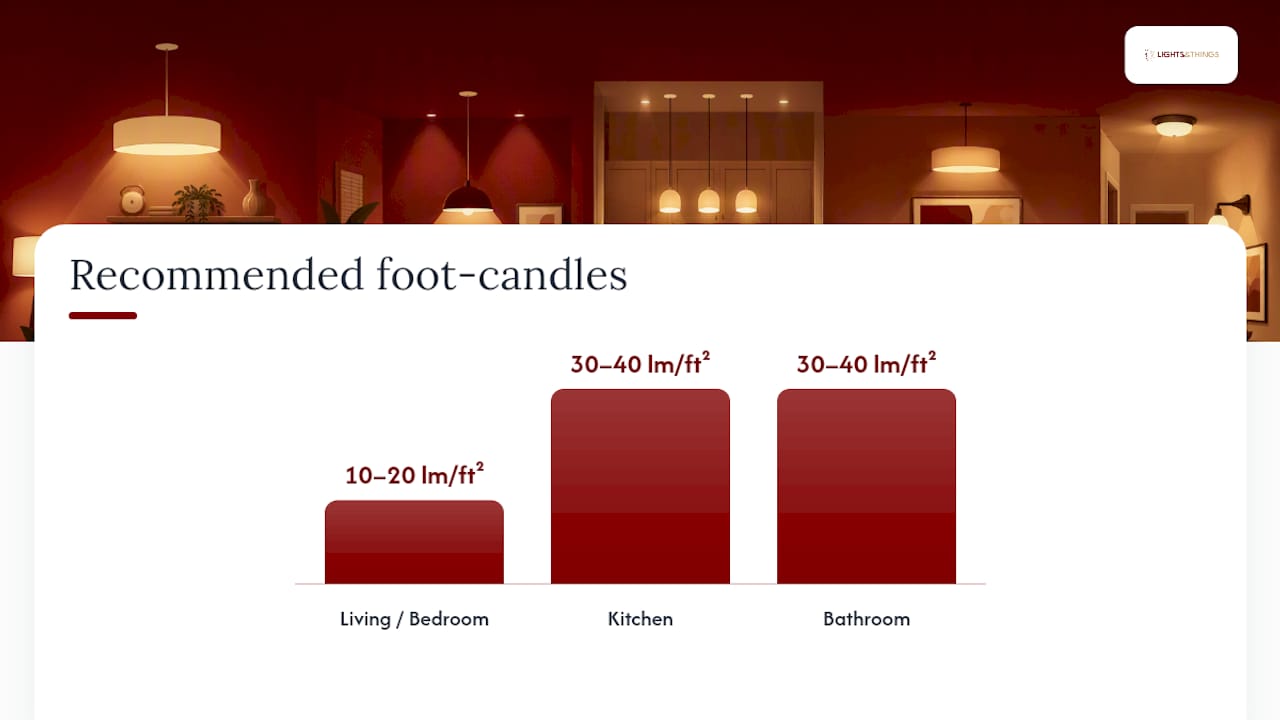
For most living rooms and bedrooms, aim for 10 to 20 lumens per square foot; kitchens and bathrooms need 30 to 40 or more for task areas. That puts a 200-square-foot living room at roughly 2,000 to 4,000 total lumens, a 12x12 bedroom around 1,440 to 2,880, and a 150-square-foot kitchen closer to 4,500 to 6,000 once you count task lighting. Dimmers and layered fixtures let you land anywhere inside that range instead of guessing.
TL;DR:
- Rooms with higher activity levels, such as kitchens and bathrooms, require significantly more lumens per square foot, often 30 to 80 lm/ft².
- Adjustments for ceiling height, wall color, and natural daylight can increase or decrease the recommended lumen targets, especially for taller or darker spaces.
- Overhead fixtures typically need to be paired with layered lighting like task and accent lights to meet the combined lumen requirements and avoid overwhelming the room visually.
- The lumen method involves multiplying room area by target foot-candles to determine total needed lumens, then dividing by fixture lumen ratings to plan fixture counts.
- Dimmers and separate switches for ambient, task, and accent layers allow flexible lighting control, optimizing both functionality and mood.
Table of Contents
- What Is the Lumen Method for Calculating Room Lighting?
- How Many Lumens Do You Need for Each Room?
- Worked Lumen Calculations You Can Copy
- Budgeting Lumens Across Ambient, Task, and Accent Light
- What Changes Your Lumen Target?
- Choosing Bulbs and Fixtures to Hit Your Lumen Target
- How to Plan Room Lighting
- Style Versus Substance: Reconciling Statement Fixtures With Real Light
- Find Fixtures That Match Your Lumen Plan
- Tools and Guides Used for These Numbers
- Sources
- FAQ
What Is the Lumen Method for Calculating Room Lighting?
The lumen method is the formula lighting designers have used for decades, and it works just as well for a homeowner staring at a bare ceiling box. A foot-candle (fc) measures how much light lands on a surface, and it’s numerically equal to one lumen per square foot. Once you know how many foot-candles a room needs, the math is simple:
Total lumens = room area (sq ft) x target foot-candles
Here’s how to put that formula to work in your own space:
- Measure the room. Multiply length by width in feet to get square footage. A 10x14 room is 140 square feet.
- Pick a target foot-candle level. Living rooms and bedrooms typically call for 10 to 20 lm/ft², while kitchens and bathrooms need 30 to 40 or higher over task zones.
- Multiply area by target. A 140-square-foot bedroom at 15 lm/ft² needs about 2,100 total lumens.
- Divide by lumens per fixture. Check the bulb or fixture spec for its lumen output, then divide your total by that number to get a fixture count. Round up, always.
- Build in a buffer. Add roughly 10% to your total to cover light loss from dust, dimming, and fixture covers, and adjust further for delivery factor: an open fixture throws more usable light than one with a dense shade or frosted glass covering the bulb.
Ceiling height matters here too. Standard 8 foot ceilings need no adjustment, but taller rooms lose light to the extra volume of air the beam has to travel through before it reaches your floor or countertop.
How Many Lumens Do You Need for Each Room?
Every room has its own job to do, and its lumen target should reflect that job. A bedroom exists for winding down; a kitchen exists for tasks that require precision, from dicing an onion to reading a recipe card. The ranges below use lumens per square foot, the same foot-candle standard lighting designers rely on, applied to typical room sizes.
- Living room: 10 to 20 lm/ft². A 200 square foot living room lands between 2,000 and 4,000 total lumens. Lean toward the higher end if the room doubles as a reading or hobby space.
- Bedroom: 10 to 20 lm/ft². A 12x12 bedroom (144 sq ft) needs about 1,440 to 2,880 lumens, with the lower end suited to a purely restful room and the higher end better for a bedroom that also functions as a home office.
- Dining room: 30 to 40 lm/ft². A 120 square foot dining area needs roughly 3,600 to 4,800 lumens, concentrated over the table where a chandelier or pendant cluster does most of the work.
- Kitchen (general ambient): 30 to 40 lm/ft². Task zones like counters and stovetops climb to 70 to 80 lm/ft² locally, which is why under-cabinet strips exist.
- Bathroom: 70 to 80 lm/ft² around the vanity, where shaving and makeup application demand strong, shadow-free light.
- Home office: 50 to 70 lm/ft², since reading fine print and staring at a screen both punish underlit desks.
- Hallway: 5 to 10 lm/ft². Hallways are transitional, not destination spaces, so they need far less than the rooms they connect.
- Garage or workshop: 50 to 70 lm/ft², higher still over a workbench where you’re handling tools.
A quick reference point: kitchen task lighting over a counter or sink often needs four to five times the lumens per square foot of the ambient light in the rest of the room. That gap is why a single ceiling fixture almost never covers a kitchen properly on its own.
Color temperature should track the room’s purpose as much as the lumen count does. Bedrooms and living rooms are more comfortable in warm white, 2700K to 3000K, while kitchens and home offices benefit from a slightly cooler 3000K to 4000K that keeps you alert and helps colors look accurate. Dimmers matter everywhere, but they matter most in dining rooms and bedrooms, where the same fixture needs to go from bright and functional to soft and relaxed in the same evening.
Worked Lumen Calculations You Can Copy
Numbers land better with real examples attached to them. Here’s the math for three common rooms, using standard bulb outputs of 800 lumens (a typical A19 LED) and 1,600 lumens (a brighter can or flush mount option):
- 12x12 bedroom (144 sq ft) at 15 lm/ft²: 144 x 15 = 2,160 total lumens needed. That’s roughly three 800-lumen bulbs in a multi-light fixture, or two fixtures at 1,100 lumens each.
- 250-square-foot living room at 15 lm/ft²: 250 x 15 = 3,750 total lumens. Split across a central pendant and two floor lamps, that might mean one 1,600-lumen fixture plus two 1,100-lumen lamps.
- 150-square-foot kitchen at 35 lm/ft² ambient: 150 x 35 = 5,250 lumens for general coverage, before adding under-cabinet task lighting over the counters. Five recessed downlights at roughly 1,100 lumens each covers that ambient layer, with LED strips handling the task zones separately.
Recessed downlights follow a spacing rule: keep the distance between cans at about 1.5 times your ceiling height for even coverage, which is why kitchens often need more fixtures than a single centered pendant would suggest.
Budgeting Lumens Across Ambient, Task, and Accent Light
Ambient light fills the room generally. Task light targets a specific activity, like reading or chopping vegetables. Accent light adds drama or highlights a feature, like a piece of art or a sculptural piece. Splitting your lumen budget across all three keeps a room from feeling flat or overly clinical.
A bedroom budget might look like this:
- Ambient (ceiling fixture or flush mount): 1,440 to 1,800 lumens
- Task (bedside lamps, two combined): 600 to 1,000 lumens
- Accent (a shelf light or LED strip): 200 to 400 lumens
A kitchen budget skews harder toward task:
- Ambient (recessed or flush ceiling fixtures): 3,000 to 4,000 lumens
- Task (under-cabinet strips over counters): 1,000 to 1,500 lumens
- Accent (pendant lights over an island for style): 400 to 800 lumens
Combined, those totals can look intimidating on paper, but dimmers and independent switching mean you’re rarely running every layer at full output at once.
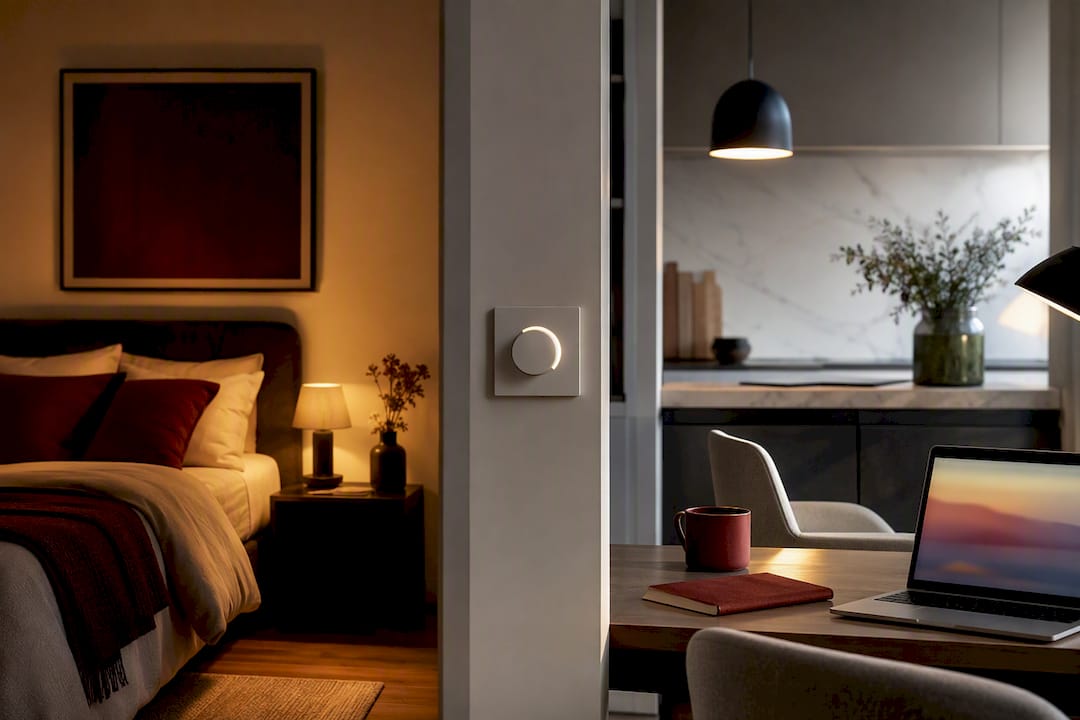
Pro Tip: Wire each layer to its own switch or dimmer, even in a small bedroom. You’ll use the accent layer alone most nights and save the full ambient blast for cleaning or hosting.
What Changes Your Lumen Target?
The per-square-foot rule is a starting point, not a fixed law. A few conditions push your target up or down.
- Ceiling height: Rooms with ceilings above 9 to 10 feet lose light to the extra volume, so increase your ambient total by 20 to 30% to compensate.
- Wall and floor color: Dark walls, dark flooring, and heavy drapery absorb light instead of bouncing it back into the room, which can push your real-world need toward the higher end of any range.
- Natural daylight: A room with large south-facing windows needs less supplemental lumens during the day but should still be planned for full output at night.
- Fixture aiming: A pendant aimed straight down concentrates light on the table below it but leaves the rest of the room dimmer than the math alone suggests.
Choosing Bulbs and Fixtures to Hit Your Lumen Target
Once you know your total lumen target, shopping gets a lot more straightforward. Standard LED bulbs commonly come in 450, 800, and 1,100 lumen options, while ceiling fixtures and flush mounts range from about 1,200 up to 3,000 lumens, and LED panels can push 3,000 to 5,000 lumens for larger spaces.
- Match color temperature to room function: 2700K to 3000K for bedrooms and living rooms, 3000K to 4000K for kitchens and offices.
- Look for a CRI (color rendering index) of 80 or higher, especially in kitchens and bathrooms, so colors read accurately under the bulb rather than washed out or off-tone.
- Confirm dimmer compatibility before buying, since not every LED bulb plays well with every dimmer switch, and mismatched pairs can flicker or buzz.
- Consider delivery: a diffused globe fixture spreads light softly across a room, while a directional can or track light punches light onto a specific surface or task area.
Pro Tip: If you love a statement chandelier that runs low on raw lumens, pair it with a few recessed downlights on a separate dimmer. You get the visual centerpiece without sacrificing the light you actually need to read or cook by.
How to Plan Room Lighting
Matching a lumen target to an actual fixture is where a lot of lighting plans fall apart, and it’s a gap many lighting resources attempt to address. Between decorative chandeliers, floor lamps, and layered accent pieces, shoppers can consider visual style alongside lumen output before buying.
A few internal resources worth bookmarking as you shop:
- How to choose ceiling lighting for guidance on matching fixture form to the light delivery your room needs.
- Ambient vs. task lighting for a deeper look at layering warm 2700K to 3000K light across a room.
- LED vs. incandescent bulbs for a straightforward comparison of lumen-per-watt efficiency between bulb types.
- Accent lighting explained for budgeting the smallest but most style-defining layer in any room.
Style Versus Substance: Reconciling Statement Fixtures With Real Light
A showpiece chandelier rarely hits its room’s full lumen target on its own, and that’s fine. The fix isn’t skipping the fixture you love; it’s pairing it with quiet supplemental light, like recessed downlights or slim LED strips, on a separate switch. That combination avoids glare from a single overpowering source while keeping the room usable for actual tasks, not just admiring.
The practical rule: let your statement piece set the mood, and let a secondary layer carry the functional lumen load. Dimmers are the bridge that makes both jobs work from the same ceiling.
— Norm Blain
Find Fixtures That Match Your Lumen Plan
Once you know your target lumen count, the fixture hunt gets a lot easier. Browsing catalogs that list output, color temperature, and style together simplifies this process.
Whether you’re filling a 250-square-foot living room or finishing a kitchen island, the LightsThings shop organizes chandeliers, pendants, and floor lamps by the kind of visual impact and light output you’re after, from accessible everyday pieces to premium statement fixtures. Pair a chandelier you love with the supplemental fixtures your lumen math calls for, and use the site’s buying guides to confirm dimmer compatibility before checkout. Start browsing by room or style, check the lumen specs on the pieces that catch your eye, and build your order around free shipping thresholds and easy returns so getting the light wrong isn’t a costly mistake.
Tools and Guides Used for These Numbers
- Room Light Calculator: a calculator that converts area and target illuminance into fixture counts.
- Bedroom Lumens Guide: sleep-friendly brightness ranges and ceiling-height adjustments.
- Bedroom Lumens Chart by Size: a size-based lumen chart for bedrooms specifically.
Sources
- Bedroom Lumens Guide: Sleep-Safe Brightness Levels
- Room Light Calculator | Lumens and LED Watts
- How Many Lumens for a Bedroom? Chart by Room Size | LedLightsGeek
FAQ
How many lumens do you need for a 12x12 room?
A 12x12 bedroom (144 square feet) typically needs about 1,440 to 2,880 total lumens for ambient overhead lighting, depending on whether it’s used purely for rest or also as a workspace.
Is 2,000 lumens too bright for a living room?
Not usually. A 150 to 200 square foot living room at the standard 10 to 20 lm/ft² range needs roughly 1,500 to 4,000 total lumens, so 2,000 lumens sits comfortably in the middle for most rooms that size.
Is 1,000 lumens enough to light a room?
It depends on the room size and purpose. For a small bedroom under 100 square feet, 1,000 lumens can work as a cozy ambient layer, but it falls short for a living room, kitchen, or any space over roughly 70 square feet used for tasks.
Is 4,000 lumens enough for a room?
For most bedrooms and living rooms, 4,000 lumens covers even a larger space at the higher end of the 10 to 20 lm/ft² range, roughly 200 to 400 square feet. In a kitchen, 4,000 lumens may only cover general ambient light and still need supplemental task lighting over counters.