For most table lamps, pick a shade whose height runs about two-thirds of the lamp base height, with a bottom diameter at least as wide as the base’s widest point. Retailers list lamp shade sizes as Top × Bottom × Slant, so you’ll need those three numbers before you shop. Get the proportions right and the fitter type confirmed, and the shade will hide the socket and balance the base every time.
TL;DR:
- The shade height should be about two-thirds of the base height, with the bottom diameter at least as wide as the base’s widest point.
- Measure from the tabletop to the harp or socket top, and record the diameter, slant height, and vertical height for accurate sizing.
- When in doubt, size up if measurements fall between standard ranges, and choose a shape and material that support your lighting and room needs.
- Confirm the fitter type and dimensions before purchasing, and consider using cardboard templates or wall outlines to visualize proportions.
- Material influences perceived size and light output, so select translucent fabrics for larger, more luminous shades or heavier fabrics for a more compact appearance.
Table of Contents
- How Do You Measure a Lamp for a Shade?
- What Size Shade Fits Which Lamp Base?
- Which Fitter Type Does Your Lamp Use?
- How Do Shape and Material Affect the Right Size?
- What Should You Check Before Buying a Lampshade?
- What Do Lighting Experts Say About Getting This Right?
- How Does Shade Material Affect the Size You Should Buy?
- Why Measurement Beats Guesswork Every Time
- Ready to Match a Lamp and Shade That Actually Fit?
- Sources
How Do You Measure a Lamp for a Shade?
Start with the base, not the shade. Measure from the tabletop to the top of the harp (the wire frame that holds the shade) or to the top of the socket if there’s no harp. Then measure the widest diameter of the base itself, usually at the bottom where it flares out. Both numbers anchor every proportion rule that follows.
If you already own a shade you like, measure it the same way retailers do:
- Top diameter: across the opening at the top, center to center.
- Bottom diameter: across the widest opening at the bottom.
- Slant height: a tape run along the sloped side, from top edge to bottom edge.
- Vertical height: the straight up and down measurement from top rim to bottom rim.
Slant and vertical aren’t the same thing. On a drum shade they’re nearly identical, but on an empire or bell shape, the slant will run noticeably longer than the vertical height because the tape is tracing a diagonal rather than a straight line. Manufacturers usually print the slant on the label, but vertical height is what actually determines whether the shade clears your harp and hides the socket. Record everything as Top × Bottom × Slant, and separately, jot down the vertical height for reference when you’re replacing an existing shade.
Pro Tip: Measure oddly shaped or scalloped shades at their widest points, not their decorative edges. A tape measure pulled taut across the true diameter beats an eyeballed guess every time.
What Size Shade Fits Which Lamp Base?
Three rules cover almost every table lamp, floor lamp, or pendant you’ll encounter. First, shade height should land between 60% and 70% of the base height, with two-thirds as your target. Second, the bottom diameter needs to be at least as wide as the base’s widest point, ideally closer to the 1.8 to 2.2 times that width. Third, many editors simplify this further: the shade bottom often ends up roughly equal to the base height, which is a useful gut check when the math feels fussy.
Typical ranges by lamp type:
- Table lamps: bottom diameter 12" to 18", height 9" to 11"
- Bedside or accent lamps: bottom diameter 10" to 14", height 7" to 9"
- Buffet lamps: bottom diameter 8" to 12", height 12" to 18" (taller, narrower profile)
- Floor lamps: bottom diameter 15" to 20", height 10" to 14"
- Pendants and mini shades: bottom diameter 4" to 10", varies widely by fixture style
When your measurements fall between two standard sizes, size up rather than down. A shade that’s slightly generous still hides the hardware and flatters the base; one that’s too small leaves the harp exposed and looks pinched. Factor in the room, too. A shade proportioned perfectly for a narrow console table can look undersized once it’s next to an oversized sofa.
Which Fitter Type Does Your Lamp Use?
The fitter is how the shade attaches, and it matters as much as diameter. Four types cover nearly every residential lamp:
- Spider (harp) fitter: a wire frame with a fitter ring sits atop the harp, the most common setup for table and floor lamps.
- Uno fitter: a threaded ring screws directly onto the socket, no harp required, common on smaller accent lamps.
- Clip-on fitter: small clips grip the light bulb itself, often seen on candlestick or buffet lamps.
- Glass neck fitter: the shade slides over a glass neck on the lamp, typical of oil-style or hurricane fixtures, with common neck sizes at 1-5/8 inches, 2-1/4 inches, 3-1/4 inches, and 4 inches.
Measure your current fitter or check your lamp’s spec sheet before ordering. If the ring is close but not exact, a harp extender, a reducer ring, or a clip-on adapter can usually bridge the gap without buying a new lamp. For unusual neck sizes, ask the retailer about custom work rather than forcing a mismatch. Whatever fitter you use, leave enough clearance around the bulb for airflow. A shade sitting too close to a bulb traps heat and shortens bulb life.
How Do Shape and Material Affect the Right Size?
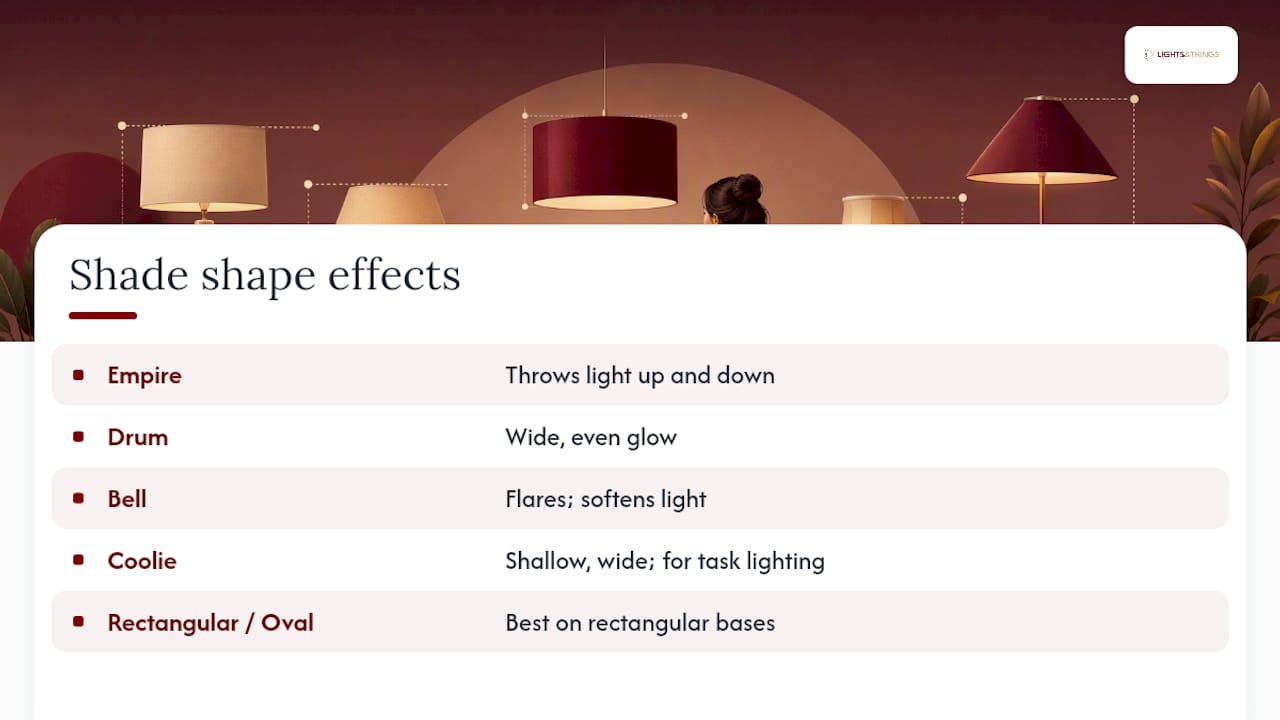
Shape changes how light spreads as much as size does. An empire shade (narrower top, flared bottom) throws light both up and down and suits most table lamps. A drum shade has straight, even sides and produces a wide, even glow, good for modern living-room settings. A bell shade flares dramatically and softens light output. Coolie shades are shallow and wide, ideal for lower profile task lighting. Rectangular or oval shades work best on rectangular bases and suit console or buffet placement.
Material shifts perceived scale, too. Linen and other opaque fabrics contain the glow and make a shade feel more compact even at the same size. Silk and other translucent materials glow more visibly, so a shade of identical dimensions can look larger once lit.
For bedside reading, a drum or empire shade in an opaque material controls glare at eye level. For living-room ambient light, a larger drum in a translucent fabric fills more of the room. For narrow console lamps, a tall, slim empire or rectangular shade respects the footprint without overwhelming it.
Pro Tip: If a room needs more ambient light than strict proportions suggest, size up the shade and choose a lighter, more translucent material rather than breaking the two-thirds rule outright.
What Should You Check Before Buying a Lampshade?
Run through this checklist before you finalize a purchase:
- Where will the lamp sit, and does the shade need to clear a shelf, headboard, or nearby furniture at eye level?
- Does the shade bottom hide the socket and harp completely when viewed from a seated position?
- Is the shade’s bottom diameter at least as wide as the base’s widest point?
- Do you need more ambient light, more focused task light, or a mix, and does the shape you like support that?
- Have you confirmed the fitter type and its dimensions match your lamp exactly?
- What is the retailer’s return or exchange policy if the size turns out wrong?
Watch for three red flags: a shade narrower than the base (it looks top-heavy and unstable), a shade so large it swallows the entire base and hides its shape, and a shade sitting so close to the bulb that ventilation is restricted.
Before you order, cut a cardboard template or tape an outline on the wall at the shade’s projected dimensions. This low-cost preview catches proportion problems that are hard to picture from numbers alone. If your base has an unusual shape or a nonstandard fitter, contact customer service before ordering. Custom sizing is usually cheaper than returning a shade that never fit.
What Do Lighting Experts Say About Getting This Right?
Norm Blain, who also wrote LightsThings’ table lamp height guide, built this measuring approach around the same principle: proportion problems are almost always measurement problems in disguise. Get the base height, widest point, and fitter type right, and the size math takes care of itself.
Some retailers support purchases with free shipping thresholds, straightforward returns, price matching, and financing, so a shade that doesn’t sit right isn’t a permanent mistake. Measure twice, confirm your fitter before checkout, and use the exchange window if something’s off once the lamp is home.
How Does Shade Material Affect the Size You Should Buy?
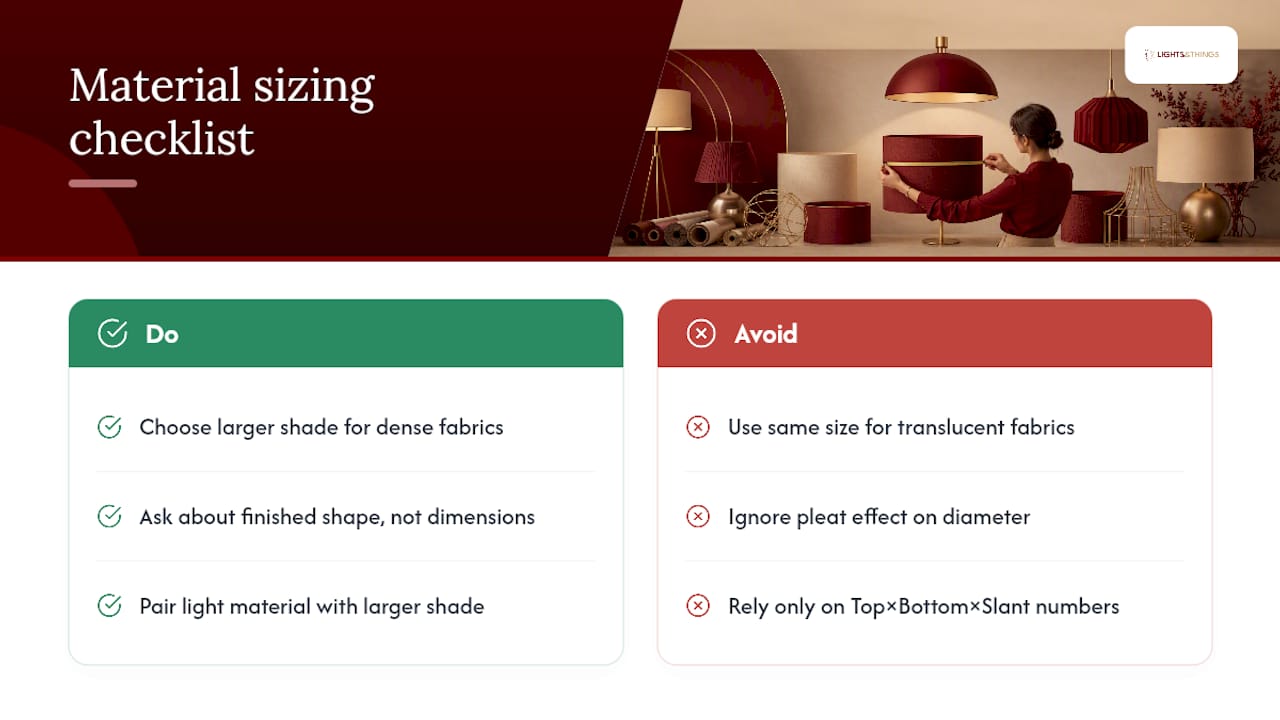
Material isn’t just about looks. It changes how much shade you actually need to get the light output you want. A dense linen or opaque cotton shade blocks more light than it releases sideways, so a slightly larger shade often reads better in the room than a small one that leaves the space dim.
Silk and other lightweight, translucent fabrics glow across their whole surface once lit, which means a shade that’s technically correct by the two-thirds rule can still look visually heavier than an opaque shade of the same size. If you’re choosing between two materials at the same dimensions, expect the translucent option to feel more prominent in the room, especially at night.
Pleated and textured fabrics also behave differently at the seams. A tightly pleated silk shade can look smaller than its stated diameter because the pleats pull inward slightly, while a stiff, structured shade in a laminated fabric holds its full measured shape. If precise scale matters for a tight space, ask about the shade’s finished shape, not just its labeled Top × Bottom × Slant numbers.
Heavier materials, like resin-coated or hardback shades, also carry more visual weight per inch than soft fabric shades. On a slender base, that can tip proportions toward top-heavy even when the diameter technically fits the rule. Pairing a heavier material with a slightly smaller shade, or a lighter one with a shade at the top of your size range, keeps the base-to-shade balance looking intentional rather than accidental.
Why Measurement Beats Guesswork Every Time
The two-thirds rule and the “at least as wide as the base” guideline aren’t arbitrary. They show up across independent sources because they solve the same functional problem: hiding the hardware while letting enough light escape. That consistency is the strongest argument for trusting the math over instinct.
Where conventional advice falls short is treating these ratios as rigid law. A translucent silk shade at the small end of a size range can look and function differently than an opaque linen shade at the large end, even with identical Top × Bottom × Slant numbers. The proportion rules get you into the right neighborhood. Material, room lighting, and furniture placement decide the final call.
If you take one thing from this guide, prioritize the base height and widest-point measurements before you look at a single shade. Everything else, shape, material, fitter adapters, is a refinement on top of those two numbers. Skip that step, and even a “correctly proportioned” shade can end up looking wrong once it’s actually sitting on your lamp.
— Norm Blain
Ready to Match a Lamp and Shade That Actually Fit?
Once you’ve got your Top × Bottom × Slant numbers and your fitter type confirmed, shopping gets a lot simpler. LightsThings’ floor and table lamp collection lets you browse lamps with shades already matched to the base, so you skip the guesswork of pairing a separate shade to an existing lamp altogether.
If you’d rather keep a lamp you already own and just replace the shade, jot down your measurements before you browse. Some lamps come with clear returns and exchange policies, so a sizing miss isn’t a dead end. Prefer a full lamp-and-shade set instead? The table lamp with shade page shows a pre-paired option worth comparing against your own measurements. Write your numbers down now, then start browsing with confidence.
Sources
- Lamp Shade Size Calculator, Measurement Guide & Size Chart | JX Lampshade
- Here’s a Formula for How to Buy the Right Size Lampshade | Apartment Therapy
- How-To: Measure Your Shade | Sorella Glenn