Industrial lighting decor uses raw materials like blackened steel, exposed bulbs, and caged glass to bring warehouse character into a home. The fastest way to start is with three fixture types: pendants over a kitchen island, sconces beside a bed or entry, and a chandelier as the anchor piece in a dining or living space. From there, sizing and finish decisions shape the rest of the room.
TL;DR:
- Hang island pendants 30 to 36 inches above the counter, and ensure at least 80 inches of clearance from the floor for walkway fixtures.
- Prefer bulbs with a color temperature between 2700K and 3000K to achieve a warm, vintage-industrial glow that complements the raw metal materials.
- Layer different fixture types, such as sconces, pendants, and floor lamps, to add depth and warmth to industrial-style rooms, avoiding a cold, single-note look.
- Start with affordable, easily-reversible updates like wall sconces or table lamps to test the industrial style’s effect before investing in larger ceiling fixtures.
Table of Contents
- What Counts as Industrial Style Lighting?
- Materials and Bulbs That Make the Look Work
- Where Each Fixture Belongs, Room by Room
- How to Size, Mount, and Light Fixtures Correctly
- How to Style Industrial Fixtures With the Rest of Your Decor
- What Lights & Things and Norm Blain Recommend
- Iconic Industrial Lighting Designs Worth Knowing
- Bringing Vintage or Repurposed Fixtures Into Your Home
- Where to Find Affordable Industrial Lighting
- What Actually Moves the Needle in a Room
- Shop Curated Industrial Lighting at Lights & Things
- Guides Worth Bookmarking
- FAQ
What Counts as Industrial Style Lighting?
Industrial style lighting borrows from factories, machine shops, and old freight warehouses. Think exposed bulbs, unfinished metal, rivets, cages, and pulley details. It works because the fixtures look like they have a job to do, even when their only job is decoration.
The style covers five main fixture categories, each suited to a different function in the home.
- Pendant lights hang from a cord or rod and deliver focused light, making them the default for kitchen islands and dining nooks.
- Wall sconces mount flush or on an arm and free up counter and floor space, which makes them useful for hallways, bedsides, and tight entries.
- Chandeliers in industrial style trade crystal for iron rings, cage frames, or clustered bulbs, and they work as a statement piece over a dining table or in a vaulted foyer.
- Flush and semi-flush mounts sit close to the ceiling, a practical choice for low ceilings, closets, or hallways where a hanging fixture would be a hazard.
- Floor and table lamps round out the layered look, adding warm accent light to a reading corner or console table.
Grouping decisions matter almost as much as fixture choice. A single oversized pendant over an island reads as a bold, modern industrial decor statement, while three matching pendants spaced evenly create rhythm and are often more affordable than one large chandelier. Clustered multi-pendant fixtures, where several bulbs drop from one canopy at staggered heights, suit a dining table or a two-story foyer that needs visual weight without a wide footprint. If you’re drawn to blackened metal, visible hardware, and glass cages, you’re looking at true industrial style fixtures rather than the softer, brass-heavy transitional look that often gets mislabeled the same way.
Materials and Bulbs That Make the Look Work
Metal does most of the work in industrial style. Raw or blackened steel, wrought iron, and galvanized finishes all read as authentic, while brass and aged bronze soften the look toward what’s often called modern industrial decor rather than the harder rustic industrial design of a converted factory loft.
- Blackened or matte black steel reads the most classic and pairs well with dark countertops and cabinetry.
- Galvanized or raw metal gives a rawer, more weathered look suited to a converted-loft feel.
- Brass or bronze accents warm up the palette and bridge industrial with traditional decor.
- Wood accents on a pendant canopy or lamp base soften an all-metal room.
- Caged glass or wire guards protect exposed bulbs and add texture without blocking light.
Bulb choice changes the mood as much as the fixture itself. A color temperature between 2700K and 3000K is the practical sweet spot for vintage industrial looks, since it mimics the warm glow of an old filament bulb without the energy waste of an incandescent one, and pairing that range with dimmable LEDs lets you shift from bright task light to a moody dinner glow with the same fixture.
Where Each Fixture Belongs, Room by Room
Placement is where most industrial lighting projects succeed or fail. Getting the fixture right and hanging it wrong wastes the investment.
- Kitchen islands call for pendants hung 30 to 36 inches above the counter, spaced so each pendant covers roughly two feet of island length. A three-foot island usually needs just one pendant; a run of six feet or more supports two or three.
- Dining tables need a chandelier or linear pendant sized to about half to two-thirds of the table’s width or diameter, hung 30 to 34 inches above the tabletop so sightlines stay clear across the table.
- Living rooms and foyers benefit from layering: a chandelier or oversized pendant as the ceiling anchor, floor lamps in reading corners, and a sconce or two flanking a fireplace or entry mirror. Reserve the largest statement piece for the room with the highest ceiling or the most open sightline from the front door.
- Bedrooms do well with wall-mounted sconces on swing or pivot arms at each side of the bed, hung about 24 to 28 inches above the mattress. They free up nightstand space and let each side of the bed control its own light.
- Entries and hallways suit flush mounts or a single small pendant, hung so the bottom clears head height, typically 80 inches from the floor at minimum.
How to Size, Mount, and Light Fixtures Correctly
A fixture that looks perfect in a photo can feel wrong in your home if the size or height is off. A few formulas take the guesswork out of it.
For pendants over an island, add the room’s length and width in feet and convert that number to inches to get a rough fixture diameter, then divide by however many pendants you’re hanging. A 10 by 12 foot kitchen suggests fixtures totaling around 22 inches in diameter. For a dining chandelier, aim for a fixture roughly 12 inches narrower than the table on each side.
Mounting height follows its own rules. Kitchen and island pendants hang 30 to 36 inches above the counter; dining fixtures hang 30 to 34 inches above the table; and any fixture over a walkway needs at least 80 inches of clearance from the floor.
Brightness needs vary by function, and lumen output should follow the job.
- Task lighting (kitchen prep, reading) needs the highest output, generally the brightest bulb the fixture rates for.
- Ambient lighting (general room fill) can run dimmer and more diffused.
- Accent lighting (highlighting art or architecture) needs the least output but benefits most from a warm color temperature.
Pro Tip: Buy one bulb before you commit to a whole set. Test it in the fixture at night, since a bulb that looks warm in daylight can throw a colder cast once the sun goes down.
Before checkout, run through a short list: measure your ceiling height and fixture drop, confirm the finish against your existing hardware, test the bulb’s color temperature in the room, and verify the fixture and dimmer switch are compatible if you want mood control.
How to Style Industrial Fixtures With the Rest of Your Decor
The biggest styling mistake with industrial lighting decor is treating it as one note instead of one layer. A single ceiling fixture, however striking, can leave a room feeling cold and unfinished. Layering ambient, task, and accent light, using a pendant for the ceiling, a floor lamp for the corner, and a small accent light for a shelf or piece of art, gives the room depth the way a single fixture never can.
Mixing metals keeps an all-black room from feeling like an unfinished garage. Pair a matte black pendant with a brass table lamp, or add a wood-based floor lamp next to a steel chandelier. Warm textiles, leather seating, and wood furniture soften metal edges and keep the room from reading as a converted machine shop.
Repetition builds cohesion faster than matching every piece exactly. A cage-style pendant in the kitchen and a smaller cage sconce in the hallway tie rooms together without forcing you to buy an entire matched suite.
- Swap a single dated flush mount for a small pendant before committing to a full fixture overhaul.
- Add one accent lamp with a warm bulb to test the mood before rewiring for permanent sconces.
- Trade a plain lampshade for a metal cage or mesh shade for an inexpensive style refresh.
Pro Tip: Start with the smallest, cheapest swap in a room, like a single table lamp, before committing to a ceiling fixture you can’t easily return.
What Lights & Things and Norm Blain Recommend
Norm Blain’s decorative lighting buying guide walks through fixture selection with the same room-by-room logic covered here. Various retailers curate industrial-style ceiling fixtures, floor and table lamps, and decorative accents alongside practical shopping tools like free shipping thresholds, easy returns, secure checkout, price matching, and financing, to support confident design purchases.
Iconic Industrial Lighting Designs Worth Knowing
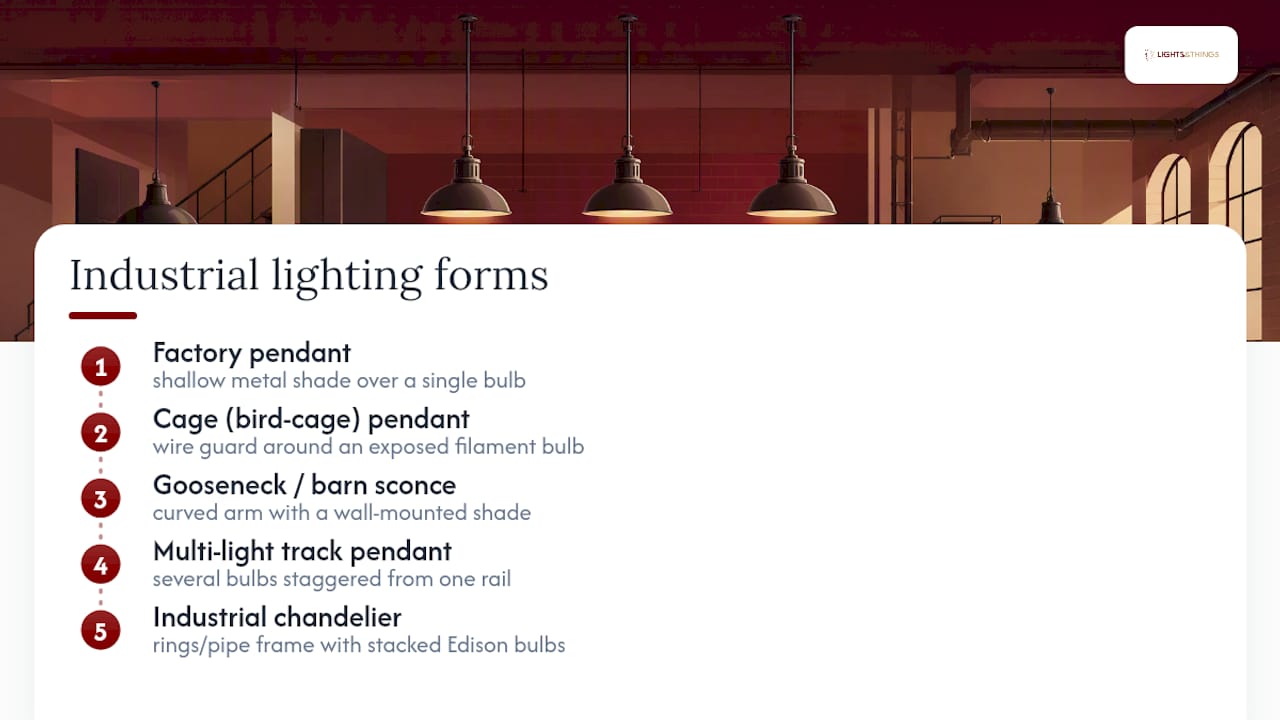
A handful of designs defined the industrial lighting look long before it became a home decor category. The factory pendant, a shallow metal shade over a single bulb, came straight off warehouse ceilings and remains the most recognizable silhouette in the style. The cage or bird-cage pendant, with its wire guard wrapped around an exposed filament bulb, became popular as breweries and restaurants leaned into raw, unfinished interiors during the 2010s and has stayed a go-to for kitchen islands ever since.
The gooseneck or barn light wall sconce, with its curved arm reaching out from a wall-mounted shade, traces back to outdoor and loading-dock lighting and now shows up constantly above kitchen sinks and on porches. Multi-light track pendants, several bulbs hung at staggered lengths from a single rail or bar, echo the look of conveyor-line lighting and work well over long islands or dining tables. Even industrial-style chandeliers, built from rings of blackened metal or stacked Edison bulbs on a pipe frame, borrow their structure from pulley systems and hanging shop lights rather than traditional candle-based designs.
What ties these examples together is honesty about material. None of them hide the bulb, the wiring, or the metal joinery. That transparency, showing the mechanics instead of dressing them up, is the through line across nearly every design the style has produced.
Bringing Vintage or Repurposed Fixtures Into Your Home
Vintage industrial lighting doesn’t have to come from an actual factory to earn its character. Salvage yards, estate sales, and architectural reclamation shops often carry old schoolhouse pendants, gooseneck sconces, and factory shades that need only a rewire to work safely in a modern home. If you go this route, always have a licensed electrician check the wiring and socket before installing a vintage find, since old cloth wiring and outdated sockets are a real fire risk.
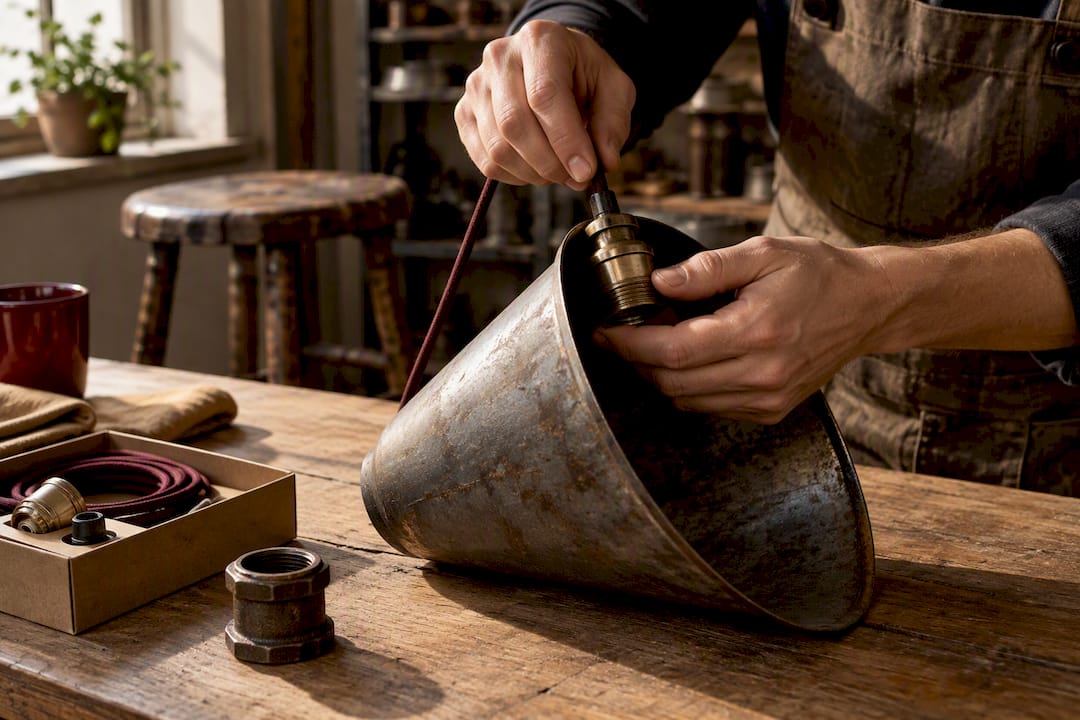
Repurposing everyday objects is the more accessible path for most homeowners. Old metal buckets, funnels, and pipe fittings can become pendant shades with a basic rewiring kit. A vintage stool or crate stacked as a side table under a hanging pendant reinforces the salvage-yard feel without requiring an actual antique fixture.
If sourcing a genuine vintage piece feels like too much of a project, a new fixture built to reference that history is the more practical middle ground. Look for reproduction schoolhouse pendants or aged-finish sconces designed to mimic worn metal without the wiring risk of an actual antique. Mixing one true vintage or repurposed piece with several new industrial-style fixtures often reads as more curated than an all-vintage or all-new room, since the contrast in patina gives the eye something to notice.
Where to Find Affordable Industrial Lighting
Industrial lighting decor doesn’t require a premium budget to look intentional. Floor and table lamps are usually the cheapest entry point into the style, letting you test a finish or bulb temperature before committing to a ceiling fixture. Semi-flush mounts and single sconces also tend to cost less than multi-light chandeliers, making them a smart place to start in a hallway or bedroom.
Retail category pages that group fixtures by room, like floor and table lamp collections, make it easier to compare finish and price side by side instead of hunting through unrelated search results. Watching for seasonal sales and email-list promotions from lighting retailers is another reliable way to catch a premium-looking fixture at a lower price point.
Secondhand and marketplace listings can turn up genuine vintage pieces for less than a new reproduction, though budget the cost of a rewire and a professional safety check into that price. Buying one strong statement piece, a pendant cluster or a single chandelier, and pairing it with simpler, budget flush mounts elsewhere in the home usually looks more finished than spreading an equal budget evenly across every fixture in the house.
What Actually Moves the Needle in a Room
If you take one thing from this guide, swap your entry or bedside lighting before you touch the ceiling fixture in your main living space. Sconces are cheap to test, easy to return, and they change how a room feels at eye level, which is where people actually notice light. Buy one, live with it for a week, and you’ll know fast whether industrial style earns a bigger investment in your home.
— Norm Blain
Shop Curated Industrial Lighting at Lights & Things
One option is to find a retailer offering a range of fixtures and accents covered in this guide, to avoid piecing a room together across many different stores. Browse ceiling lighting, which includes pendants, chandeliers, and flush mounts in industrial-friendly finishes, alongside floor and table lamps for the accent layer every good industrial room needs.
Every order ships with the practical protections that make a bigger lighting purchase feel low-risk: a free shipping threshold, easy returns if a finish doesn’t match your space, secure checkout, price matching, and financing options for larger statement pieces like the Crystal Chandelier Double Helix. If you’re ready to anchor a room, consider browsing ceiling lighting collections and narrowing down options by finish and size using the room formulas above.
Guides Worth Bookmarking
For deeper detail on any step in this guide, these resources go further into sizing, placement, and pendant grouping:
For lighting layout questions that touch architecture, tips on pairing interior doors with home office lighting offer a useful complement.
FAQ
What is the difference between industrial and rustic industrial design?
Industrial style leans on raw, unfinished metal, exposed bulbs, and factory-inspired shapes. Rustic industrial design adds reclaimed wood, worn leather, and warmer textures to soften that same metal base, so it feels more lived-in than a straight factory look.
How high should I hang a pendant over a kitchen island?
Hang island pendants 30 to 36 inches above the counter, and space multiple pendants so each covers roughly two feet of island length. This range keeps the light functional for prep work without hanging low enough to block sightlines across the island.
What color temperature looks best for industrial lighting?
A range of 2700K to 3000K gives the warm, vintage-filament glow most industrial rooms are going for. Pairing that temperature with a dimmable LED bulb lets you shift from bright task light to a dimmer, moodier setting on the same fixture.
Can I mix industrial lighting with modern or traditional decor?
Yes. Modern industrial decor already blends clean lines with raw metal, and pairing a black pendant with brass accents or wood furniture is one of the easiest ways to keep an industrial fixture from feeling out of place in a softer room.
Where can I buy affordable industrial-style fixtures?
Floor and table lamps are typically the least expensive entry point, and category pages that group fixtures by room make it easier to compare finishes and prices. Lights & Things lists current pricing on its ceiling lighting and lamp collections rather than in a printed catalog, so check the site directly for up-to-date options.