For most kitchen islands, a few pendant lights hung at a visually appropriate height above the countertop is generally best; longer islands typically suit a linear chandelier or multiple pendants arranged to spread light evenly. Match every bulb to the same 2700 to 3000K color temperature and put the whole layer on a dimmer. Start by measuring your island’s length, then pick your fixture type from there.
TL;DR:
- Most long islands over 8 feet benefit from three to four pendants spaced 24 to 32 inches apart or a linear chandelier that is half to two thirds the island’s length.
- For ceilings under 8 feet or smaller islands, flush or semi-flush fixtures prevent crowding and eye-level obstruction, while adjustable cords enable fine-tuning height.
- Matching all bulbs to 2700 to 3000K and layering task lighting with under-cabinet or recessed lights help avoid uneven illumination and enhance color accuracy.
- Fixture size and placement should follow specific guidelines: pendants 30 to 36 inches above the counter, with spacing maintaining 6 to 12 inches clearance from the ends of the island.
- When shopping, measure your island’s length and height first, check fixture dimensions upfront, and prioritize return policies to ensure the chosen style and size fit your space and design.
Table of Contents
- Kitchen Island Lighting Ideas That Actually Work
- Which Fixture Type Fits Your Island?
- What Are the Right Sizing and Spacing Rules?
- How Do You Match Lighting to Your Kitchen’s Style?
- Getting Bulbs and Layering Right
- Installation Tips That Save You Rework
- Common Kitchen Island Lighting Mistakes
- What We’ve Learned Curating Island Lighting
- Ready to Shop for Your Island Fixtures?
- Sources
- FAQ
Kitchen Island Lighting Ideas That Actually Work
The right island lighting idea depends on your island’s length, your ceiling height, and how much of the space doubles as a workstation versus a gathering spot. Pendant lights remain the most popular choice for kitchen islands because they create visual rhythm and turn the island into the room’s focal point rather than an afterthought.
Here are the concepts worth considering, each with a quick sizing cue:
- Clustered mini pendants. Best for long islands (8 feet or more). Space three to four small pendants 24 to 32 inches apart, center to center.
- Linear chandelier. Best for islands 8 feet and longer. Choose a fixture roughly half to two thirds the length of the island for balanced coverage.
- Single oversized pendant. Best for short islands or peninsulas. The shade diameter should run about a third to half the island’s width.
- Glass globe trio. A clean, symmetrical look for modern kitchens with 7 to 8 foot islands.
- Drum shades. Diffused, even light that suits transitional kitchens and softens a bright room.
- Woven rattan pendants. A textured, natural look that pairs well with wood countertops and warmer palettes.
- Industrial cage pendants. Exposed bulbs inside black steel cages for a loft or workshop feel.
- Amber glass pendants. Adds warmth to the light itself, flattering for skin tones and food.
- LED linear strips. A low-profile option under upper shelving or inside a coffered ceiling detail above the island.
- Flush or semi-flush fixtures. The fix for ceilings under 8 feet, where hanging pendants would sit too close to eye level.
- Pendants over the cooktop. Pair with a supplementary task light or under-cabinet strip since a single pendant rarely lights a cooking surface evenly.
2026 design trends lean toward rhythmic, slightly irregular arrangements. Mixed materials and staggered pendant heights read as more curated than three identical fixtures lined up in a row.
Which Fixture Type Fits Your Island?
Not every island calls for the same category of fixture. Ceiling height, island length, and how much task lighting you already have all factor into the decision.
- Pendants. The default for most islands. They deliver both task and decorative light, and an open or translucent bottom sends more usable light down onto the counter for chopping and prep.
- Linear chandeliers. The better call for islands over 8 feet, since a single long fixture spreads light evenly instead of leaving dark gaps between separate pendants. Aim for a length equal to half to two thirds of the island.
- Flush or semi-flush mounts. The practical fix for ceilings below 8 feet or compact islands where hanging pendants would crowd the sightline.
- Track and recessed lighting. Useful as adjustable, supplemental light rather than the star of the show. Recessed cans fill in shadows a pendant can’t reach; track heads let you redirect light as your layout changes.
What Are the Right Sizing and Spacing Rules?
Getting the proportions right is the difference between an island that looks designed and one that looks like an afterthought. A few numbers do most of the work.
- Hanging height: Keep the bottom of the fixture 30 to 36 inches above the countertop, a range confirmed by Houzz’s pendant lighting guidance. If people will sit at the island on stools, lean toward 36 inches so the fixture stays out of sightlines across the counter.
- Number of pendants: Islands under 6 feet typically need just two pendants; 6 to 8 foot islands look best with three; islands over 8 feet usually call for three to four pendants or one long linear fixture.
- Spacing between pendants: Keep 24 to 32 inches center to center, and leave 6 to 12 inches of clearance between the outermost fixture and each end of the island.
- Fixture width: For a single statement pendant, the shade diameter should measure roughly a third to half the island’s width. For a linear fixture, the total length should run about half to two thirds of the island’s length.
Write these four numbers down before you shop. They will narrow your fixture search faster than any style filter.
How Do You Match Lighting to Your Kitchen’s Style?
Fixture shape carries most of the visual weight in a kitchen, but material and finish decide whether it reads as modern, farmhouse, or industrial.
- Modern: Slim linear LED bars or globe pendants in matte black or polished chrome, kept to crisp, simple silhouettes.
- Farmhouse and transitional: Lantern-style pendants, aged brass finishes, and glass schoolhouse shades bring warmth without looking dated.
- Industrial: Cage pendants, exposed bulbs, and black steel hardware suit exposed brick or concrete countertops.
- Coastal and natural: Woven rattan or seagrass shades in light wood or brushed nickel finishes soften a bright, airy kitchen.
If you’re mixing metals elsewhere in the kitchen (cabinet hardware, faucet, appliances), pick one dominant finish for the pendants and let a second metal show up only as a small accent, like the pendant’s canopy or cord grip.
Getting Bulbs and Layering Right
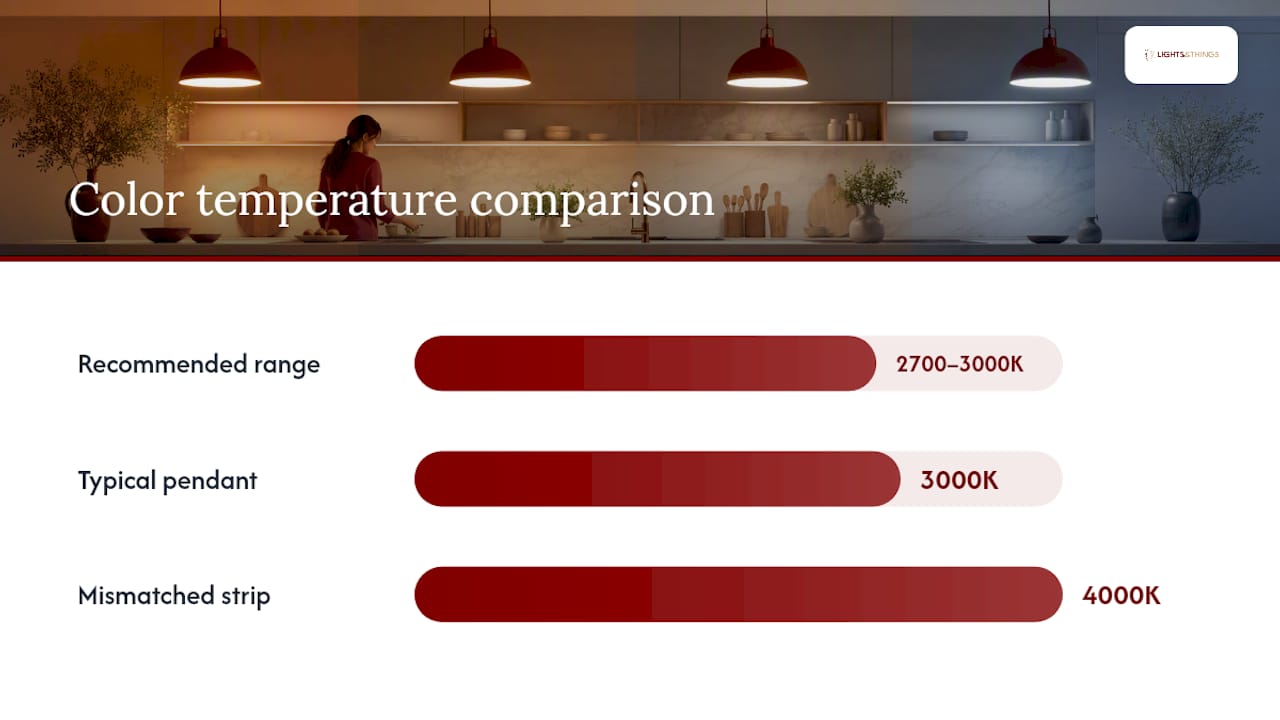
Color temperature matters more than most homeowners expect. Stick to 2700 to 3000K across every fixture in the kitchen. Mixing a 3000K pendant with 4000K under-cabinet strips is one of the fastest ways to make a finished kitchen look unfinished.
Quick spec sheet for island pendants:
- A typical pendant bulb provides sufficient brightness for task lighting at a kitchen island. Selecting bulbs with a high Color Rendering Index (CRI) helps colors appear more natural, which is important for food preparation and aesthetic appreciation.
- Designers recommend layering pendants for task light with recessed or under-cabinet fixtures to fill in shadows the pendants leave behind, with each layer on its own dimmer.
Installation Tips That Save You Rework
A few small decisions before the drill comes out will save you a second trip up the ladder later.
Mock up the layout first. Painter’s tape on the ceiling and cardboard cutouts on the counter let you check spacing and sightlines before committing to a hardwired install. Adjustable rods or cords let you fine-tune the final height once the fixture is actually hanging in the room, since photos never quite capture how a pendant reads at eye level.
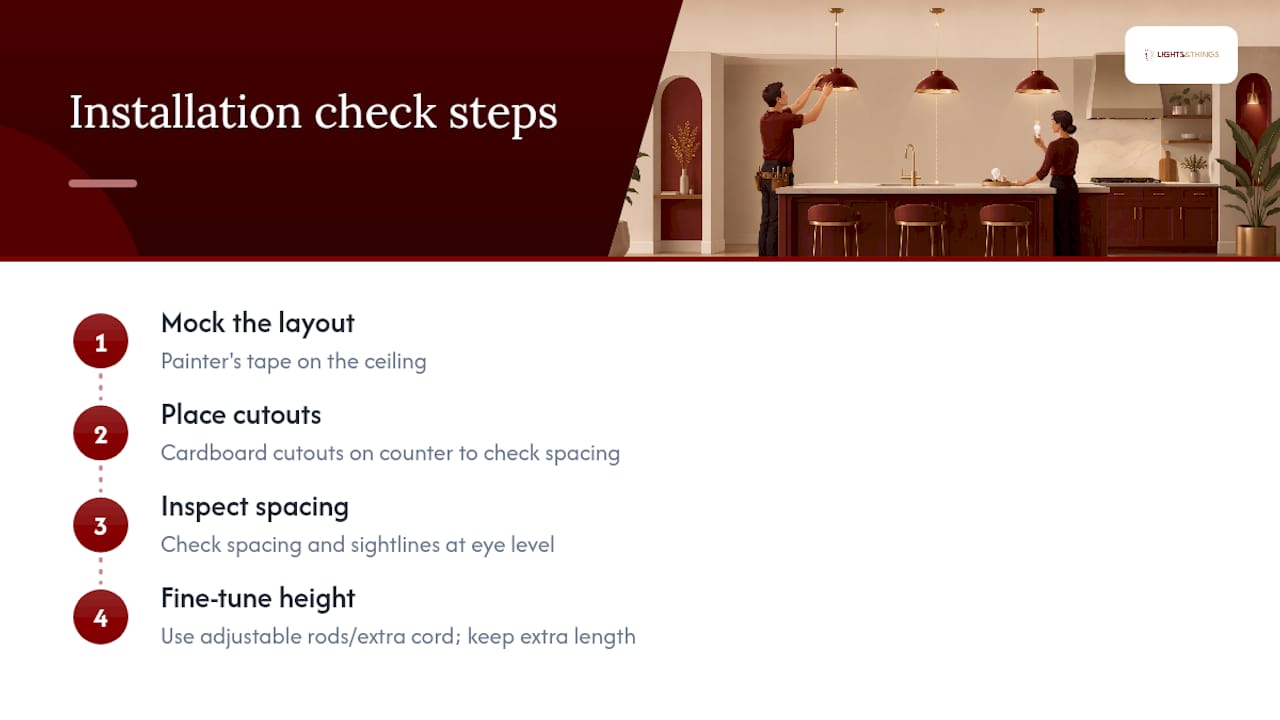
Pro Tip: Buy fixtures with a few inches of extra cord or rod length even if you plan to hang them short. It’s far easier to shorten a cord than to discover it’s too short once it’s mounted.
Choose metal or glass finishes near the cooktop side of the island. They wipe clean far more easily than fabric or woven shades, which trap grease and odor. Confirm your dimmer is rated for LED drivers before installing, since mismatched dimmers cause flickering, and bring in a licensed electrician for any new wiring or box relocation.
Common Kitchen Island Lighting Mistakes
- Too-small fixtures on a large island. Fix it by sizing up or adding a third or fourth pendant instead of stretching one small shade to cover the space.
- Mixed color temperatures. Fix it by matching every bulb in the kitchen to the same 2700 to 3000K range.
- Pendants hung too low. Fix it by remeasuring to the 30 to 36 inch rule from countertop to fixture bottom.
- No dimmers installed. Fix it by adding one during installation. It’s cheap now and expensive to retrofit later.
What We’ve Learned Curating Island Lighting
Most kitchen island lighting fails for a boring reason: the fixture was chosen on style alone, with the measuring tape left in the drawer. A gorgeous pendant hung eight inches too low, or three of them crammed onto a nine-foot island with no room to breathe, will always look worse than a plain glass globe sized and spaced correctly.
Norm Blain has spent years watching customers get this backward, and Lights & Things builds its curated lighting collections around style and specs together, not style alone. Every fixture listing can carry the dimensions and wattage details needed before purchase, and return policies can give room to send a piece back if it doesn’t sit right once hanging.
— Norm Blain
Ready to Shop for Your Island Fixtures?
Once you know your island’s length, your ceiling height, and the fixture type that fits your space, shopping gets a lot simpler. You can often find a single place to compare pendants, linear chandeliers, and flush mounts side by side, instead of hunting across multiple retailer sites with inconsistent sizing charts.
Browse the full ceiling lighting collection with your island’s length, ceiling height, and preferred color temperature on hand. Every product page lists the dimensions and bulb specs you’ll need to confirm it fits your 30 to 36 inch hanging rule before you check out. Purchases over the site’s free shipping threshold ship at no extra cost, and easy returns mean a fixture that looks different in your kitchen than it did in the photo isn’t a permanent commitment. If you’re also warming up a reading corner or a console table nearby, the floor and table lamp collection rounds out the same 2700 to 3000K palette so your whole space feels consistent. Measure your island tonight, and you’ll know exactly which fixture to add to your cart.
Sources
- Choose the Right Pendant Lights for Your Kitchen Island
- Pendant Lights Over Island: A Designer’s Playbook for Perfect Scale, Placement, and Performance
- 13 Kitchen Island Lighting Ideas That Brighten Your Entire Kitchen
- 75 dazzling kitchen island pendant lights (HGTV gallery)
FAQ
What type of lighting is best for a kitchen island?
Pendant lights are the most popular and generally the best choice, since they combine task lighting with a strong decorative focal point. For islands over 8 feet, a linear chandelier often works better than multiple separate pendants.
What is the trend for kitchen island lighting in 2026?
Current trends favor rhythmic, slightly staggered pendant heights and mixed materials, like pairing a metal frame with a woven or glass shade, over matched, evenly spaced sets.
How many pendant lights does my island need?
Islands under 6 feet typically need two pendants, islands between 6 and 8 feet work well with three, and islands longer than 8 feet usually need three to four pendants or one linear fixture.
What color temperature should I choose for island lighting?
Choose 2700 to 3000K for a warm, inviting look, and keep every bulb in the kitchen at that same temperature to avoid a mismatched, clinical feel.
Where can I find well-sized pendant options for my island?
LightsThings lists dimensions, wattage, and finish details on every ceiling lighting product page, which makes it easier to confirm a fixture fits your island’s length before you buy.