Every replacement bulb question comes down to one thing: matching the base code and contact style, not the bulb’s shape or wattage. The main families you’ll run into are Edison screw (E12, E17, E26, E27, E39), pin and bi-pin (MR16, G4, G13), twist-and-lock GU sockets (GU10, GU24), bayonet and wedge bases, and plug-in fluorescent bases. Read the code stamped on the old bulb or the fixture socket, count the contacts, and match both before you buy anything.
TL;DR:
- Matching the base code and contact style is essential, regardless of bulb shape or wattage, to ensure compatibility across fixtures.
- Edison screw sizes range from E12 to E40, with E26 being the most common in American household fixtures, but regional standards and voltage differences can cause mismatches.
- Twist-and-lock GU bases, such as GU10 and GU24, require matching both the socket type and voltage, especially for modern recessed or energy-efficient bulbs.
- Pin and bi-pin connectors like MR16, G4, and G13 must be matched exactly by code and spacing, as they are not interchangeable between similar-looking types.
- Using adapters is possible for obsolete bases but only if wattage ratings are strictly followed and fixture condition is sound; otherwise, replacement fixtures are safer.
Table of Contents
- Understanding Edison Screw Bulb Base Types
- Twist-and-Lock GU Bases for Spotlights
- Pin and Bi-Pin Bases in Accent and Linear Fixtures
- Bayonet and Wedge Bases You’ll Find Outside the US
- Fluorescent and CFL Plug-In Bases
- Miniature and Automotive Bulb Bases
- When to Use an Adapter Instead of Chasing a Rare Base
- How to Identify Your Bulb Base in Four Steps
- E26 vs E27 and Other Swaps That Look Safe But Aren’t
- What Experience Shopping for Decorative Bulbs Teaches You
- Find Decorative Bulbs and Fixtures With Clear Base Specs
- Where to Verify Base Codes and Measurements
- Sources
Understanding Edison Screw Bulb Base Types
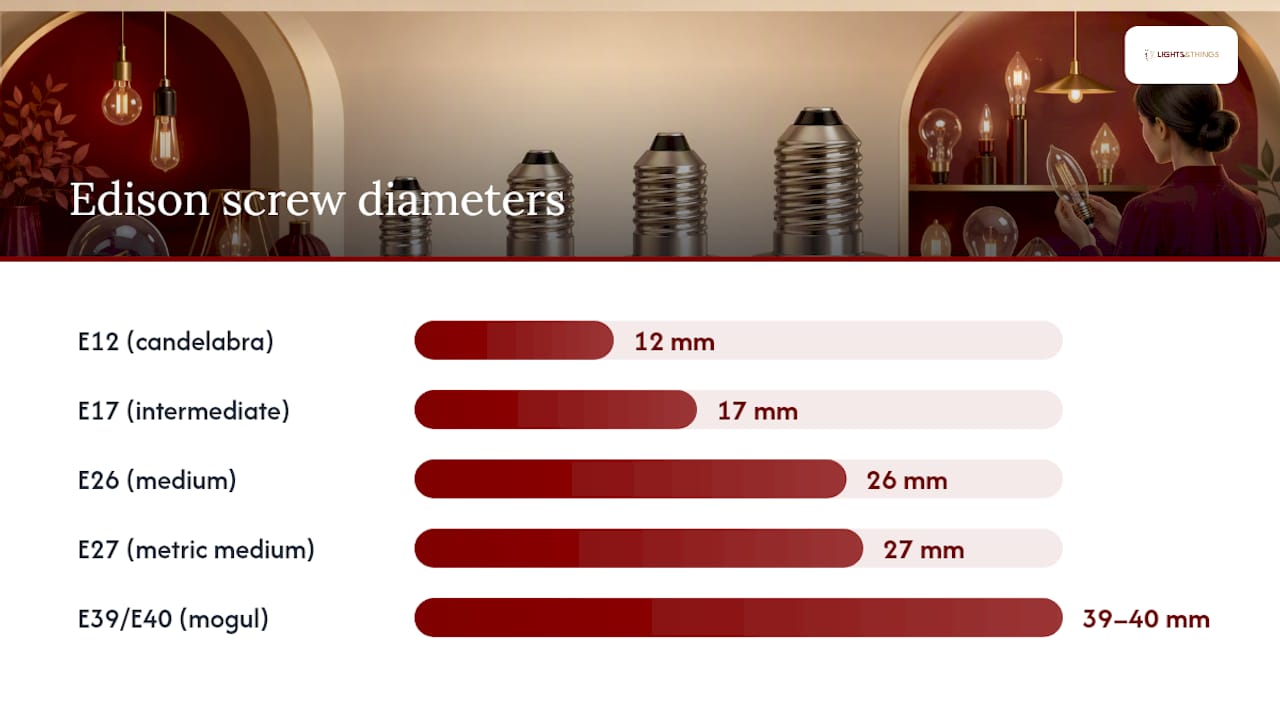
The “E” stands for Edison screw, and the number that follows is the base diameter in millimeters. An E26 base measures about the size typical for medium screw bases. This letter-plus-number system runs through nearly every screw-in bulb sold in the United States, and once you know how to read it, you can decode almost any package label at a glance.
Here’s how the common sizes break down:
- E12 (candelabra): small screw base used in chandeliers, sconces, and decorative fixtures
- E17 (intermediate): a middle-ground size found in some appliance bulbs and older ceiling fixtures
- E26 (medium/standard): the workhorse base for table lamps, floor lamps, and most household fixtures in the US
- E27 (metric medium): nearly identical to E26 and common in fixtures made to European specifications
- E39/E40 (mogul): oversized bases built for high-wattage bulbs in commercial or industrial fixtures
Pro Tip: If your old bulb has a “three-way” base with an extra ring contact at the tip, note that before shopping. A standard E26 replacement won’t give you the low/medium/high switching your fixture expects.
Edison screw sizes officially recognized include E10, E11, E12, E14, E17, E26, E27, E39, and E40, with E26 as the standard medium screw base widely used in American household lamps and ceiling fixtures.
Twist-and-Lock GU Bases for Spotlights
GU bases don’t screw in. They push in and twist a quarter turn until the pins lock into place, which is why you’ll find them almost exclusively in fixtures where the bulb needs to sit at a precise angle, like recessed cans and track heads.
- GU10: runs on standard 120V household current and dominates modern recessed and track spotlights
- GU5.3/MR16: the low-voltage counterpart, typically paired with a transformer and used in the same accent-lighting roles
- GU24: a locking socket built specifically for CFL and LED bulbs designed around energy codes
GU10 handles mains voltage while GU5.3/MR16 serves as its low-voltage bi-pin equivalent, so check your transformer setup, not just the socket shape, before ordering a replacement.
Pin and Bi-Pin Bases in Accent and Linear Fixtures
Bi-pin bulbs use two small metal prongs instead of a screw thread, and the spacing between those pins tells you exactly which bulb you need. Single-contact pins carry current through one prong pair; double-contact versions separate the circuit for more precise control, common in some specialty halogens.
- MR16: the reflector bulb that pairs with GU5.3 bases in accent lighting
- G4: a compact bi-pin used in under-cabinet lights and small halogen fixtures
- G5.3: slightly wider spacing, found in similar low-voltage accent applications
- G13: the standard for T8 linear fluorescent tubes, where the bulb clicks into rotating tombstone sockets wired to a ballast
Always match the letter-number code exactly. A G4 socket won’t accept a G5.3 pin spacing no matter how close the bulbs look side by side.
Bayonet and Wedge Bases You’ll Find Outside the US
Bayonet bases lock in with a push-and-twist motion using small pins on the side of the base, similar in spirit to GU sockets but built at a much smaller scale. Common codes include B15, B22, and BA9s, and they show up far more often in UK and European fixtures than American ones.
- B22 (bayonet cap): standard household base in UK lighting, rare in US fixtures
- BA9s: miniature bayonet used in indicator lights and some decorative string lights
- Wedge bases: no locking mechanism at all. The bulb seats by spring compression against two flat contacts
You’ll mostly encounter bayonet and wedge bases in automotive lighting and decorative string lights, where the compression fit makes for a quick, tool-free swap.
Fluorescent and CFL Plug-In Bases
Not every CFL screws in. Plug-in versions use pin bases instead, and the pin count tells you which ballast they’re designed to work with.
- 2-pin plug-in CFL: common in older recessed downlights with a magnetic ballast
- 4-pin plug-in CFL: works with electronic ballasts and often supports dimming
- G13: the standard pin base for T8 fluorescent tubes, same code used across most linear fixtures
- GU24: increasingly used as a screw-free alternative for CFL and LED bulbs in fixtures built to modern energy codes
Fluorescent and CFL bulbs show up with screw bases, plug-in pin bases, and GU24 sockets depending on the fixture’s age and ballast type, so the base alone won’t tell you the whole story. Check the ballast label too.
Miniature and Automotive Bulb Bases
Small doesn’t mean simple. Miniature bases like E5 and E10 show up in flashlights, nightlights, and appliance indicator bulbs, while BA9s bayonet bases handle dashboard and panel lighting in older vehicles.
- E10/E5: tiny screw bases for flashlights and low-voltage indicator lamps
- Wedge and miniature bi-pin: standard for automotive turn signals, brake lights, and many decorative string-light strands
- R7S: a linear double-ended base used in halogen work lights and some architectural fixtures
When a bulb looks nothing like the household types above, check the fixture’s spec sheet before guessing.
When to Use an Adapter Instead of Chasing a Rare Base
Older homes sometimes still have obsolete bases: mogul bayonet fittings, discontinued pin spacings, or European bayonet sockets on imported antique fixtures. These aren’t dangerous by design, but forcing an incompatible bulb into them is.
- Screw or twist-lock adapters can bridge some mismatches safely, provided wattage and voltage ratings line up
- Never exceed the adapter’s stated wattage limit, since heat buildup is the real risk, not the electrical connection itself
- If a socket shows scorch marks, a loose fit, or corrosion, replace the fixture or have an electrician rewire the socket rather than adapting around the problem
Pro Tip: An adapter that lets a bulb “technically fit” isn’t the same as a safe match. If you need to force it, stop and check the fixture’s rating plate first.
How to Identify Your Bulb Base in Four Steps
You don’t need special tools to identify most bases correctly. A tape measure, good lighting, and the old bulb in hand will get you there in a few minutes.
- Turn off power and remove the bulb carefully, then photograph the base straight on. A clear photo makes it easy to compare against a chart later or show a store associate exactly what you’re holding.
- Measure the base diameter in millimeters across the widest point of a screw base, then match that number to its E-code (25 to 26mm reads as E26, for example).
- Count the contacts. A single metal tip means single-contact; two separate rings or an extra tip at the base means it’s a specialty or three-way fitting.
- Read every marking on the bulb and the fixture itself, things like “A19/E26” printed near the base, and cross-check against the product listing before you order a replacement.
Retail guides consistently recommend photographing the base and comparing it to a reference chart before purchase, since screen colors and camera angles can make similar bases look identical when they’re not. When you’re shopping for chandelier or decorative bulbs, product photos and listed specs on the fixture’s page do the same job. Confirm the base code shown matches what you measured before adding anything to your cart.
E26 vs E27 and Other Swaps That Look Safe But Aren’t
E26 and E27 bulbs will often screw into each other’s sockets without resistance, which is exactly why this pairing causes more confusion than any other base mismatch. The two standards share nearly the same diameter but differ in thread pitch and voltage standards depending on the country the fixture was manufactured for.
Before assuming any two bases are interchangeable, check:
- The exact designation stamped on the fixture, not just what physically fits
- Voltage rating, since a bulb built for 220V European current behaves differently on 120V American circuits
- Wattage and temperature limits printed on the fixture’s rating label
- Contact type, so a three-way bulb doesn’t end up in a standard single-contact socket
Thread pitch, contact placement, and regional standards can make bases that look identical actually incompatible. If your fixture’s manual lists a specific standard, or if you’re dealing with a chandelier wired decades ago, a quick call to an electrician costs far less than a damaged fixture or a fire risk.
What Experience Shopping for Decorative Bulbs Teaches You
Style sells the bulb, but the base code decides whether it works. That’s the lesson worth remembering above almost anything else here: shoppers fall in love with a filament shape or a smoky glass finish, then discover at checkout that it’s built on a base their fixture doesn’t take. Confirm the code first. Let shape and finish be the fun part that comes second.
Clear product photos and listed specs remove most of the guesswork, and a reasonable return policy covers you on the rare case a measurement was off. Between the two, most compatibility headaches disappear before they start.
— Norm Blain
Find Decorative Bulbs and Fixtures With Clear Base Specs
Once you know your base code, the harder part is finding decorative bulbs and fixtures that actually list it clearly. Base type and measurements are often published right on product pages, so you’re not guessing between an E12 candelabra fit and an E26 standard base while scrolling product photos on your phone.

Every decorative lighting listing shows the specs you need before checkout, and if a bulb or fixture doesn’t work out, straightforward returns and secure checkout mean a wrong guess costs you nothing but a little time. Shopping for a chandelier instead of a single bulb? The ceiling lighting collection lists bulb shape and base requirements up front, and a piece like the Crystal Chandelier Double Helix spells out exactly what it takes before you commit. Pull up the product page, check the base code and measurements against what you found on your own fixture, and order with confidence instead of a guess.
Where to Verify Base Codes and Measurements
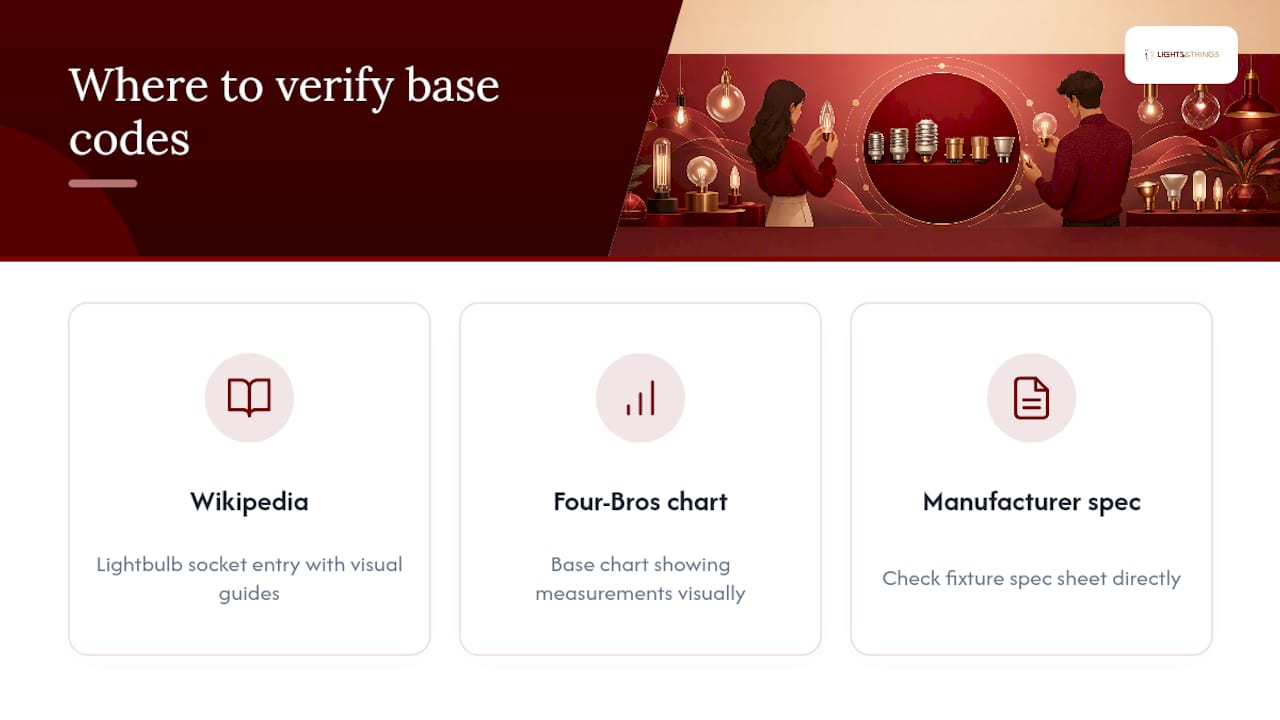
For deeper reference, Wikipedia’s lightbulb socket entry and Four-Bros’ base chart offer visual measurement guides. When in doubt, check your fixture manufacturer’s spec sheet directly.
Sources
- Lightbulb sockets — Wikipedia
- A Guide to Light Bulb Sizes, Types, Shapes, and Codes — GE Lighting
- Light Bulb Base Size Guide — Light Adviser
- Reference Chart - Common Light Bulb Base Types Explained — NostalgicBulbs